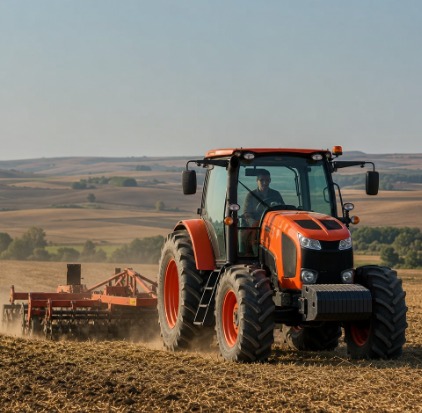

Selecting the right tractor is one of the most consequential decisions a farm operator can make. Too little horsepower and productivity suffers; too much machine and the investment becomes difficult to justify. For mid-to-large scale agricultural operations, the Kubota M lineup has long represented a compelling middle ground — powerful enough for serious fieldwork, refined enough for precision tasks. But as the M Series has expanded to include the M7 and M8 sub-families, the decision has grown more nuanced. Understanding what separates these machines — and which one genuinely fits your operation — requires a closer look at specifications, intended use cases, and long-term value.
The Expanding Landscape of Mid-to-Large Horsepower Tractors
Modern agriculture demands more from its equipment than ever before. Farmers are managing larger acreages with smaller labor pools, integrating GPS-guided implements, and balancing fuel efficiency against raw output. In this environment, tractor manufacturers have responded by broadening their lineups — offering machines that span a wide range of horsepower ratings while sharing common platforms, parts, and dealer networks. Kubota’s M Series sits squarely in this competitive space, targeting operators who need reliable, capable machines without necessarily moving into the premium price brackets occupied by the largest row-crop tractors on the market.
The challenge for buyers is that a broader lineup also means more complexity. Choosing between the standard M Series, the M7, and the M8 requires understanding not just horsepower numbers but also transmission options, hydraulic capacity, cab comfort, and compatibility with precision agriculture systems. Dealers who specialize in these machines can be invaluable guides, but informed buyers make better decisions — and better negotiations.
What the Standard M Series Delivers
The foundational M Series tractors are workhorses in the truest sense. Designed for versatility across a wide range of tasks — from loader work and hay production to light tillage and orchard management — these machines prioritize reliability and ease of operation. Their horsepower range typically spans from the upper 60s into the low 100s, making them well-suited for smaller farms or operations that need a capable utility tractor rather than a dedicated field machine.
Transmission and Hydraulic Considerations
Standard M Series models are available with both gear-drive and power shuttle transmissions, giving operators flexibility based on their preferred working style. Hydraulic flow rates are adequate for most mid-duty implements, though operators running high-demand equipment like large round balers or hydraulic-driven seeders may find themselves approaching the upper limits of the system’s capacity. For those applications, stepping up to the M7 or M8 becomes a more compelling argument.
The M7 and M8: Purpose-Built for Serious Field Work
The M7 and M8 represent Kubota’s push into the higher-horsepower segment traditionally dominated by European and American manufacturers. These machines are engineered with large-scale row-crop and mixed farming operations in mind, featuring more sophisticated transmissions, higher hydraulic output, and cab environments that reduce operator fatigue during long days in the field.
Transmission Technology and Field Efficiency
One of the most significant differentiators between the standard M Series and the M7/M8 is the transmission. The M7 and M8 offer continuously variable transmission (CVT) options that allow operators to maintain optimal engine speed independently of ground speed — a feature that translates directly into fuel savings and reduced mechanical stress during variable-load operations like plowing or planting. For operations covering hundreds of acres per season, the efficiency gains from CVT technology can meaningfully offset the higher purchase price over time.
Cab Comfort and Operator Experience
The M7 and M8 cabs are noticeably more refined than those found on the standard M Series. Improved sound insulation, larger glass areas for better visibility, and more ergonomically positioned controls all contribute to a working environment that reduces fatigue during extended shifts. For operations where a single operator is responsible for covering large acreages in tight planting or harvest windows, this is not a luxury — it is a productivity factor.
Precision Agriculture Integration Across the M Lineup
Modern farm management increasingly relies on data — from soil sampling and variable-rate application to yield mapping and fleet telematics. The ability to integrate precision agriculture tools with your tractor platform is no longer optional for competitive operations. Both the M7 and M8 offer stronger compatibility with GPS guidance systems and ISOBUS-compliant implements, making them better suited for farms that have already invested in or are planning to adopt precision technology.
For operations looking to build a more data-driven approach to farm management, understanding how custom software development is reshaping agricultural operations can provide important context for evaluating which tractor platform will best support long-term digital integration goals.
The Autonomous Horizon: Where Tractor Technology Is Heading
Beyond the current generation of precision tools, the agricultural equipment industry is moving steadily toward greater automation. Autonomous and semi-autonomous tractor systems are no longer purely experimental — they are entering commercial deployment on farms around the world. Understanding the key benefits that autonomous tractors offer modern farming operations helps contextualize where equipment investment decisions are heading and why platform compatibility with future technology matters when choosing between tractor families today.
Operators who select machines with robust electronic architectures and open communication protocols are better positioned to adopt autonomous features as they become available — either through manufacturer updates or third-party integration. This is a consideration that extends well beyond the immediate purchase decision.
HR Agri Power: Specialist Guidance for Kubota Buyers
Navigating the differences between Kubota’s M Series families is considerably easier with access to knowledgeable dealer support. HR Agri Power has built a reputation for providing detailed, honest guidance to farmers evaluating their tractor options — particularly within the Kubota lineup. Their team understands that the right machine depends on the specific combination of tasks, acreage, soil conditions, and implement requirements that define each individual operation. Rather than defaulting to the highest-spec machine available, they help buyers identify the model that delivers the best return on investment for their actual working conditions.
Making the Decision: A Framework for Buyers
When evaluating which Kubota M variant is right for your operation, consider the following framework. First, define your primary use case — is this machine primarily a utility tractor, a dedicated field tractor, or a hybrid of both? Second, assess your hydraulic demand based on the implements you currently run and those you plan to add. Third, evaluate how important transmission sophistication is given your typical field conditions and acreage. Finally, consider your precision agriculture roadmap and whether the machine you choose will support the technology investments you plan to make over the next five to ten years.
The Kubota M Series comparison resource from HR Agri Power provides a detailed breakdown of how the standard M, M7, and M8 differ across key specifications — making it an excellent starting point for buyers who want to approach dealer conversations with a clear understanding of the options in front of them.
Conclusion
The Kubota M lineup offers genuine options for a wide range of farming operations, but the breadth of that lineup also demands careful evaluation. Whether the standard M Series meets your needs or whether the M7 or M8 is justified by your operational scale and technology requirements, the decision deserves the same rigor you would apply to any major capital investment. Take the time to understand the specifications, consult with specialists who know the machines in real-world conditions, and align your choice with both your current needs and your long-term farm management vision.