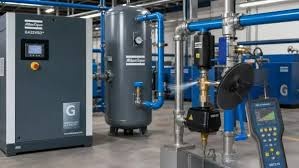

Factory expansion usually puts attention on visible production assets: new process lines, packaging equipment, filling machines, robots, inspection systems, and warehouse capacity. Compressed air sits behind those assets, but it can still determine whether the expansion performs as expected. If the compressed air system is unstable, the new line may suffer downtime, poor repeatability, quality variation, or rising energy cost before the investment has produced its full return.
Selecting compressed air equipment for a growing factory is therefore a risk-control exercise. The purchasing team needs more than a quotation. It needs a way to judge whether each proposal can support production, maintain air quality, fit the site, and remain serviceable after the handover. The following checks give engineering and procurement teams a practical framework for reviewing suppliers and equipment before committing budget.
Check Whether the Supplier Understands the Production Process
A supplier does not need to know every detail of a factory’s proprietary process, but it should understand how compressed air interacts with that process. Air used for pneumatic tools has different risk from air used near food contact surfaces, electronics, coating lines, laboratory instruments, or chemical controls. A supplier that only asks for flow and pressure may miss air quality, redundancy, and control issues that matter to the application.
During early discussions, the plant should explain where air is used, which users are critical, which users can tolerate short interruptions, and whether production has cleanliness or moisture restrictions. The supplier’s questions reveal a lot. Strong suppliers usually ask about duty cycle, ambient conditions, existing system behavior, air treatment, condensate management, and maintenance expectations. Weak suppliers often move directly to a standard model recommendation without exploring the plant’s risk profile.
Separate Expansion Demand From Existing System Problems
Many factories plan a compressor purchase because output is increasing, but existing system problems may already be consuming capacity. Leaks, incorrect pressure settings, dirty filters, restrictive pipework, and poorly controlled standby machines can make a plant believe it needs much more new capacity than it really does. Before buying, the team should identify how much demand comes from the expansion and how much comes from correctable losses.
This does not mean delaying the project indefinitely for a perfect audit. Even a simple review can help: record pressure at the compressor and at critical users, estimate leakage during non-production hours, inspect main filters and dryers, and note whether old machines spend time unloaded. These findings make the new equipment specification more realistic and can prevent oversizing, which often increases both purchase cost and energy waste.
Review Redundancy Against the Cost of Downtime
A low-cost single-compressor package may be adequate for a small workshop, but it can be risky for a factory where air loss stops multiple departments. Growing plants should connect redundancy decisions to downtime cost. If a compressor fault would stop a packaging line, disrupt batch processing, or delay shipment, the system may need standby capacity, staged machines, bypass planning, or a service response agreement that matches production urgency.
Redundancy is not always about buying a duplicate machine. In some cases, an existing compressor can serve as standby after refurbishment. In other cases, two smaller units may provide better flexibility than one large unit. The right approach depends on load pattern, budget, space, maintenance capacity, and the plant’s tolerance for interruption. Procurement should ask suppliers to explain the operating sequence during normal demand, peak demand, service, and fault conditions.
Look at Controls, Not Just the Compressor Body
Modern compressed air performance depends heavily on control behavior. The system must maintain pressure without excessive cycling, unloading, or over-pressurizing the network. If several machines are installed, controls should prevent units from fighting each other. For variable-speed equipment, buyers should ask where the efficient operating window sits and whether the unit will spend most of its time inside that window.
The proposal should describe how pressure is sensed, how machines are sequenced, how alarms are displayed, and what data operators can review. A controller that records trends can help maintenance teams identify leaks, demand changes, and recurring faults. A basic controller may be enough for simple applications, but the plant should make that decision consciously rather than discover limitations after installation.
Confirm Air Treatment Scope in the Same Quote
Compressed air equipment is often quoted in pieces: compressor, dryer, filters, receiver, drains, pipework, and sometimes installation. If air treatment is not included clearly, the plant may compare incomplete packages. A quote that excludes filtration or drying can look attractive until the missing items are added. More importantly, the wrong air treatment can create process quality problems even when the compressor itself is reliable.
The purchasing brief should state air quality expectations and ask the supplier to confirm the treatment chain. This includes dryer type, filtration stages, oil removal where needed, condensate discharge, receiver sizing, and maintenance intervals. If the plant requires oil-free air, the team should ask how the supplier verifies that requirement and what downstream protection remains necessary. Reviewing the PanGeng Compressor site can help buyers frame this discussion around complete compressed air systems rather than isolated machines.
Check the Site Before Accepting the Lead Time
Lead time promises can be misleading when the site is not ready. A compressor may arrive on schedule, but installation can stall because the room lacks ventilation, electrical capacity, lifting access, drainage, or safe service clearance. Growing factories often repurpose existing spaces, which makes this risk higher. A site check before order approval is a simple way to protect the schedule.
The site check should include room dimensions, door and path clearance, slab condition, ambient temperature, dust exposure, exhaust route, electrical feed, grounding, condensate handling, and noise sensitivity. It should also include a maintenance path: technicians need enough space to remove panels, access filters, clean coolers, and handle common service tasks. If these items are documented before purchase, installation planning becomes less dependent on assumptions. The same review should name who owns each preparation task, because unclear responsibility is a common reason technically simple compressor projects drift past the planned start-up date.
Evaluate Supplier Documentation and Handover Discipline
Good documentation reduces long-term operating risk. The factory should know what manuals, drawings, wiring diagrams, spare parts lists, maintenance schedules, commissioning sheets, and training materials will be provided. If a supplier cannot explain the handover package, the maintenance team may struggle after the first alarm or service interval. This is especially important when the compressor is part of a broader expansion and staff are already learning new production equipment.
Documentation should also identify recommended consumables and critical spare parts. A plant that waits until a breakdown to find part numbers may lose time unnecessarily. Where uptime matters, the buyer should discuss which parts should be stocked locally and which can be supplied quickly by the vendor. This conversation is part of buying reliability, not an optional afterthought.
Compare Total Operating Risk, Not Only Purchase Price
Price matters, but a compressor proposal should be compared across several risk categories. Energy use, control suitability, service access, air treatment completeness, spare parts availability, installation scope, warranty clarity, and supplier experience can all affect the real cost of ownership. A slightly cheaper package may become expensive if it increases downtime or forces additional site work.
A practical comparison matrix can score each proposal on capacity fit, air quality fit, control strategy, installation readiness, energy behavior, service plan, documentation, and commercial terms. The team can then explain why a proposal is preferred instead of relying on a vague sense of confidence. For projects involving high-volume or sensitive applications, reviewing centrifugal compressor options from PanGeng may also help teams ask more precise questions about efficiency, capacity range, and industrial operating conditions.
Plan a Verification Period After Start-Up
Commissioning confirms that the equipment starts correctly, but a verification period confirms that the system works for the factory. During the first weeks of operation, teams should record pressure stability, alarm history, dryer performance, condensate behavior, user complaints, and energy patterns. If the expansion ramps up gradually, the system should be reviewed again when the new line reaches normal output.
This verification period gives the supplier and factory a chance to adjust settings, correct small installation issues, and confirm that the original assumptions were accurate. It also provides a baseline for future maintenance. Without this step, plants often operate for months with settings that are acceptable but not efficient.
Build the Purchase Around Production Continuity
Compressed air equipment selection becomes easier when the team treats production continuity as the central goal. The right system is not simply the machine that meets a flow number. It is the equipment package, control plan, air treatment path, service arrangement, and documentation set that support the factory through growth.
For a growing plant, the most useful purchasing question is practical: what could interrupt production, reduce quality, or make maintenance harder after this compressor is installed? A proposal that answers that question clearly is worth serious attention. A proposal that avoids the question may be inexpensive on paper but costly in operation.