
Across the San Antonio area this summer, residential attics have been logging some of the hottest readings homeowners have ever measured. Thermal imaging of a typical attic during a Texas afternoon often shows surface temperatures far above what people assume is happening a few feet over their heads. Those numbers are more than a curiosity. A superheated attic quietly works against the roof, the air conditioning system, and the household budget all at once.
Understanding why attics get so hot, and what actually keeps them in check, is the difference between a home that stays comfortable through a long cooling season and one that struggles no matter how hard the equipment runs.
The Real Cost of an Overheated Attic
Heat that builds up under the roof deck does not stay put. It radiates downward into the living space and it bakes the roof from the inside. Over time, that heat degrades asphalt shingles from below, shortening the roof service life and leading to earlier replacement than the material should ever require.
The cooling system pays a price too. When the attic runs hot, ductwork and the air handler sit inside an oven, and the unit has to fight that stored heat around the clock. The result is longer run times, higher wear, and a shorter lifespan for equipment that is expensive to replace. Any conditioned air moving through ducts in that superheated space also picks up heat along the way, which means the system delivers less cooling than it is actually producing.
Why Insulation Alone Is Not the Whole Answer
There is a common assumption that adding more insulation solves an overheating attic. Insulation matters, but it is only half of the system. Insulation slows the movement of heat into the living space. It does nothing to remove the heat that has already collected in the attic itself. If that trapped heat has nowhere to go, the assembly keeps climbing, and the insulation simply sits on top of a very hot surface.
This is where a lot of installations fall short. A crew that measures depth and R value but ignores airflow has addressed only part of the problem.
Ventilation Has to Work in Both Directions
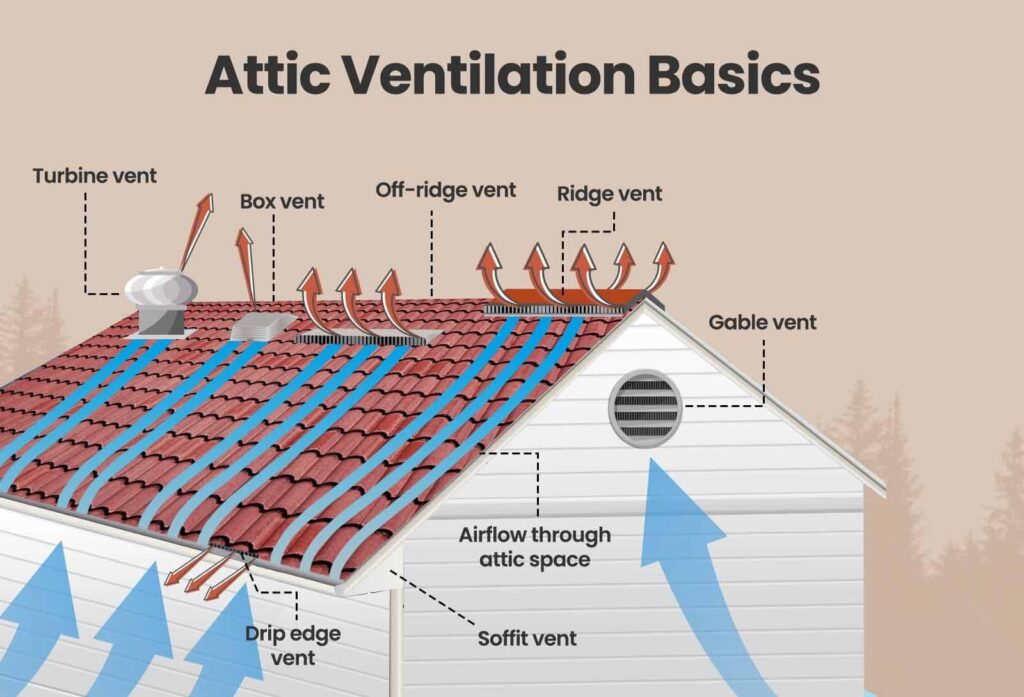
Effective attic ventilation depends on balanced intake and exhaust. Cool air needs a way in near the eaves, and hot air needs a clear path out at the peak. Specialists such as Koala Insulation of Texas Hill Country design the attic as a connected system, pairing the right insulation depth with a ventilation path that lets built up heat escape rather than recirculate. A well balanced attic targets roughly 6 to 10 air exchanges per hour, which is enough to keep hot air moving out steadily instead of pooling under the deck.
Intake without exhaust, or exhaust without intake, chokes the whole assembly. Both have to be sized and placed together for the airflow to actually happen.
A Simple Benchmark: The 10 Degree Rule
One practical way to judge whether an attic is performing is to compare the surface temperature of the insulation to the outside air. In a properly ventilated and insulated attic, that surface should sit within about 10 degrees of the outdoor ambient temperature. When the insulation is running dozens of degrees hotter than the air outside, it is a clear sign that ventilation is inadequate and heat is being trapped rather than released.
Design Options That Fit Hill Country Homes
There is no single correct layout, and the right approach depends on the roof and the home. Some houses are best served by a solar powered attic fan working alongside gable vents, which move hot air out without adding to the electric bill. Others perform better with a properly designed ridge vent, soffit vents, and baffles that keep the intake path open where insulation meets the eaves. What matters is that intake and exhaust are matched so that air genuinely moves through the space.
Baffles deserve particular attention, because they are easy to overlook. When insulation is blown in without them, it can pack into the eaves and block the very intake vents that make the system work. Keeping that path clear is a small detail that has an outsized effect on how well the whole attic breathes.
Treating the Attic as a Complete System
Managing attic heat is not about piling on material and hoping for the best. It is about treating insulation and ventilation as one system, so the roof lasts longer, the cooling equipment works less, and the temperature downstairs holds steady even when the attic above is facing the worst of a Texas summer. For homeowners watching their comfort and their energy bills, that combined approach is what actually moves the needle.