
Six hundred dollars per door, per year. That is the maintenance budget a lot of small Pine Belt rental portfolios actually run on, which is why an out-of-state owner who gets a tenant photo of a sagging soffit line and a brown ring spreading around a bathroom vent ends up typing roof installation hattiesburg ms into a phone at ten at night. Four doors, $2,400 a year, and one of them has just asked for a decision that cannot be made from seven hundred miles away. The question is never whether the roof looks bad in the photo. It is whether you are buying a repair or a replacement, and whether the paperwork you get back proves it.
The argument of this guide is blunt: deck condition, not shingle age, decides which one you are buying, and documentation is the only inspection a remote owner ever gets. Market conditions do not rescue you either. In July 2026 the National Association of the Remodeling Industry reported that national homeowner spending on remodeling and repairs is on track for roughly $519 billion through mid-2027, with year-over-year growth decelerating to something like 0.5% to 1.2% as housing starts pulled back. Slower growth in the sector does not translate into cheaper roofs on rental property. It means crews are pricing tighter, and a bid that ignores the decking is easier to spot once you know what to read.
Deck Rot Decides Repair Versus Full Replacement
Shingles are the part you can see in a phone photo. The decking tells the truth the shingles will not. A stain spreading around a bathroom vent usually means the vent flashing or the rubber boot failed a while back, and the sheathing under it has been absorbing moisture through every humid Mississippi summer since. A soffit line that sags in the same photo says water has already reached the edge of that sheathing. What usually turns up once the shingles come off is a soft patch two or three sheets wide around the penetration, firm plywood across the rest of the slope, and fascia that has to be replaced whether or not the roof does.
That gives you a rule you can carry without an inspection report in front of you. If the decking under the stain is soft or springy across more than a sheet or two, you are buying a replacement, and the repair quote is money you will spend twice. If the sheathing is firm and the leak traces back to one flashing detail, fix the detail and stop there. What I cannot give you is a percentage. Nobody tracks how much of a small landlord’s repair spending goes into patches that get torn off inside three years, so when I have watched an owner put $1,800 into one roof across two summers before replacing it anyway, I genuinely do not know whether that owner was unlucky or typical.
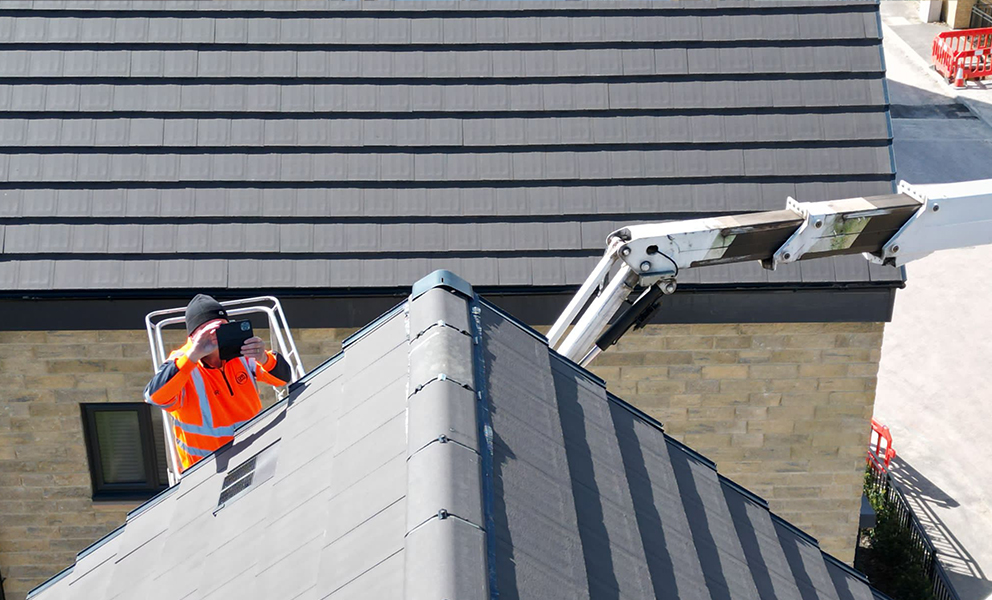
Nobody walks that roof to find out. Not the tenant, not a handyman doing you a favor, and not you on your next visit, because decking that is soft, springy or visibly sagging can give way under a person, so the look happens from a ladder or from a professional wearing fall protection.
Documentation Is The Remote Owner’s Only Inspection
Ask for the inspection in a form you can read from a desk, and be specific about it. Wide photos of each slope, close-ups of every penetration, a shot of the decking after tear-off with a tape measure in frame for scale, and dated files rather than screenshots forwarded through three people. A written scope should name the underlayment product, the moisture barrier at valleys and eaves, the flashing detail at the chimney and vents, and how many sheets of decking are included before change orders start. A contractor who inspects the existing roof, photographs the rot, and puts replacement quantities in writing before work begins has handed you a basis for approving a replacement from another state.
If you do ask anyone to climb for those photos, say the safety part first. The U.S. Consumer Product Safety Commission advises keeping a ladder at least twice its own length away from the nearest overhead power line while cleaning gutters or working near the eave. On a four-door portfolio with service drops crossing two of the back yards, that clearance is a real constraint and not a formality.
Questions To Ask Before Signing A Roof Contract
The vetting call is short if you drive it. You are not asking whether they do good work, because everyone says yes to that. You are asking for numbers, names and the specific paperwork you will hold afterward, and the answers tell you how the job will be run before you have paid anything.
- How many sheets of decking are in the base price, and what does each additional sheet cost? A good answer names a per-sheet figure and a threshold rather than saying we handle it.
- Which underlayment and which moisture barrier are you installing, by product name? A good answer names the products and says where each one goes at valleys, eaves and penetrations.
- Will you photograph the exposed decking before you cover it, and send those photos the same day? A good answer treats this as routine, because crews that document rot already expect to be asked.
- Who pulls the permit, and who is actually on the roof, your crew or a subcontractor? A good answer names the company doing the labor and sends me its certificate directly.
Two of those four questions are about paper, on purpose. A crew that answers the decking question with a per-sheet price has bid this kind of job before and is not planning to discover rot as a surprise on Friday afternoon. Vague answers about underlayment usually mean whatever happens to be on the truck that morning.
Which Warranty Paperwork Follows The Property
Two different warranties come out of a replacement, and they are not the same promise. The manufacturer warranty covers the shingles and, on some systems, more of the assembly when the installer is certified and the job is registered. The workmanship warranty is the contractor’s own, and it is the one that matters on a leak in year three, since most callbacks trace to installation details rather than defective material. Transferability is where rental property gets interesting: some manufacturers allow a single transfer to a new owner inside a set window, sometimes for a fee, and terms vary by manufacturer and by system, so ask for the actual document instead of a summary of it.
Ask who registers the warranty, and have the confirmation emailed to you rather than to the property address where a tenant sorts the mail. Keep the written scope, the decking photos, the invoice and the registration in one folder per door. When you sell, that folder is the difference between a roof you say is four years old and a roof you can prove is four years old.
One Vetted Local Crew Beats Yearly Patch Bids
Patch bids are how a remote portfolio loses money in small increments. Four doors at $600 each is a workable budget until one door absorbs two years of it on repairs that get torn off anyway, and the owners who escape that pattern are usually the ones who stopped re-shopping every leak. Search roof installation Hattiesburg MS again next spring and you will still get a page of names, so the value sits in having already picked one, with your questions answered and a documented job to compare against. Call it $11,000 to $14,000 for a full replacement on a small single-story door, a planning number rather than a quote, and the reason to buy it once with real paperwork is that the next photo from a tenant arrives as information instead of a decision you cannot make.