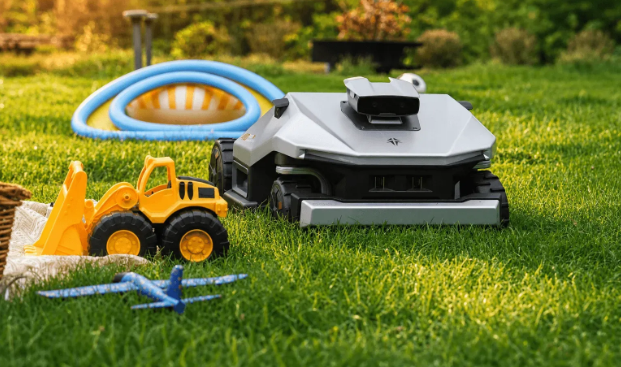

If you’re after a robot mower for large-yard duty and your property has real slopes, tree roots and awkward transitions, the field narrows to two premium names: the GOKO M6 and the Worx Landroid Vision Cloud 4WD. Both sit under $3,000, both ditch the perimeter wire, and both use four-wheel drive to conquer ground that strands a lightweight two-wheeler. But past the marketing, these two flagships take very different routes to the same goal. Here’s a spec-driven breakdown to pick the best 4WD robot lawn mower for your yard.
Coverage and Battery — Sizing Up for the Large Yard
For a large-yard robot mower, runtime and coverage count as much as climbing ability. The Worx Vision Cloud 4WD range steps by model — the WR344 does 1 acre, the WR346 reaches 1.5 acres — all on Worx’s shared PowerShare cordless battery. The GOKO M6 answers with an expandable dual-battery layout: one pack covers 0.5 acre per charge, and adding a second 12Ah cell lifts that to a full acre per charge and as much as 2 acres within a 12-hour span. Its 16.5-inch cut is markedly wider than the Worx 4WD’s ~8.7-inch deck, so the M6 takes more grass per lap — a lead that grows across a big property. Map memory goes to 15 acres over unlimited zones, leaving room for complicated, split-section lawns.
Where 4WD Matters Most: Slopes
A 4WD robot lawn mower exists to climb what a 2WD can’t. The Worx Vision Cloud 4WD is quoted for an 84% grade (about 40°), mating four-wheel drive with an articulated, terrain-following chassis and front steering. Separate front and rear axles keep all four wheels down over bumps and raised edges; reviewers who ran it on real banks liked how it held grip while turning across a slope, not only going straight up. The GOKO M6 raises that bar to 42° (90%). It teams high-grip 4WD with adaptive suspension and active front steering, plus 3-inch (75 mm) ground clearance to roll over roots and curbs. On spec the M6 holds the steeper edge, and its independent front steering is aimed squarely at cutting drag and turf damage on tight turns. Both are strong where traction is the worry; the M6’s higher grade is the measurable advantage.
Two Ways to Find the Lawn: Cloud vs Box
Both drop the boundary wire, yet their positioning thinking diverges. Worx uses RTK Cloud — centimeter fixes pulled straight from commercial RTK networks, no roof antenna or lawn pole needed — with V-SLAM and stereo vision stepping in when the sky signal thins. It’s a neat, light-hardware approach, though it leans on Worx’s cloud and connectivity. The GOKO M6 runs its CyberNav Fusion stack — RTK, nRTK, VSLAM, IMU and wheel tracking — and includes its own RTK base station in the box. That yields a self-contained positioning system that stays steady across open grass, tree lines and tight lanes without fully depending on a subscription. Both navigate wire-free well; the split is cloud ease versus onboard independence.
Avoiding the Dog at Night
Worx’s Vision AI, trained on millions of real mowing hours, grasps objects rather than merely spotting them, and brings FiatLux lighting for night work. The GOKO M6’s QuadVision uses four cameras to ID 200+ objects — pets, toys, furniture — and keeps working after dark. Both put child and pet safety first; the M6 layers on IP66 sealing, sub-62 dB(A) quiet running, and AirTag-friendly theft protection.
The Call
There’s no single best for everyone — only the best for your terrain. Take this honest, spec-driven comparison to your yard and let the contours of your land make the final call.
Frequently Asked Questions
Which climbs steeper, GOKO M6 or Worx Landroid 4WD?
M6 up to 42° (90%); Worx Vision Cloud 4WD rated 84% (about 40°).
What cutting widths compare?
M6 16.5-inch deck; Worx 4WD roughly 8.7-inch deck.
Does the Worx need a rooftop RTK antenna?
No — Worx RTK Cloud uses commercial networks; GOKO ships its own RTK station in the box.
Which is quieter?
Both are quiet; the M6 runs sub-62 dB(A) and the Worx uses Vision AI with night lighting.