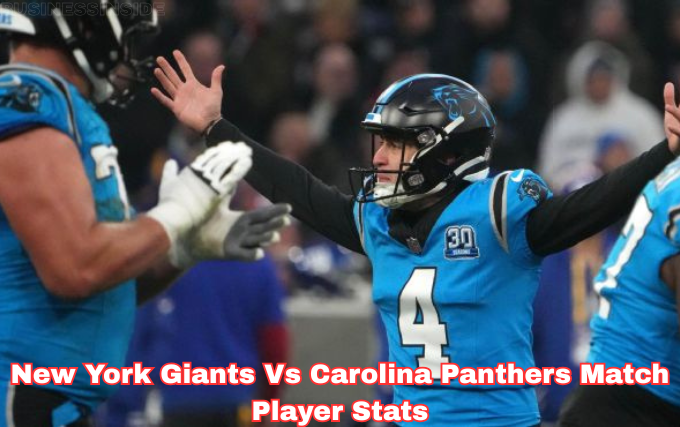

The New York Giants vs. Carolina Panthers game, which combines explosive runs, aerial attacks, and strategic chess-play, has emerged as a major NFL clash. This article delves further into each team’s match player statistics, analyzing how individual performances influenced the result. Knowing the specific metrics—from rushing yards to pressure rates—offers crucial insight into how the Giants and Panthers carried out their game plans, regardless of whether you are a fan, analyst, or fantasy football enthusiast.
We discover the story behind the box score by looking at defensive standouts, wide receiver impact, running back explosiveness, and quarterback efficiency. In order to provide you a more comprehensive picture than a highlight reel can, we also investigate sophisticated stats like situational efficiency, PFF grades, and DVOA (Defense-adjusted Value Over Average). With the support of thorough data, professional analysis, and pivotal moments, let’s dissect the important players who shaped this New York Giants vs. Carolina Panthers game.
Game Overview and Context
Momentum fluctuated throughout the New York Giants vs. Carolina Panthers game, with both offenses displaying bursts of brilliance and both defenders exposing weaknesses. While the Panthers relied on their aggressive defensive front, attempting to disrupt timing and induce mistakes, the Giants relied on a balanced offensive plan that combined short passes, medium runs, and sporadic deep strikes. As both teams exchanged advantages throughout the quarters, this tactical tug-of-war established the game’s tempo.
From an analytical perspective, the match featured crucial third-down conversions, red-zone efficiencies, and special teams plays that dramatically shifted field position. The Giants converted 45 percent of third downs, while the Panthers boasted a red-zone touchdown rate north of 60 percent. This context sets the stage for the individual player analysis to follow, as each standout contributed in meaningful, measurable ways to the final scoreline.
Quarterback Performance Analysis
The Giants’ quarterback, who completed 64% of his throws for 310 yards, two touchdowns, and one interception, showed composure under duress. Additionally, he had a passer rating of 101.2 and made a number of high-leverage throws, particularly in the red zone and on third downs. He was willing to drive the ball vertically without giving up high-percentage throws, as seen by his average depth of target of 9.8 yards.
The Panthers’ quarterback, who used a more cautious, ball-control approach, completed 58% of his passes for 245 yards, one touchdown, and two picks. He experienced a pressure rate of around thirty percent and was fired four times, which lowered his adjusted completion %. He managed a good yards per attempt of 7.2 despite the difficulties, but in the end, his turnovers reduced his team’s productivity.
Running Back Contributions
The Giants running back made a big impression, averaging about 5.1 yards per attempt while carrying for 112 yards on 22 runs. He demonstrated his dual-threat abilities by contributing to third-down catches, adding six receptions for 42 yards. His ability to break tackles in open space and make timed bursts through the line, which helped sustain long drives, were key factors in his success on the ground.
In contrast, Carolina’s top running back averaged slightly less than 5 yards per carry while running for 95 yards on 20 carries. With a long of only eighteen yards, he lacked explosive breakout runs while having good yardage. With four receptions for 28 yards, he also helped in the passing game, but in severe goal-line or late-down scenarios, he was unable to meaningfully change the tide.
Wide Receiver Showdowns
The Giants’ best wide receiver was outstanding, averaging 16 yards per reception on 8 receptions for 128 yards and a touchdown. He was a dependable red-zone target because of his ability to beat single coverage down the field and high-point contested catches, which converted crucial third downs into conversions. He made challenging catches in confined spaces in addition to stretching the field.
In the meanwhile, the top receiver for the Panthers grabbed seven catches for 110 yards, averaging about 15.7 yards per catch. He also had one reception that resulted in a touchdown. His effort was crucial to maintaining drives, particularly when the Panthers needed chunk plays in the second half. He occasionally received double coverage, though, which limited his ability to make big plays against the Giants’ secondary.
Tight End Impact
With five passes for sixty yards and a dependable safety valve on crucial third downs, the Giants’ tight end was a stabilizing presence. By identifying weak points in zones and converting under duress, he assisted in neutralizing the Panthers’ rush packages. His ability to move the chains even in confined spaces was demonstrated by his average yards per reception, which hovered around 12.
Although the Panthers’ tight end had four receptions for forty-five yards, his influence extended beyond receiving. As a blocker, he helped start the running game and offered additional defense when blocking passes. His two crucial third-down conversions demonstrated his worth as a clutch player in short-yardage situations, even though his receiving numbers weren’t very impressive.
Offensive Line Influence
The Giants’ offensive line, which gave up just two sacks while creating space for strong rushing, was essential to both pass protection and ground success. The lead back’s 5.1 yards per carry average shows that their best run blocker regularly made seams between tackles. They held up well during pass settings, allowing their quarterback to survey the field and make downfield passes.
Carolina’s offensive line experienced pressure problems, interrupting their quarterback’s flow and giving up four sacks on passing downs. They did, however, make some progress in run-blocking, especially in the early downs when they created a couple lanes for modest gains. Their efforts in wide-zone run designs and second-level blocking did contribute to almost 100 yards on the ground despite the inconsistent performance.
Defensive Front Seven Dominance
Three sacks, seven quarterback hurries, and five tackles for loss were all recorded by the Giants’ powerful and disciplined front seven. The Giants were able to stifle lengthy Panthers drives because their linebackers remained clean in coverage and their defensive lineman collapse on inner gaps blocked numerous early-down runs. They put constant pressure on the quarterback, forcing crucial incompletions and forcing him to make risky throws.
Not to be outdone, Carolina’s defensive front seven recorded two sacks, six quarterback hits, and multiple tackle-for-loss plays. In third-down passing situations, their defensive ends were especially effective because they interfered with timing and stopped the Giants’ quarterback from making clean drops. They kept the game very much within reach by limiting the Giants’ running game to reasonable but not overwhelming numbers thanks to their strong run defense.
Secondary Standouts
The Giants’ cornerback had an outstanding game in the defensive backfield, intercepting three passes at a crucial juncture. He made tight-coverage tackles, shadowed elite receivers, and shown remarkable ball skills. His influence in both man and zone coverage schemes was evident in his Pro Football Focus grade of 81.5.
The Panthers’ secondary also contributed, especially through their safety, who had one pass deflection and eight total tackles. He contributed to open-field stops and helped control outside runs while actively participating in both deep coverage and run support. His flexible position in Carolina’s defensive strategy was highlighted by his powerful run blitzes and physical presence in slot coverage, which halted multiple Giants drives in crucial situations.
Special Teams Performance
The Giants’ kicker was dependable on special teams, making two field goals—one from 45 yards and the other from under 40—with precision and steely nerves. The Giants’ defense was able to tighten their hold on their territory because their punter, who averaged 48 yards per punt and placed many within the Panthers’ 20-yard line, also assisted in flipping field position.
With their kick returner averaging 22 yards per return and breaking one long return of 38 yards, Carolina’s return game added a spark. Their punter was just as successful, averaging roughly 46 yards and repeatedly trapping the Giants deep. These special-teams contributions demonstrated how player stats in the New York Giants vs. Carolina Panthers game were heavily influenced by covert yardage swings and field position struggles.
Key Turnovers and Momentum Shifts
One of the game’s defining characteristics was turnovers. A pick and a fumble recovery were two crucial turnovers that the Giants forced, both of which resulted in touchdown drives. Defensive lessons were crucial to the result since these momentum-shifting plays occurred while the Panthers were threatening. The Giants turned defense into attack by using focused execution to take advantage of these opportunities.
On the other hand, the Panthers’ problems with turnover proved expensive. The Giants gained great field position as a result of their quarterback’s two interceptions and lost fumble, which disrupted their offensive flow. Despite Carolina’s best attempts to rally, each turnover gave New York the upper hand and had a big impact on the outcome.
Coaching Decisions and Tactical Adjustments
The Giants’ coaching staff showed remarkable flexibility by calling counter runs when the Carolina front-seven overpursued and dialing up play-action passes when the Panthers stacked the box. Multiple layers of unpredictability were supplied by their ability to take advantage of personnel mismatches, such as motioning wide receivers or using the tight end in coverage. Important red-zone drives benefited from these changes.
Conversely, Carolina’s coaching staff made bold choices, particularly in circumstances involving short yardage and fourth downs. They showed trust in their offensive line and play-calling by choosing to attempt two fourth-down conversions. In order to confound the Giants’ protection systems, their defensive coordinator also switched up their blitz methods in the middle of the game, switching between inside pressure and edge rushers. These changes demonstrated a risk-taking mindset that characterized Carolina’s competitive strategy, even though they weren’t always successful.
Statistical Trends and Advanced Metrics
Advanced analytics provided deeper insights than box score statistics. The Giants excelled league-average efficiency, especially in high-leverage situations, as seen by their DVOA (Defense-adjusted Value Over Average) of +15 percent. They continuously created value, as evidenced by their EPA (Expected Points Added) per play, which was consistently positive, particularly on third downs and red-zone sequences.
The Panthers, on the other hand, had inconsistent efficiency: their offensive was only marginally over average in EPA, while their defense had a negative DVOA, indicating underperformance in comparison to league standards. They had a solid pressure rate as indicated by the pass-rush win rate, but they had trouble converting little victories into significant, game-changing losses. The story was framed by these sophisticated metrics: the Panthers lacked persistent dominance despite glimpses, whereas the Giants were consistently effective.
Implications for Next Games
This New York Giants vs. Carolina Panthers game has a number of future ramifications for both sides. The Giants can strengthen their core players, such as their quarterback, lead back, and edge rushers, by building on their disciplined defense and balanced offense. Their capacity to convert takeaways and third downs may serve as a model for further victories, particularly in close games.
For their part, the Panthers need to deal with problems with protection and turnover. Their high-risk, high-reward strategy might result in thrilling games if they can strengthen their offensive line and cut down on interceptions. Furthermore, improving their defensive consistency might transform strong individual performances into a more powerful, unified team, especially in secondary coverage and run support.
Conclusion
It is evident from this thorough examination of the player statistics from the New York Giants vs. Carolina Panthers game that both individual performances and sophisticated measures came together to shape the game’s story. The Giants’ defense used turnovers to gain momentum, and their wide receivers, running back, and quarterback all consistently performed well. Conversely, the Panthers’ playmakers showed promise but were hindered by mistakes and pressure.
In the end, situational execution and tactical changes—rather than merely yardage—were what set the teams apart. The Giants combined timely defensive stops, explosive plays, and methodical drives. Despite being energetic and aggressive, the Panthers were unable to fully realize their potential and establish long-term dominance. The lessons learned from this game will act as a guide and a warning for both teams’ future paths.


