
Choosing between forging and casting can directly affect your product quality, cost, lead time, and long-term performance. Both technologies are extensively used in industrial manufacturing, though they address different business demands.
What Is Forging?
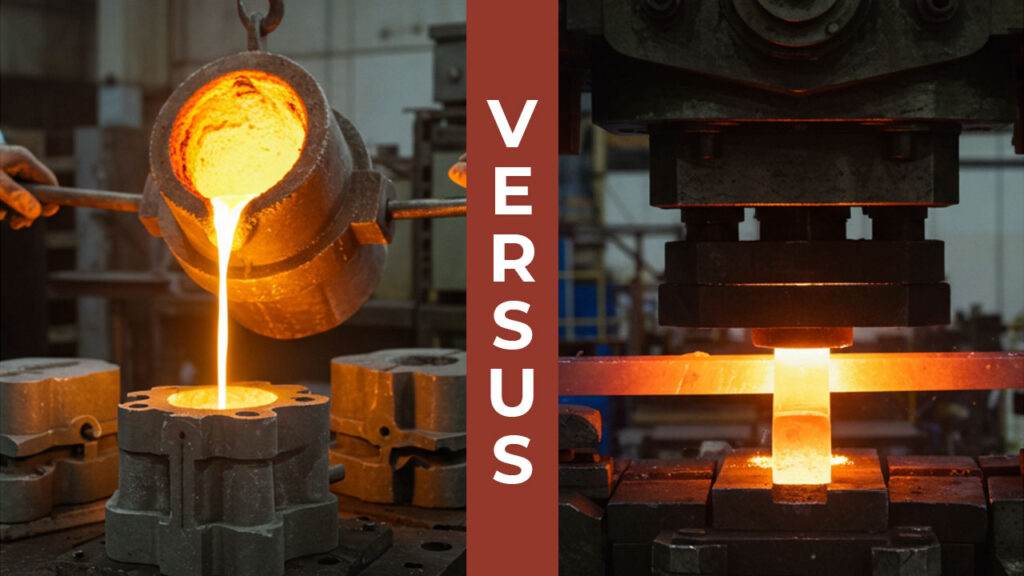
Forging is a production process that shapes metal by means of compressive force. The metal is usually heated and then pressed, hammered, or rolled into the required form. Because the material is compressed rather than melted into a mold, the internal grain structure becomes tighter and more aligned.
This results in forged parts that are strong, dense, and resistant to impact, fatigue, and pressure. Forging is commonly used for components that must perform under heavy load or harsh working conditions, such as shafts, rings, gears, pressure parts, and metal flanges.
What Is Casting?
Melted metal is poured into a mold and left to cool and solidify during the casting process. Once the metal hardens, the part is removed from the mold and finished through machining, cleaning, or surface treatment.
Casting is especially suitable for complex shapes, large parts, and designs with internal cavities. This provides forged parts with superior strength, density, and resistance to impact, fatigue, and pressure. Many industrial components, housings, pump bodies, valves, and metal pipe fittings can be produced through casting.
Key Differences Between Forging and Casting
The key distinction lies in the metal forming method. Forging reshapes solid metal under force, while casting forms parts by solidifying liquid metal inside a mold. This difference affects strength, precision, cost, and production flexibility.
Forged parts usually have better mechanical properties because the grain flow follows the part shape. This enhances toughness while lowering the risk of cracks, porosity, and internal defects. In contrast, cast parts can produce more complex shapes because molten metal flows into detailed mold cavities.
In simple terms, forging is better for strength, while casting is better for shape complexity.
Strength and Durability
If your business needs parts that must withstand high pressure, vibration, repeated impact, or heavy loads, forging is usually the better choice. Forged components provide greater tensile strength, improved fatigue resistance, and more dependable performance in demanding environments.
Casting may have lower strength because defects such as porosity, shrinkage, or inclusions can occur during solidification. Modern casting technologies can reduce these issues, but forged parts still generally perform better in critical load-bearing applications.
Design Flexibility
Casting has a clear advantage when it comes to complex shapes. If the part has thin walls, internal channels, irregular curves, or detailed structures, casting may be more practical and cost-effective.
Forging has more limitations in shape design because the part must be formed under pressure. Complex forged parts may require additional machining, which increases production time and cost.
Cost Considerations
Casting is often a more economical option for intricate parts, large components, or low-to-medium strength uses. Mold costs can vary, but the process can reduce machining work when the shape is close to the final design.
Forging may require higher tooling costs and more powerful equipment, especially for large or precision parts. However, its longer service life and lower failure risk can reduce replacement costs over time.
For businesses, the lowest unit price is not always the best decision. The better choice depends on total cost, including maintenance, downtime, safety, and product lifespan.
Surface Finish and Machining
Both forging and casting may require machining after production. Cast parts can sometimes achieve near-net shapes, reducing machining needs. However, surface defects may require additional treatment.
Forged parts often need machining to reach final dimensions, but their dense structure makes them stable and reliable during finishing. If tight tolerances and high structural integrity are required, forging is often preferred.
Which Process Is Better for Your Business?
There is no single answer. Forging is better if your priority is strength, durability, fatigue resistance, and safety. It is ideal for critical components used in automotive, construction, oil and gas, machinery, and heavy equipment industries.
Casting is better if your priority is complex design, lower cost for intricate shapes, and production flexibility. It is suitable for parts where geometry matters more than maximum strength.
Final Recommendation
Your business should opt for forging when performance and reliability are the highest priorities. Choose casting when design complexity and cost efficiency are more important.
Before making a decision, consider the part’s working environment, load requirements, material, tolerance, order quantity, and long-term maintenance cost. The best manufacturing process is not simply the cheaper one, but the one that gives your product the right balance of quality, function, and business value.
READ ALSO: Secure and Durable Fencing Gloucester Services Across the UK