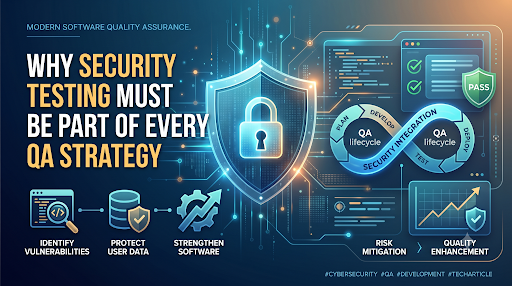

Most software teams treat security as something to sort out after the product is built. QA handles the bugs, developers ship the features, and security gets a quick scan before go-live. That approach is expensive and increasingly indefensible.
The average cost of a data breach in Malaysia is expected to reach RM3.2 million in 2026, up from RM2.9 million the year before, according to a report by the National Tech Association of Malaysia (Pikom). Some organizations surveyed reported losses exceeding RM5 million from a single incident. Those numbers do not include reputational damage, customer churn, or regulatory penalties under the Personal Data Protection Act (PDPA).
Security failures are no longer rare edge cases. They are a predictable outcome for any organization that leaves security testing out of its QA strategy, and a fixable one for organizations that bring it in early.
What Security Testing Actually Covers in a QA Context
Security testing is the practice of identifying vulnerabilities, misconfigurations, and weaknesses in software before they can be exploited in production. Within a QA testing service framework, it sits alongside functional testing, performance testing, and regression testing rather than after them.
The core types of security testing that belong inside a modern QA strategy include vulnerability assessment, which scans for known weaknesses across the application stack; penetration testing, which simulates real-world attacks to see how far an exploitable flaw can actually go; static application security testing (SAST), which analyzes source code for insecure patterns during development; dynamic application security testing (DAST), which tests a running application from the outside the way an attacker would; and API security testing, which verifies that the interfaces connecting services are not leaking data or accepting unauthorized requests.
Each of these serves a different purpose. Running only one gives a partial picture. A complete QA testing service embeds multiple layers of security validation throughout the development lifecycle, not just at the end of it.
Why “Test at the End” Fails Every Time
The traditional model of building first and testing later made sense when software shipped once a quarter. Modern applications release continuously. Features go live weekly or daily. By the time a security review happens at the end of a sprint cycle, the code has already been integrated into several other components, and fixing a vulnerability found late costs significantly more in time and rework than catching it during development.
There is also the question of what gets missed entirely. Security testers brought in only at the final stage are working against a deadline, testing a system they did not see being built, and often working from incomplete documentation. The vulnerabilities they miss do not disappear; they go to production.
The DevSecOps model addresses this directly by embedding security checks into the CI/CD pipeline so that every code commit triggers automated security scans. IBM’s research has consistently found that organizations using a DevSecOps approach see meaningful reductions in breach costs compared to those relying on end-stage testing alone. Faster detection and containment, much of it driven by AI-assisted security tooling, is now one of the primary levers for reducing the financial impact of incidents.
The Most Common Security Gaps That QA Testing Services Should Catch
Injection Vulnerabilities
SQL injection, command injection, and cross-site scripting (XSS) remain among the most prevalent vulnerabilities in web applications despite being well-documented for decades. They persist because developers are under pressure to ship fast, and injection flaws are easy to introduce accidentally. A QA testing service with proper DAST coverage will catch these before they reach production.
Broken Authentication and Session Management
Applications that handle login flows incorrectly, whether through weak password policies, improperly expiring sessions, or tokens that do not invalidate on logout, create windows for attackers to hijack legitimate user accounts. These flaws often pass functional testing because the feature technically works. Security testing evaluates whether the implementation is actually safe, not just functional.
Insecure API Endpoints
APIs are now the backbone of enterprise software. They connect mobile apps to backends, integrate third-party services, and expose data to partners. They are also one of the most frequently targeted attack surfaces. An API that returns more data than the requesting user is authorized to see, or that accepts requests without proper rate limiting, can be exploited without ever touching the main application interface. API security testing as part of a QA strategy closes these gaps systematically.
Misconfigured Cloud Infrastructure
As Malaysian enterprises shift workloads to cloud platforms, misconfiguration becomes a leading cause of data exposure. S3 buckets left publicly accessible, overpermissioned IAM roles, and unencrypted data stores are all infrastructure-level issues that belong in the security testing scope. QA testing services that cover infrastructure configuration alongside application code give organizations a more complete security posture assessment.
Security Testing and PDPA Compliance in Malaysia
Malaysia’s Personal Data Protection Act requires organizations that process personal data to implement adequate security safeguards. “Adequate” is not defined as a specific technology. It is assessed based on the nature of the data, the risks involved, and what a reasonable organization in that industry would have done.
In practice, organizations that can demonstrate regular security testing as part of their QA process are in a significantly stronger position when facing regulatory scrutiny after an incident. Those that cannot show a testing history tend to face higher penalties and find it harder to demonstrate that they took their obligations seriously.
Bank Negara Malaysia’s Risk Management in Technology (RMiT) policy adds further requirements for financial institutions, mandating security assessments for systems handling customer data and financial transactions. For organizations in that space, embedding security testing into QA testing services is not optional. It is a compliance requirement with real audit consequences.
What Good Security Integration in QA Actually Looks Like
Security embedded into QA does not mean hiring a separate security team to audit every release. It means building security validation into the workflow that already exists.
Automated SAST tools run inside the IDE or as part of the code review process, flagging insecure patterns before a pull request is even submitted. DAST scans run automatically against staging environments as part of the CI/CD pipeline, producing results that the QA team reviews alongside functional test results. Penetration testing happens on a scheduled basis, typically before major releases and at regular intervals for live systems, carried out by specialists who can probe for vulnerabilities that automated tools alone will not surface.
The shift in mindset is equally important. QA engineers who understand the OWASP Top 10, the industry’s established list of the most critical web application security risks, will write better test cases and flag implementation concerns during development rather than discovering them post-release. Security awareness inside the QA function is a genuine force multiplier.
Industries Where Security Testing in QA Is Non-Negotiable
Financial Services
Banking applications handling real-time transactions, loan processing, and customer account management are among the highest-value targets for attackers. Functional bugs are inconvenient. Security vulnerabilities in this context can enable fraud at scale. QA testing services for financial applications need to treat security testing with the same rigor as functional coverage.
Healthcare
Patient records, diagnostic data, and insurance information are highly sensitive under both PDPA and healthcare-specific regulations. A breach in a hospital system does not just result in financial penalties. It disrupts care delivery and erodes the trust patients place in the institution. Security testing in healthcare QA is ultimately a patient safety issue.
E-Commerce and Retail
Checkout flows, payment integrations, loyalty program backends, and customer profile systems are all high-value targets. Malaysian consumers who experience a data breach through a retail platform tend not to return. Security testing in e-commerce QA protects both revenue and reputation simultaneously.
How Zchwantech Approaches Security Within QA Testing Services
Zchwantech’s software QA testing services are built on the understanding that quality and security are inseparable. A product that works correctly but exposes user data is not a quality product. The team integrates security validation across the testing lifecycle, starting from requirements review through to pre-release penetration assessment, so that security findings surface when they are still straightforward to fix.
Working with enterprises across financial services, government technology, and enterprise software, Zchwantech brings both the QA depth and the cybersecurity context needed to assess applications against real-world threat models rather than just checkbox frameworks. As an organization that also delivers comprehensive cybersecurity solutions, the team understands how attackers actually think, and that perspective shapes how security testing is approached within every QA engagement.
For enterprises that are shipping software and want to be confident it is secure before it reaches users, the starting point is an honest assessment of where security currently sits in the QA process and what gaps need to close.
Reach out to the Zchwantech team at [email protected] to explore how purpose-built QA testing services with integrated security validation can protect both your users and your business.