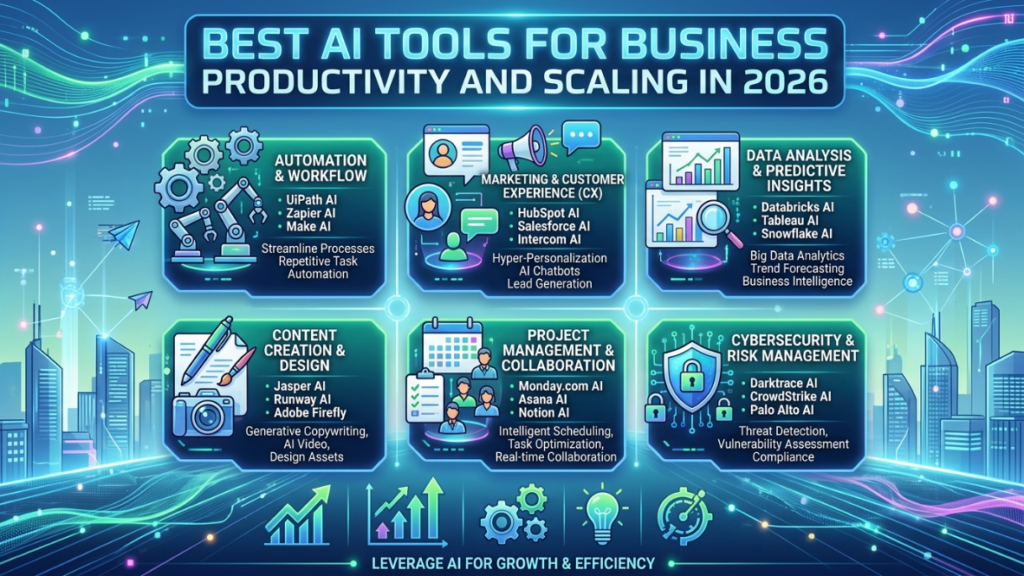

In 2026, artificial intelligence has become the backbone of modern business operations. From marketing automation and data analysis to customer service and workflow optimization, AI tools are helping companies scale faster while reducing operational costs. Businesses that adopt AI strategically are gaining a major competitive advantage in speed, efficiency, and decision-making.
However, while AI dominates digital industries, traditional service-based sectors such as home services, construction, and HVAC are also experiencing transformation. For example, companies offering essential services like air conditioning services houston tx are now integrating AI-driven scheduling, customer support automation, and predictive maintenance systems to improve efficiency and customer satisfaction.
This combination of AI innovation and real-world service industries shows how deeply technology is reshaping business in 2026.
Why AI Tools Matter for Business Productivity
AI tools are no longer optional—they are essential for survival in competitive markets. Businesses use them to:
- Automate repetitive administrative tasks
- Improve customer engagement and personalization
- Analyze data for faster decision-making
- Reduce operational costs
- Scale operations without increasing workforce size
Even industries that rely on physical services, such as HVAC installation, benefit from AI optimization. For example, companies specializing in ac installation houston tx are increasingly using AI-based tools for scheduling, route optimization, and customer communication, allowing them to serve more clients efficiently.
Top AI Tools Driving Business Growth in 2026
1. AI Productivity Assistants
AI assistants such as ChatGPT, Claude, and Notion AI have become essential tools for modern teams. They help with:
- Writing business documents
- Summarizing meetings
- Creating marketing content
- Managing workflows and tasks
These tools reduce manual workload and allow employees to focus on higher-value work.
2. AI Marketing and SEO Tools
Marketing has evolved dramatically with AI integration. Businesses now use AI tools to:
- Generate SEO-optimized content
- Analyze search intent and keywords
- Automate social media posting
- Optimize ad campaigns
This shift has made it easier for businesses to scale online visibility without large marketing teams.
3. AI for Customer Service and CRM
Customer expectations are higher than ever. AI-powered CRM systems and chatbots now provide:
- 24/7 customer support
- Instant response handling
- Personalized product recommendations
- Automated lead management
This ensures businesses never miss potential customers and maintain strong engagement.
4. AI in Operational Efficiency
One of the most impactful uses of AI is operational optimization. Businesses now use AI to streamline logistics, scheduling, and resource allocation.
In service-based industries, such as HVAC and home maintenance, companies offering air conditioning services houston tx rely on AI tools to manage service requests, assign technicians, and optimize scheduling routes for faster response times.
How AI Helps Businesses Scale Faster
Scaling a business traditionally required hiring more employees and increasing overhead costs. AI changes this model completely.
1. Automation of Repetitive Work
Tasks like reporting, scheduling, and customer follow-ups can now be fully automated.
2. Faster Decision-Making
AI provides real-time insights that help leaders make smarter business decisions.
3. Increased Productivity Without Extra Staffing
Teams can produce more output using AI assistance without increasing headcount.
4. Smarter Resource Allocation
AI ensures businesses use time, labor, and budget efficiently.
5. Improved Customer Experience
AI-driven personalization leads to better satisfaction and higher retention rates.
Real-World Impact of AI Across Industries
AI is no longer limited to tech companies. It is transforming industries like healthcare, retail, finance, and even HVAC services.
For example, companies specializing in ac installation houston tx now use AI-powered tools to:
- Predict system failures before they happen
- Recommend energy-efficient cooling systems
- Optimize technician dispatch routes
- Improve customer communication through automation
This shows how AI is bridging the gap between digital intelligence and real-world service delivery.
Challenges of AI Adoption
Despite its advantages, AI adoption comes with challenges:
- Data privacy concerns
- Integration complexity with legacy systems
- Employee training requirements
- Over-dependence on automation
- Quality control of AI-generated outputs
Businesses must balance automation with human oversight to ensure accuracy and trust.
Best Practices for Using AI in Business
To maximize AI benefits, businesses should:
Start Small
Begin with one or two tools before scaling across departments.
Focus on High-Impact Areas
Prioritize AI in marketing, customer service, and operations.
Train Employees
Ensure staff understand how to use AI tools effectively.
Combine AI with Human Expertise
AI should enhance—not replace—human decision-making.
Continuously Optimize
Regularly review performance and adjust AI strategies.
Future of AI in Business (2026 and Beyond)
The future of business will be increasingly AI-driven. Key trends include:
- Fully automated business workflows
- AI-powered decision-making systems
- Hyper-personalized customer experiences
- Predictive business intelligence
- AI-first startups replacing traditional business models
Businesses that adopt AI early will continue to dominate their industries.
Conclusion
AI tools are fundamentally reshaping how businesses operate in 2026. From productivity and marketing to customer service and operational efficiency, AI is enabling faster scaling and smarter decision-making.
Even traditional industries like HVAC are evolving, with companies offering air conditioning services houston tx and ac installation houston tx leveraging AI systems to improve efficiency, reduce costs, and enhance customer experience.
Businesses that embrace AI strategically today will be the market leaders of tomorrow.
FAQs
1. What are the best AI tools for business in 2026?
Popular tools include ChatGPT, Claude, Notion AI, Zapier AI, and AI CRM platforms for sales and customer service.
2. How does AI improve business productivity?
AI automates repetitive tasks, provides real-time insights, and enhances decision-making speed.
3. Can small businesses benefit from AI tools?
Yes, many AI tools are affordable and scalable, making them ideal for startups and SMEs.
4. Is AI difficult to implement in traditional industries?
No, many AI solutions are now user-friendly and designed for non-technical users.
5. What industries benefit most from AI?
Marketing, e-commerce, finance, healthcare, and service-based industries benefit significantly from AI adoption.