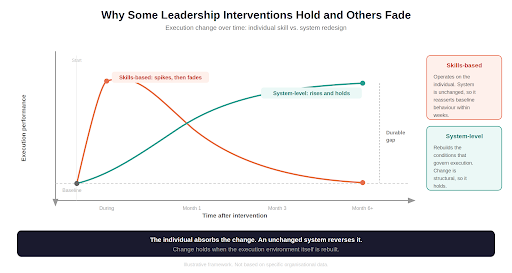

Leadership interventions produce lasting execution change when they operate on the organization’s systems rather than the individual’s skills. Interventions that transfer knowledge to individuals fade because the system the individual returns to is unchanged. Interventions that diagnose and rebuild the conditions governing execution hold, because the change is structural and does not depend on individual retention.
Why Do Most Leadership Interventions Fail to Produce Lasting Change?
Most leadership interventions are built on a transfer model. Knowledge, frameworks, and techniques are delivered to individuals, who are expected to apply them back in the organization. The model assumes the individual is the variable that determines execution.
The individual returns to a system that has not changed. The same operating rhythms, the same accountability structures, the same measurement systems remain in place. Within weeks, the system reasserts the behavior it was designed to produce, and the intervention fades. This is not a retention failure. It is a structural one.
The organization then concludes that the intervention did not work, when the more accurate conclusion is that it targeted the wrong level. The individual absorbed the change. The system reversed it.
What Determines Whether a Leadership Intervention Holds?
Three conditions separate interventions that produce durable execution change from those that do not.
- Systemic diagnosis before intervention. Interventions that hold begin by diagnosing the specific structural conditions producing the execution problem in that organization. Interventions that fade begin with a predetermined curriculum applied regardless of the underlying structure. Diagnosis is what makes the intervention specific to the system rather than generic to the topic.
- Work on the system, not only the individual. Durable interventions change the conditions governing execution: how decisions are made, how accountability is structured, how functions coordinate. The individual develops inside a system that is being rebuilt around them, so the new behavior and the new structure reinforce each other rather than working against each other.
- Depth over exposure. Change that holds requires sustained work on real conditions, not brief exposure to concepts. Interventions that produce lasting change operate on the actual execution environment over time, allowing the structural changes to stabilize before the intervention ends.
Why Skills-Based Programs Produce Temporary Results
Skills-based programs operate on the individual in isolation from the system. They develop capability, and that capability is real, but it is deployed into an environment that governs behavior more powerfully than any individual skill.
The result is a predictable pattern: measurable improvement during and immediately after the program, followed by a return to baseline as the unchanged system reasserts itself. The program is judged on the initial improvement. The organization experiences the return to baseline.
This is why execution problems recur after significant investment in leadership development. The investment targeted the individual. The execution environment, which is what actually governs the outcome, was never part of the work.
This is the principle behind Carlos Raposo Coaching’s Leadership Immersions. Rather than delivering a curriculum to individuals, the work diagnoses the structural conditions governing execution in a specific organization and rebuilds those conditions through sustained, immersive work on the real execution environment. The change is built into the system, which is what allows it to hold after the engagement ends.
What Lasting Execution Change Actually Requires
Producing lasting execution change requires operating at the level where execution is actually governed, which is the system, not the individual. That means diagnosing the specific structural conditions in the organization, working on those conditions directly, and sustaining the work long enough for the new structure to stabilize.
Interventions built this way do not depend on individuals remembering to apply what they learned. The change is structural, so it persists whether or not any single individual sustains a new behavior. The system now produces the execution outcome by design.
This is the distinction that determines return on any leadership investment. Interventions that operate on individuals produce temporary results at recurring cost. Interventions that operate on the system produce durable change that compounds, because the execution environment itself has been rebuilt to produce the outcome.
Why Durable Execution Change Requires System-Level Work
Carlos Raposo Coaching works with executive teams on the structural conditions that govern execution, rather than the individual skills that operate inside those conditions. Leadership Immersions diagnose the specific conditions producing an organization’s execution problems and rebuild those conditions through sustained work on the real environment.
The work is structural and diagnostic, not a curriculum-based program. It targets the execution environment itself, which is what determines whether change holds after the engagement ends.
For executive teams that have invested in leadership development and seen execution problems recur, Carlos Raposo Coaching operates at the system level, where lasting execution change is actually produced.
Frequently Asked Questions
Why do most leadership interventions fail to produce lasting change?
Because they operate on individuals rather than systems. Knowledge is transferred to a person who returns to an unchanged organizational environment. The system reasserts the behavior it was built to produce, and the intervention fades. The failure is structural, not a matter of individual retention.
What makes a leadership intervention produce durable results?
Three conditions: diagnosing the specific structural conditions before intervening, working on the system rather than only the individual, and sustaining the work long enough for structural change to stabilize. Together these make the change structural, so it holds independent of individual behavior.
Why do skills-based leadership programs produce only temporary results?
Skills-based programs develop individual capability in isolation from the system that governs behavior. Improvement appears during the program, then returns to baseline as the unchanged environment reasserts itself. The capability is real, but it is deployed into a structure that overrides it.
How is lasting execution change actually produced?
By working at the level where execution is governed, which is the organizational system. That requires diagnosing the specific structural conditions, rebuilding them directly, and sustaining the work until the new structure stabilizes. The change then persists by design rather than depending on individual retention.