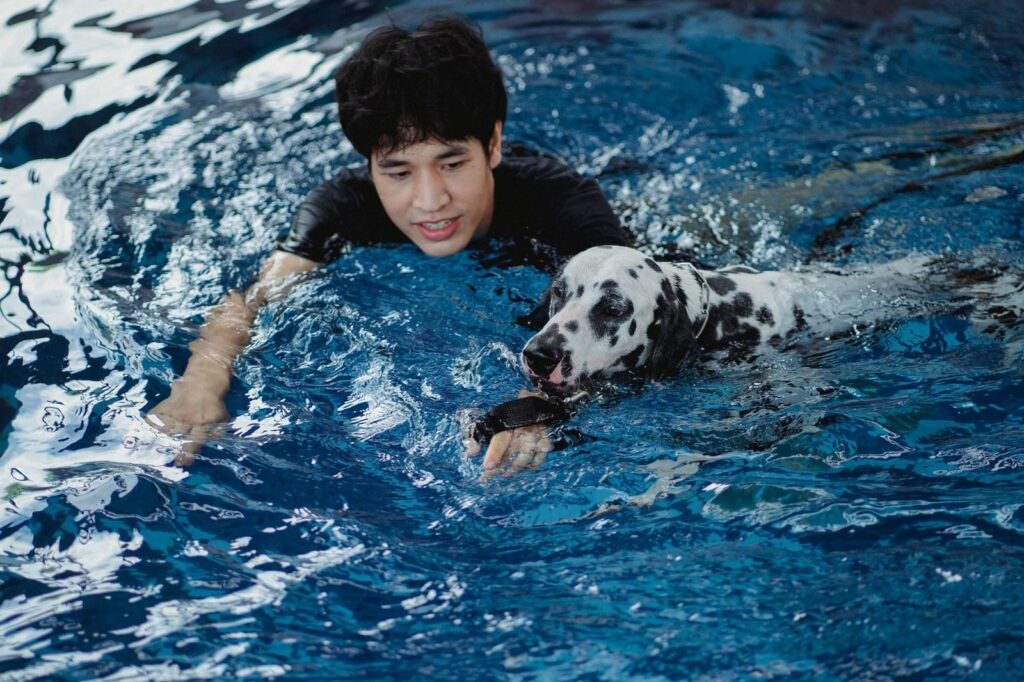

There’s a small but telling moment in most dog-owner routines: the swim happens, and the person watches from the edge. A lead is looped over one arm, a towel over the other, and the dog does its thing in the water while the human stays dry and slightly outside the experience. It works, but it also misses something. When the owner gets in too, the whole dynamic changes, and it’s worth understanding why before assuming poolside spectating is simply how this works.
Dogs read their owners constantly, more than most people realise. A raised voice, a tense shoulder, a hesitant step towards water — all of it gets noticed and processed, often faster than the owner clocks it themselves. So when the person a dog trusts most steps into the pool alongside them rather than staying on dry land, the water stops being a separate, slightly uncertain place and becomes somewhere shared. Nervous dogs in particular tend to settle faster this way. It isn’t about coaxing or commanding; it’s proximity and calm doing the work that a raised voice from the side never quite manages.
Confidence is contagious, in both directions
Anyone who has taken a dog swimming for the first time knows the early minutes can go either way. A dog might paddle straight in, or might hover at the edge working out whether this is a good idea. An owner in the water changes that calculation. There’s something physical about a dog being able to touch its owner, orient towards them, paddle a short distance and arrive somewhere familiar, that a poolside voice can’t replicate. The dog isn’t performing for an audience; it’s swimming with a companion. Confidence tends to build faster that way, and it tends to last — a dog that learns water is fine with its owner beside it usually carries that ease into the next session too.
The reverse is just as true. Owners who are a little unsure themselves — maybe they’ve never been much of a swimmer, maybe the idea of getting in a pool with a boisterous dog sounds chaotic — often find the opposite happens. Once they’re actually in, watching their dog relax and start to enjoy itself tends to relax the owner as well. A supervised activity turns into a shared bit of fun almost without either of them deciding it should.
Why private hire suits this particular experience
This kind of thing rarely works as well in front of an audience. A public pool session, however well run, still comes with other dogs barking nearby, other owners watching, a queue building for the next slot — all of which nudges people towards staying poolside rather than getting in themselves. Self-consciousness is a real barrier here, and it’s a reasonable one. Getting into a pool in front of strangers, in a swimming costume, with a dog who might not want to swim in a straight line, is exactly the kind of thing that puts people off trying.
A private booking removes most of that. It’s just the owner, their dog, and whoever else came along — no other animals to negotiate around, no one else’s timetable to work to, no sense of being watched. Privacy of that kind is much of the appeal of a dedicated pool, and it is what owners searching for dog swimming Swindon are usually after: a session that will belong entirely to them for its duration, which makes getting in the water a far easier decision than it would be somewhere shared.
The practical side of getting in
A few sensible things make the experience smoother: a proper swimming costume rather than ordinary clothes, plenty of towels, and comfortably warm water, since a chilly pool makes both owner and dog keen to get out rather than settle in. Long nails are worth trimming beforehand too, so a paddling dog doesn’t scratch an owner by accident. Physically, owners should expect to be reasonably active — treading water, guiding a dog gently, possibly being splashed rather more than anticipated — so it helps to go in expecting a bit of exertion rather than a passive dip. Any specific health question, whether about a dog’s joints, a pre-existing condition, or a puppy that’s very young, is genuinely best raised with a vet beforehand rather than guessed at poolside.
Why it’s worth trying at all
Very little of this is really about the swimming itself. It’s about the fact that so few activities put owner and dog in the same physical space, doing the same thing, at the same pace, with nothing else competing for either of their attention. A walk has other people, other smells, other dogs to react to. A pool, kept private, strips a lot of that away. What’s left is a dog and an owner working out something together in the water, which is a fairly rare kind of togetherness once a dog is past puppyhood. That, more than any particular exercise benefit, is the case for getting in rather than staying on the side.