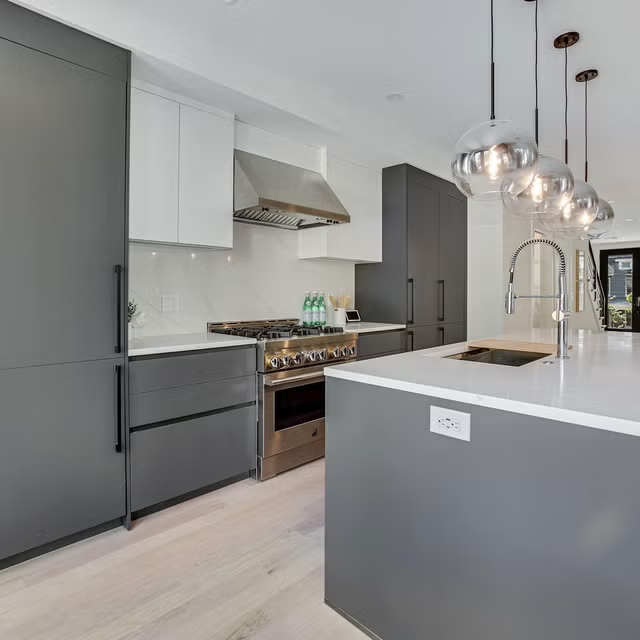

There is a persistent gap between how cabinetry finishes are presented in showrooms and how they actually perform after years of daily use. A finish that photographs beautifully under controlled lighting may chip along door edges within eighteen months. A color that reads as a deep, sophisticated tone in a design catalog can appear flat or inconsistent once installed across a full run of cabinetry under natural light. These are not rare complaints — they are recurring issues that homeowners, contractors, and interior designers deal with regularly.
The conversation around high-end cabinetry finishes has often been dominated by aesthetics alone. What gets left out is performance: how a finish responds to humidity cycles in a kitchen, how it holds up under repeated cleaning, and whether the application process itself introduces variability that shows up months later. Understanding which finishes genuinely earn the designation “high-end” — not just in appearance but in real-world durability — is a practical question with meaningful financial and operational consequences.
The ten finishes covered here reflect what actually holds up in residential environments where cabinetry is used daily, cleaned frequently, and exposed to heat, moisture, and light over many years.
What Makes a Finish High-End in Practice, Not Just in Price
High-end custom finishes for kitchen and bath cabinetry are not simply expensive coatings applied to premium wood. They represent a combination of material quality, application method, surface preparation, and finish chemistry that, when correctly executed, produce results that remain stable under conditions most decorative finishes cannot tolerate. The distinction matters because many finishes priced at a premium level do not perform at one. Price reflects craftsmanship and process as much as material cost, and when either is compromised, the finish fails regardless of what it cost to apply.
For anyone evaluating options or managing a renovation project, the High-End Custom Finishes For Kitchen And Bath Cabinetry guide offers a grounded starting point for understanding how these finishes are categorized and what distinguishes one application method from another in terms of real-world durability and consistency.
Surface Preparation Is the Foundation, Not a Preliminary Step
One of the most common reasons a premium finish fails prematurely is inadequate substrate preparation. Even the most durable topcoat will not compensate for a surface that was not properly sanded, sealed, or primed. In high-humidity environments like bathrooms and kitchens, wood movement and moisture infiltration begin at the substrate level. When the foundation is unstable, the finish layer above it cracks, peels, or loses adhesion — often in less than two years. High-end application processes treat surface preparation as a primary step that takes as much time and care as the finish itself.
Conversion Varnish and Its Reputation for Durability
Conversion varnish is a catalyzed finish that undergoes a chemical curing process rather than simply drying through solvent evaporation. Once fully cured, it forms a hard, cross-linked film that resists moisture, household chemicals, and physical abrasion at a level that most standard lacquers cannot match. It is widely used in professional cabinet finishing precisely because it performs reliably in kitchens where surfaces are cleaned with soap, degreasers, and steam with regularity.
Why Curing Time Matters for Long-Term Performance
Conversion varnish requires adequate cure time before a cabinet is put into regular use. When this process is rushed — as it sometimes is when project timelines are compressed — the finish remains chemically incomplete. A partially cured conversion varnish surface will scratch more easily, react to cleaning products, and show wear patterns within the first year. Full cure can take several days under normal shop conditions, and this is not a detail that should be negotiated away to meet a delivery schedule.
Painted Cabinetry With Catalyzed Topcoats
Painted cabinetry has grown considerably in popularity, but the durability of the result depends almost entirely on what sits beneath and above the paint layer. High-end custom finishes for kitchen and bath cabinetry in painted applications typically involve multiple coats of primer, a consistent color layer, and a protective catalyzed topcoat. Without that topcoat, painted cabinetry in a kitchen environment will show wear at corners, around hardware, and along frequently touched edges within a relatively short period.
Color Consistency Across Multiple Doors and Panels
One technical challenge in painted cabinetry is maintaining consistent color across a full set of doors, drawer fronts, and frames — especially when components are finished in batches. Slight variations in mixing, spray distance, or coat thickness can produce subtle but visible color shifts that become apparent once cabinetry is installed and viewed under consistent lighting. Professional finishing operations manage this through strict batch control and systematic quality review before delivery. It is one of the more practical reasons to distinguish between shops that treat finishing as a production discipline and those that treat it as a final step.
Glazed Finishes and Why They Require Skilled Application
A glaze is a semi-transparent medium applied over a base coat and then manipulated before it sets to create depth, shadow, or an aged appearance. When applied correctly, it adds dimension that paint alone cannot produce. When applied inconsistently, it looks muddy, patchy, or overworked. Glazed finishes as part of high-end custom finishes for kitchen and bath cabinetry are not appropriate for every project — they require both the right substrate profile and a finisher with genuine experience in controlled glaze manipulation.
The Risk of Replication in Future Touch-Ups
Glazed finishes are also among the most difficult to touch up later. Because the glaze layer depends on technique rather than formula alone, matching the appearance of an existing glazed surface years later — after a door is damaged or replaced — is genuinely difficult. This is worth understanding before committing to a glazed finish in a high-use kitchen environment, where the probability of needing a replacement panel over a decade is not insignificant.
Wire-Brushed and Cerused Wood Finishes
Wire-brushed finishes involve mechanically abrading the surface of the wood to emphasize grain texture, then applying stain or clear finish that settles into the open grain and produces a layered, tactile surface. Cerusing, a related technique, fills the open grain with a contrasting pigment — typically white or gray — before finishing. Both approaches work best on open-grained species such as oak and ash, and both produce surfaces that are genuinely distinctive in appearance without relying on purely decorative coatings.
Durability Trade-Offs With Textured Surfaces
The textured quality of wire-brushed and cerused finishes means that cleaning requires slightly more attention than flat painted or stained surfaces. Debris and grease can settle into the open grain areas, and aggressive cleaning can lift or lighten the ceruse fill over time. These are manageable realities, not reasons to avoid the finish — but they are worth communicating clearly to homeowners who will maintain the cabinetry over years.
Rift-Cut and Quarter-Sawn Veneers With Clear Finishes
The character of the wood itself becomes the finish statement in rift-cut and quarter-sawn veneered cabinetry. Rift-cut veneers display a straight, linear grain that reads as clean and contemporary. Quarter-sawn veneers show a distinctive medullary ray figure that is unique to certain species. In both cases, the finishing goal is to protect and clarify rather than to add color or decorative complexity. Clear catalyzed finishes applied to these veneers are among the more demanding applications because any inconsistency in the finish coat is immediately visible on a naturally figured surface.
Two-Tone Cabinetry Finishes
Two-tone cabinetry — typically with upper and lower cabinets in contrasting colors or finishes — requires that both finishes age at a compatible rate. High-end custom finishes for kitchen and bath cabinetry in two-tone applications need to be specified and applied with long-term visual consistency in mind. If one finish fades or yellows more quickly than the other, the contrast that made the design compelling becomes an aesthetic liability. Matching the chemistry and durability profile across both tones is a detail that separates carefully managed projects from those that simply look good at installation.
Lacquer Finishes — Solvent-Based vs. Waterborne
Lacquer remains common in cabinetry finishing, but the distinction between solvent-based and waterborne lacquer matters in performance terms. Solvent-based lacquers have a longer track record in high-use environments, though waterborne formulations have improved substantially and carry the advantage of lower VOC emissions — a factor regulated by environmental agencies including the U.S. Environmental Protection Agency, which sets standards that affect which products can be used in commercial finishing shops in many states. Waterborne lacquers are now considered appropriate for residential cabinetry in many applications, though their performance relative to solvent-based products can vary by manufacturer and formulation.
Hand-Applied Oil and Wax Finishes
Oil and wax finishes occupy a different category from film-forming finishes like lacquer or varnish. Rather than forming a protective layer above the wood surface, they penetrate into the wood and cure within it. The result is a surface that looks and feels like wood rather than a surface coated in plastic, which many people prefer aesthetically. The trade-off is maintenance: oil and wax finishes require periodic reapplication to remain effective, and they are not well suited to cabinetry in high-moisture zones without careful species and product selection.
Custom Stained Finishes and the Challenge of Consistency
Custom stain work is one area where the term “high-end” is most easily applied and most frequently overstated. A true high-end custom stain is developed through sample iterations, tested for compatibility with the specific species and cut of wood being used, and applied with consistent technique across every component in a project. High-end custom finishes for kitchen and bath cabinetry in stained applications often involve multiple stain layers, toning steps, and a final protective coat — a process that takes time and cannot be shortcut without visible consequences in the final result.
Species Variation and Its Effect on Stain Absorption
Wood is a natural material, and even within the same species, individual boards absorb stain differently based on grain density, moisture content, and growth ring orientation. This means that achieving a consistent stain result across a full kitchen requires either selecting wood specifically for uniformity or using techniques like wash coats and sealers to moderate absorption before stain is applied. When this is done well, the result looks intentional and refined. When it is not, stained cabinetry can show blotching, streaking, or tonal inconsistency that no topcoat can correct.
Closing Thoughts
The finishes that hold up in real homes over time share a common thread: they are the result of careful material selection, methodical preparation, and disciplined application — not simply the use of expensive products. High-end custom finishes for kitchen and bath cabinetry earn that description through process and execution, and the difference between a finish that lasts a decade and one that begins showing wear in the first two years is almost always traceable to decisions made early in that process.
For homeowners, contractors, and designers working through cabinetry specifications, the most useful question to ask is not which finish looks best in a sample but which finish is being applied with the preparation, chemistry, and quality control that the end environment actually demands. The answer to that question — more than any aesthetic preference — will determine whether the investment in high-end cabinetry finishes proves worthwhile over the full life of the installation.