
In warehouses, distribution centers, and manufacturing facilities, the containers used to move bulk materials are rarely given much thought until something goes wrong. A collapsed box mid-shipment, a pallet load that shifts during transit, or a container that fails under the weight of its own contents — these are the kinds of operational failures that interrupt workflows, damage product, and create liability. Gaylord boxes sit at the center of these conversations more often than most people expect. Understanding how they are built, what variations exist, and which specifications match which applications is the kind of knowledge that prevents costly errors before they happen.
What Gaylord Boxes Are and How Wall Construction Defines Their Function
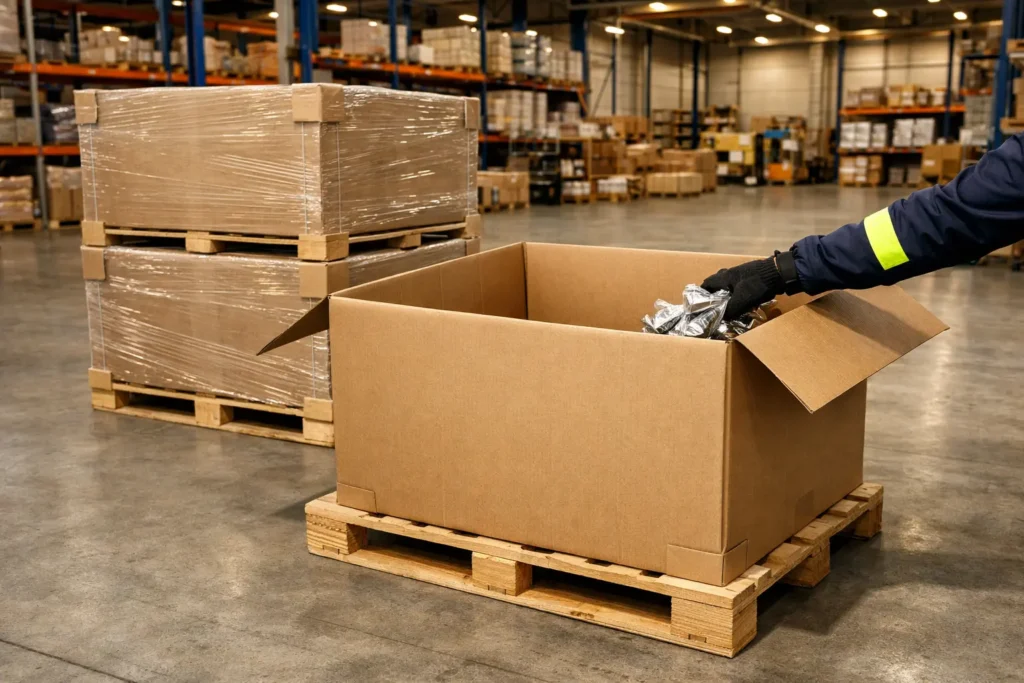
A gaylord box is a large, bulk-capacity corrugated container designed to hold substantial volumes of product or material. It sits on or integrates with a standard pallet, allowing it to be moved by forklift or pallet jack without additional handling. The name itself has become a generic industry term, though it originated from a specific manufacturer. Today, gaylord boxes are used across industries ranging from food processing and agriculture to chemicals, automotive parts, and recycling operations.
What separates one gaylord box from another is not primarily its exterior dimensions but its wall construction. The number of corrugated layers bonded together to form the sidewall determines the box’s structural capacity, stacking strength, and resistance to compression under load. Among the available wall types, triple wall gaylord boxes represent the most structurally robust option in standard corrugated packaging, and they are the format most commonly specified for heavy, abrasive, or moisture-adjacent applications. Procurement teams and operations managers evaluating bulk container options will find that the wall type is the single most consequential variable in the buying decision.
Single Wall and Double Wall: Where They Fit and Where They Fall Short
Single wall corrugated construction consists of one fluted medium bonded between two flat liner sheets. This is adequate for light-to-moderate loads in controlled environments, but it compresses under sustained vertical pressure and offers limited resistance to puncture or moisture exposure. It is appropriate for lighter bulk applications where the contents themselves are not dense and where the box is unlikely to be stacked under additional weight.
Double wall construction adds a second corrugated medium and an additional liner sheet. This produces a meaningful improvement in rigidity and compression strength, making it suitable for heavier materials and multi-layer stacking. However, double wall boxes still have practical limits when the load weight is substantial, when the material being contained has sharp or irregular edges, or when the storage environment introduces humidity. These conditions accelerate degradation in double wall containers and increase the risk of structural failure before the box reaches its final destination.
How Triple Wall Construction Changes the Load Equation
Triple wall corrugated board is built with three fluted mediums and four liner sheets, creating a panel that behaves more like a rigid board than a standard cardboard wall. The added layers distribute compression forces more evenly across the sidewall surface, which is particularly important when a loaded gaylord is placed under a second stacked container or stored in high-density configurations. The thickness of the wall itself acts as a buffer against the kind of point-load pressure that causes single and double wall containers to buckle.
This structural depth also improves resistance to moisture absorption. While no corrugated product is waterproof without additional treatment, the additional liner layers in triple wall construction slow the rate at which humidity penetrates to the inner flutes. In environments where refrigeration, condensation, or outdoor staging is involved, this characteristic extends the functional lifespan of the container noticeably compared to thinner wall formats.
Standard Size Ranges and How They Relate to Pallet Compatibility
Gaylord boxes are produced in a range of footprints and depths, but they are generally designed to align with standard pallet dimensions. The most common formats are built to sit within the boundaries of a forty-eight by forty-inch pallet or a forty-eight by forty-five-inch pallet, both of which are prevalent in North American logistics infrastructure. Depth varies considerably depending on the intended application — shallower designs are used for materials that need to remain accessible from above, while deeper configurations maximize cubic volume for loose or granular contents.
Matching Box Depth to Material Behavior
The depth of a gaylord box affects not just volume capacity but also how the contents exert pressure on the sidewalls during filling and transport. Dense materials — metal components, wet waste, compacted recyclables, heavy granules — generate significant lateral pressure as they settle. A deeper box with heavy contents places more outward stress on the lower third of the sidewalls. This is precisely where triple wall construction provides a practical advantage: the thicker panel resists lateral bowing that thinner walls cannot sustain under comparable fill conditions.
Shallower gaylords are commonly used in food processing applications where the product needs to be accessible to workers at floor level, or where the material itself is fragile and cannot be stacked deep without damage. In these cases, the structural demands on the container are lower, and double wall construction may perform adequately. Depth selection, in other words, is not a standalone decision — it interacts directly with the wall type required to keep the container stable throughout its use cycle.
Open-Top, Half-Slotted, and Telescoping Configurations
Beyond wall type and footprint, gaylord boxes are available in different opening and closure configurations. Open-top designs are the most common for bulk filling applications, where material is loaded from above by conveyor, hopper, or manual means. Half-slotted containers have flaps on one end only, which can be useful when a partial closure is needed to retain contents during transit without fully sealing the box. Telescoping designs use a separate lid section that slides over the body of the container, offering a more secure closure when contents must be protected from the environment or stacked under additional containers.
Each configuration has specific handling implications. Open-top gaylords are faster to load and unload but require careful handling to prevent spills during transport. Telescoping lids add handling steps but significantly improve stability in stacked configurations, particularly when combined with triple wall sidewalls that resist compression from the lid weight and the load above.
Industry Applications Where Triple Wall Is the Practical Standard
The corrugated packaging industry is governed by testing standards that assess burst strength and edge crush resistance, both of which are directly tied to wall construction. According to the specifications outlined by ASTM International for compression testing of shipping containers, the performance of a container under sustained load is a function of board construction, box geometry, and environmental exposure. Triple wall board consistently performs at the upper end of what corrugated packaging can deliver without moving into wood or plastic crating.
This performance profile makes triple wall gaylord boxes the default choice in several demanding environments. Recycling and waste management operations use them to collect and stage heavy materials such as cardboard bales, metal scrap, and dense plastics. Chemical manufacturers use them for powders, granules, and solid compounds that would compromise thinner containers over time. Automotive suppliers use them for metal stampings and cast components where sharp edges would puncture single or double wall sidewalls during vibration-heavy transit.
Returnable and One-Way Use Decisions
One variable that often influences wall type selection is whether the container is intended for a single use or a returnable cycle. In one-way applications, the box travels with the product to its final destination and is then broken down and recycled. In returnable programs, the same container makes multiple trips between supplier and customer, being refilled and reused until it degrades below an acceptable condition threshold.
Triple wall construction extends the returnable lifespan of a gaylord box considerably. Because the sidewalls resist deformation more effectively, the container retains its structural geometry through more loading and unloading cycles before the board begins to lose integrity. For operations running high-volume returnable programs, the cost-per-use comparison between double and triple wall often favors triple wall when the full cycle count is factored in, even though the initial unit cost is higher.
Sourcing Considerations That Affect Operational Consistency
Consistent box performance depends heavily on consistent board quality. Two boxes described as triple wall may differ meaningfully in how their liner sheets and mediums are specified, the weight of the paper used, and how the board is manufactured. These differences are not always visible from the exterior of the box but become apparent under load conditions or after exposure to humidity. Buyers who source purely on unit price without reviewing board specifications often encounter inconsistency across production runs that creates unpredictable performance in the field.
Suppliers who specialize in bulk corrugated containers typically offer product categorized by board grade alongside wall type, allowing procurement teams to match specifications to their actual load and environment requirements. Requesting samples and reviewing board construction details before committing to volume orders is a straightforward way to reduce the risk of receiving product that technically meets the wall-type description but underperforms in practice.
Conclusion: Making the Right Container Decision Before the Load Is on the Pallet
Gaylord boxes are a functional and widely used packaging format, but they are not interchangeable. The difference between a single wall and a triple wall container is not cosmetic — it is structural, and it has direct consequences for product protection, stacking safety, and container longevity. Wall construction determines how a container behaves under real operating conditions, not just ideal ones.
For operations handling heavy, dense, abrasive, or moisture-adjacent materials, triple wall construction is not an upgrade — it is the baseline specification that ensures the container performs reliably from the point of loading through final delivery or return. Understanding the relationship between wall type, box depth, configuration, and material behavior allows procurement and operations teams to make container decisions based on actual need rather than assumption. Getting that decision right before the load is on the pallet is considerably less costly than addressing a container failure after the fact.