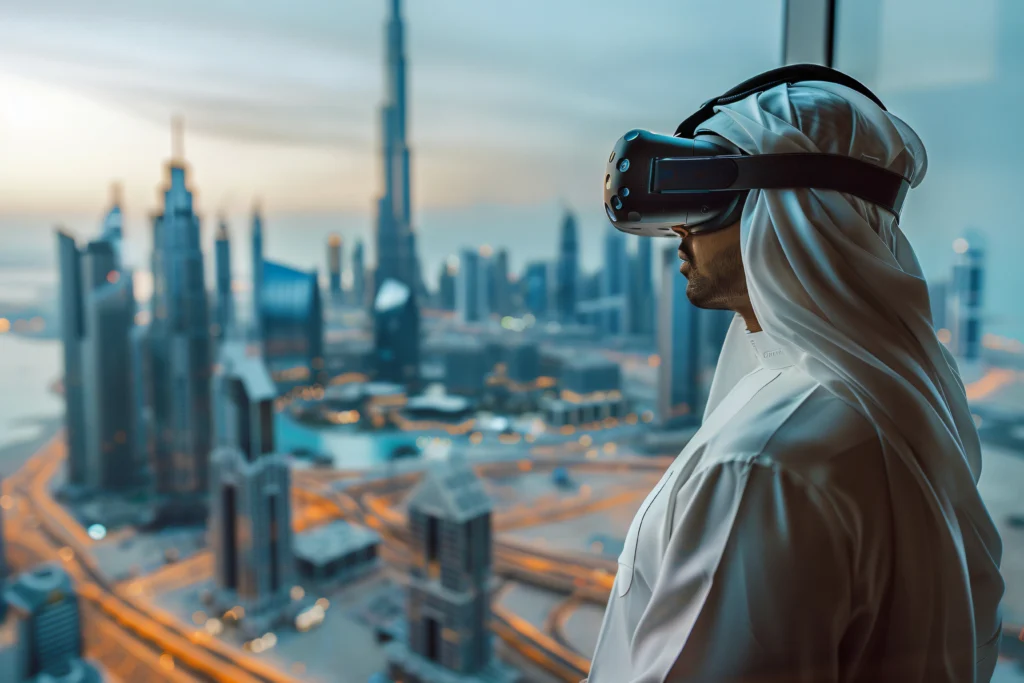

Something quiet has been shifting in how US-based technology startups source their immersive technology development. For years, the default assumption was straightforward: if you needed serious augmented reality or virtual reality work done, you hired a team in San Francisco, Austin, or New York. The talent was there. The venture capital community understood the ecosystem. The cultural alignment felt natural.
That assumption is now being tested — not through ideology, but through outcomes. A growing number of American startups are signing contracts with development firms based in Dubai, and the reasons behind that shift are more operational than they are opportunistic. This is not about chasing cheap rates or exotic alternatives. It is about what actually happens when a product ships, what the collaboration looks like in practice, and whether the team on the other end understands the industry context well enough to make meaningful decisions. Understanding why this is happening requires looking carefully at what the Silicon Valley model has become and what the Dubai model is quietly delivering.
The Shift Toward Dubai Is Not About Cost — It Is About Capability Configuration
When US startup founders discuss their decision to work with a custom ar/vr app development company in dubai, the cost argument comes up, but it rarely leads the conversation. What leads the conversation is something more structural: the configuration of skills within a single team. Dubai-based firms operating in the immersive technology space have had to build capability sets that cover hardware integration, spatial computing, enterprise-grade user experience, and industry-specific deployment — often within the same organization. This happened not by accident but because the regional market demanded it.
Dubai’s positioning as a hub for real estate, logistics, healthcare, retail, and government services meant that early clients for AR and VR work came from sectors with non-negotiable performance requirements. A retail group deploying virtual showroom experiences could not afford a fragile build. A logistics company using AR overlays for warehouse navigation needed something that held up across shifts, devices, and operator skill levels. These requirements pushed development firms to build internal discipline that many Silicon Valley boutique shops — focused on demos, pitch decks, and prototype cycles — simply did not need to develop at the same pace.
Why Enterprise-Readiness Matters More Than Innovation Theater
There is a meaningful difference between building a proof-of-concept that impresses in a boardroom and building a product that performs consistently across real operating conditions. Silicon Valley has long excelled at the former. The investor-facing demo, the product hunt launch, the TechCrunch write-up — these are the milestones that shaped how many local agencies structured their development cycles. The problem for startups that actually need to deploy is that this orientation can produce polished surfaces over unstable foundations.
Dubai-based AR/VR firms have been building for deployment from earlier in their development as a market. Their clients — governments, large retailers, construction groups, healthcare networks — were not interested in what a prototype might eventually become. They needed applications that ran correctly on a defined set of devices, that could be maintained by teams without specialized technical backgrounds, and that integrated with existing enterprise software environments. This practical pressure produced a different kind of organizational discipline, one that American startups increasingly find more useful at their stage of growth.
Time Zone Asymmetry as a Working Advantage
The most common objection to working with overseas development teams is the time zone gap. The assumption is that distance in hours creates friction, delay, and miscommunication. In practice, what US startups working with Dubai-based teams often report is the opposite effect, particularly during intensive development phases. Dubai operates roughly eight to nine hours ahead of US Eastern time, which means that a startup’s internal team ends its workday while the Dubai team is beginning its morning. Work that is handed off at end of day returns with progress by the following morning.
This structure only works if the development firm has strong project management practices and clear communication protocols. The Dubai firms that have built lasting relationships with US clients tend to be those that invested early in structured handoff documentation, asynchronous communication standards, and milestone-based accountability. The time zone gap, in these cases, stops being a liability and becomes a functional extension of the startup’s productive hours. The product development cycle effectively does not stop overnight.
Communication Infrastructure and the Reality of Remote Collaboration
Effective collaboration across geographies depends less on physical proximity and more on the quality of the systems that govern how decisions get made, how feedback is processed, and how changes are tracked. The Silicon Valley assumption that being in the same city as your development partner creates better outcomes is being quietly challenged by distributed work norms that matured significantly during and after 2020. What matters now is whether the remote team has clear processes, experienced project leads who understand the product context, and the technical breadth to handle decisions without constant escalation.
Dubai-based development firms that serve international clients have had to build exactly these systems to remain competitive. Their project leads are typically fluent in English at a business level, experienced in working with Western product teams, and accustomed to the documentation and review cadences that US startups operate on. The result is that the practical experience of working with a custom ar/vr app development company in dubai often feels less disjointed than founders expect before they start.
Dubai’s Regulatory and Market Position as a Technical Context Driver
The United Arab Emirates has invested heavily in digital infrastructure and positioned itself as a testbed for emerging technology adoption. Initiatives across government services, healthcare, and urban planning have included immersive technology components at a meaningful scale. According to the World Intellectual Property Organization’s research on AR and VR technology trends, adoption of immersive technologies in commercial and government contexts is accelerating in Gulf markets at a rate that creates strong demand for production-quality applications rather than experimental builds.
This market context matters for US startups because it means that the technical teams in Dubai have been solving real deployment problems at scale, not hypothetical ones. A development firm that has shipped AR applications for a major UAE retailer’s in-store experience or built VR training environments for a government workforce program has accumulated a kind of operational knowledge that does not come from working in a startup-centric innovation bubble. That knowledge transfers to new client engagements in the form of better architectural decisions, more realistic scoping, and fewer mid-project surprises.
How Regional Client Diversity Builds Stronger Technical Teams
The client base available to a custom ar/vr app development company in dubai spans industries, languages, device environments, and deployment contexts in ways that differ substantially from what most US-based boutique agencies encounter. A firm in San Francisco might specialize deeply in one vertical — enterprise training, or consumer retail, or healthcare — because that specialization is commercially advantageous in a market where clients value niche expertise. A Dubai-based firm working across regional markets has often had to build a team that can move across verticals without losing quality.
This cross-sector experience has a practical benefit for startups whose product strategy is still evolving. If the core product touches multiple use cases — say, a spatial computing application that serves both industrial inspection and field training — a development partner with genuine multi-sector experience can bring relevant precedent to architectural decisions that a narrowly specialized firm cannot. The breadth is not a sign of lack of focus; it is a sign of having solved different categories of real problems.
What the Selection Process for a Dubai AR/VR Partner Actually Looks Like
US startups that have successfully worked with custom ar/vr app development companies in Dubai generally describe a selection process that looks similar to any serious vendor evaluation, with some specific additions. The technical portfolio matters, but so does the nature of the projects in that portfolio — specifically, whether the listed work represents actual deployed applications or primarily prototype builds. A firm that has shipped multiple production applications across different industries is a different kind of partner than one whose portfolio is heavy on demonstrations.
References from previous US or European clients are particularly valuable because they speak to how the firm handles the specific dynamics of international collaboration: communication responsiveness, transparency about delays, willingness to push back on poorly scoped requirements, and the ability to maintain relationship continuity even when project conditions change. Startups that skip this due diligence in favor of a favorable initial proposal often find themselves managing the relationship friction later, when the cost of switching partners is much higher.
Structuring the Engagement to Reduce Risk at Both Ends
The most durable working relationships between US startups and Dubai-based AR/VR development firms tend to be structured in phases, with clear deliverable definitions at each stage and a defined review process before moving forward. This phased approach serves both parties. The startup gets meaningful checkpoints to assess quality, alignment, and responsiveness before committing to longer development cycles. The development firm gets clarity on scope before the work begins, which reduces the internal costs associated with poorly defined requirements and mid-stream pivots.
Contracts that include a discovery and architecture phase before full development begins are particularly common in successful engagements. This phase allows the development team to understand the product vision, the technical constraints, the target device environment, and the performance expectations before writing production code. It also surfaces misalignments early, when addressing them is still relatively low-cost. Startups that try to compress this phase to save time almost always encounter those misalignments later, at higher cost and with less flexibility.
Concluding Perspective
The decision to work with a custom ar/vr app development company in dubai rather than a domestic Silicon Valley shop is not a statement about the quality of American technical talent. It is a practical response to what has changed in how AR and VR applications need to be built and deployed. The firms that have gained traction in this space have done so by solving real operational problems for demanding regional clients, building communication systems that support effective international collaboration, and developing cross-sector experience that translates into better architectural decisions.
For US startups in the immersive technology space, the geography of where work gets done matters less than whether the team doing the work has the right combination of production experience, communication discipline, and technical depth. The evidence from startups that have made this shift suggests that Dubai-based development firms, at least the established ones with serious portfolios, are meeting that bar. That is why the conversation is shifting — quietly, deliberately, and based on outcomes rather than assumptions.