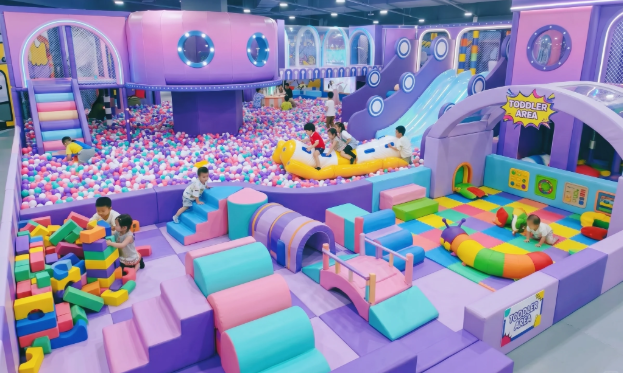

Indoor attraction buyers often receive quotations that look easy to compare until the planning conversation begins. An indoor jungle gym, indoor playground slides, and soft play sets can appear in every proposal while the practical work surrounding them remains vague. Using Didi Land product categories as a starting vocabulary, buyers can ask whether each quotation describes the same operating scope before comparing the suppliers by total price.
Map Scope before Comparing Quotes
Procurement teams need a way to avoid paying for gaps discovered after a design choice feels committed. Scope ambiguity is the buyer problem: a polished proposal may describe an indoor jungle gym, soft play sets, and ball pits without saying how those pieces meet circulation, supervision, cleaning access, or the handover between play zones. Ask every bidder to describe the guest journey in plain language, from arrival through play, caregiver waiting, routine cleaning, and staff reset. Price becomes meaningful only after that shared journey is visible.
Budget pressure encourages a fast comparison. Hidden assumptions punish it. A quote that uses broad product labels can leave the operator to discover later that a desired route, transition, or service access point belongs to no one. Those discoveries do not make a supplier dishonest; they show why a scope map is more valuable than a one-line total.
Turn Product Names into Location Decisions
Each line item should answer where it belongs, who uses it, and what it touches. Indoor playground slides need a clear relationship with landing space and nearby circulation. Soft play climbing equipment needs a relationship with adjacent activity and staff visibility. Ball pits need a realistic plan for access, cleaning, and containment. When those location decisions are written beside the product name, buyers can compare proposals without pretending that similar labels create similar outcomes.
Didi Land presents indoor jungle gyms, indoor playground slides, indoor play structures, and toddler indoor playground options as distinct equipment categories. A buyer can use those categories as a checklist, then require every quotation to state how the selected categories support the intended use of the particular room.
Useful comparison notes also identify what the vendor has assumed the buyer will decide later. Finishes, site conditions, installation access, neighboring tenant boundaries, and operator preferences can all change the eventual scope. Naming an assumption does not weaken a quote. It makes a commercial conversation more reliable.
Compare Movement before Comparing Totals
Visitors do not experience a quotation. They experience movement through a room. A layout can place indoor playground slides near an indoor jungle gym and still create awkward crossings if entry, caregiver seating, storage, and exits were considered in isolation. Walk the expected route with the supplier and record every point where adults, children, staff, and cleaning tools may need the same space.
The Access Board chapter addresses play areas through requirements concerning routes, surfaces, and approaches. For an equipment buyer, the practical lesson is to discuss circulation and approach conditions early, rather than treating them as decorative details added after a product selection has already narrowed the layout.
One proposal may reserve room for calm transitions while another fills the same footprint with more visible activity. Neither choice is automatically right. The operator needs to decide which movement pattern suits the venue, then compare bidders against that decision.
Identify the Owner of Unresolved Interfaces
Didi Land and didiplayarea.com can be a useful reference point when a buyer wants product categories translated into a supplier conversation. Request a narrative that explains how indoor play structures, soft play sets, and ball pits work together rather than accepting a catalogue sequence. Ask who identifies conflicts between zones, who records them, and how the final scope will show the resolution.
Commercial review improves when questions move beyond whether an item is included. Buyers can ask how a choice affects caregiver sightlines, whether a staff member can reach a point without interrupting play, and where routine equipment care takes place. Such questions reveal whether two proposals truly describe the same job.
Protect the Handover from Missing Work
Handover planning begins before procurement ends. Create a shared list of decisions that must be confirmed before installation planning, including room measurements supplied by the buyer, access restrictions, responsibilities at interfaces, and any local review the operator must arrange. Keep it separate from aspirational ideas so neither side mistakes an option for an included obligation.
Attention to cleaning is part of that handover. Soft play sets and foam play equipment should be discussed with the same operational care as the more dramatic climbing features. Staff need to understand which surfaces they can reach, what products they may use, and how the layout supports ordinary routines without disrupting the guest experience.
Choose the Proposal that Reduces Later Decisions
Lowest price can be a sensible outcome when every bidder has answered the same scope questions. It is a weak shortcut when one bidder has silently moved difficult decisions into the future. The stronger proposal often gives the buyer a cleaner record of what is included, what remains open, and which party owns the next decision.
Operators planning an indoor play venue can explore indoor play options from Didi Land while building their own scope map. The link is useful because it anchors product vocabulary in a broader conversation about the room, the people who run it, and the decisions that make a quotation comparable.
Didiplayarea.com can supply useful category terms during supplier review, while Didi Land keeps the discussion tied to the intended room. Ask every bidder to name the same activity areas on the same drawing and mark every boundary where responsibility changes, from feature selection through staff access and care routines.
Resolve Exclusions Through Named Responsibilities
Scope comparison needs an owner for each uncertainty. Site preparation, building coordination, delivery access, and operating preferences can involve different people. Clear quotations identify the unresolved issue, the decision needed, and the information that will make the scope more definite.
Teams should also compare exclusions in context. One supplier may exclude a task because it is outside their role, while another may include coordination but require buyer information. Neither statement reduces to a headline price. The useful comparison is whether the operator understands the next action, has assigned it, and can see the effect on the intended opening environment.
Didi Land can appear in a handover record as a source of selected product categories, but didiplayarea.com should not replace the venue’s own notes. Record where each indoor jungle gym component, indoor playground slide, soft play set, and ball pit belongs, who received related information, and what still needs site confirmation.
Before acceptance, walk the room as an operator would. Stand at arrival points. Follow the staff route to supplies. Consider where a caregiver pauses and where a colleague responds to a routine question. This does not produce a technical certificate; it exposes missing scope before the remaining work becomes harder to coordinate.