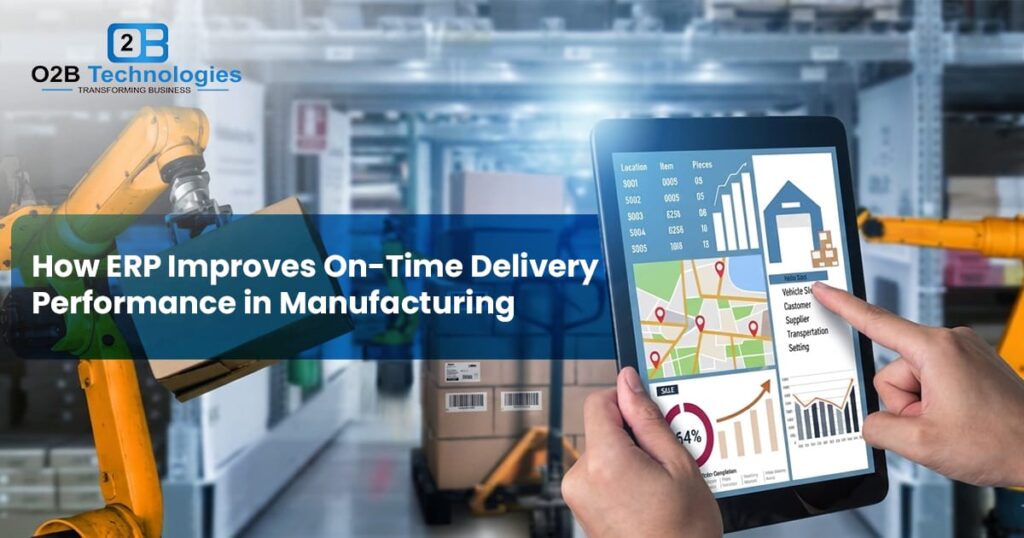

Late shipments are one of the most expensive problems a manufacturer can have. They damage customer trust, trigger penalty clauses, and quietly erode margins through expedited freight, overtime labor, and rush production runs. Yet most delivery delays don’t start on the shop floor; they start with disconnected data. A purchasing team that doesn’t know a machine is down. A planner working from a spreadsheet that’s three days old. A sales rep promising a delivery date without checking real capacity.
This is why manufacturers are choosing ERP implementation, especially modern ERP like Odoo, which brings together production, inventory, procurement, and order data into one single source of truth, which provides manufacturers with the visibility and control necessary to consistently meet delivery commitments.
1. Real-Time Visibility Replaces Guesswork
In manufacturing environments running on disconnected tools, spreadsheets, standalone MRP software, and paper-based shop floor tracking, information moves slower than the business does. By the time a delay is noticed, it’s often too late to fix without missing the ship date.
ERP consolidates data from production, warehouse, purchasing and sales into one live system. Planners can know exactly what is in stock, what is in production and what is on order, all updated in real time.
2. Accurate Demand and Production Planning
Realistic planning long before an order ships is the first step to on-time delivery. ERP systems produce more accurate demand forecasts against historical sales, current order volume and inventory levels. This allows manufacturers to synchronize raw material procurement and production schedules with real demand as opposed to responding to it.
Modules like Master Production Scheduling (MPS) and Material Requirements Planning (MRP), both standard in most modern ERP platforms, calculate exactly what needs to be produced, when, and with what materials. This reduces the two biggest causes of late delivery: material shortages and overloaded production lines.
3. Better Coordination Between Departments
A delivery delay is rarely the fault of a single department. This is often due to poor handoffs between sales, procurement, production and logistics. Sales gives a date without checking capacity. Procurement orders materials late as they didn’t know about a rush order. Production only learns of a schedule change after it is too late to make any adjustments.
ERP breaks down these silos by giving every department access to the same real-time data. When a sales order is entered, procurement and production see it immediately. When a material delivery is delayed, planners are alerted automatically so they can adjust the schedule rather than discovering the gap on the shop floor. This kind of coordination is difficult, sometimes impossible, to achieve with disconnected systems.
4. Inventory Optimization Prevents Bottlenecks
Surpluses and shortages have a negative impact on on-time delivery, but they are of opposite effect. Excess stock is a drain on cash and storage space, and too little means manufacture is halted to await materials. Automated reorder points, safety stock calculations and demand replenishment are the ways in which ERP systems maintain balance.
Real-time inventory management provides manufacturers with an accurate view of the location of materials, components, work-in-progress, and finished products – all in a single location. This eliminates the need for people to scramble to find materials which can be a delay in order fulfillment.
5. Predictive Insights Through Analytics
Modern ERP suites aren’t just to record history, they’re designed to forecast the future. There are capacity information and reporting tools built into the system which will identify potential capacity issues, repeated supplier delays or production bottlenecks before they affect delivery dates. This information puts manufacturers in a position to renegotiate with underperforming supplier, change manufacturing lines or shorten/lengthen lead times that are communicated back to the customer, all in a proactive fashion rather than a reactive one.
6. Streamlined Logistics and Order Fulfillment
And finally, ERP systems provide visibility to the last mile of delivery. Integrated logistics and warehouse management provides manufacturers with the advantage of monitoring the status of the order from the completion of the manufacturing to packing, shipping and final delivery.
On-time delivery isn’t the result of one department working harder; it’s the result of accurate, real-time information flowing across the entire manufacturing operation. That is possible with ERP systems, which link planning, procurement, production and logistics together into one coordinated system.
When manufacturers are considering ERP as a means to improve delivery performance, the focus should be on a platform that provides real-time visibility, strong planning tools and ease of integration across the departments, not just another siloed piece of software. Solutions like Odoo ERP, implemented by partners like O2B Technologies, are built around exactly this kind of connected, real-time approach, helping manufacturers transition from reactive firefighting to predictable, on-time delivery.