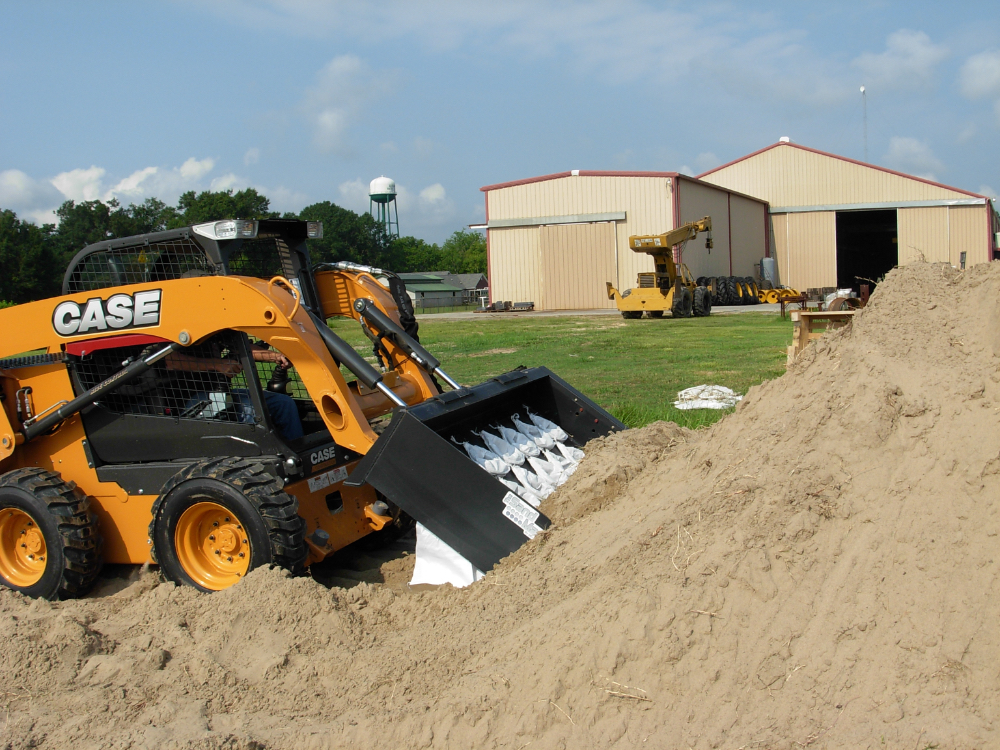

The world is getting wetter. Over the past two decades, the frequency and severity of flooding events has increased dramatically across every continent — driven by shifting weather patterns, urban expansion into flood plains, and aging drainage infrastructure that was never designed for modern rainfall volumes.
In the United States alone, the Federal Emergency Management Agency (FEMA) responds to dozens of major flood disasters every year. In Europe, Asia, and Australia, the story is the same. And at the frontline of every flood defense operation, there is one tool that has remained constant for over a century: the sandbag.
But while the sandbag itself hasn’t changed much, the way they are filled and deployed has transformed dramatically. Sandbag making machines — automated systems that fill, and in some cases seal, thousands of bags per hour — are now standard equipment for forward-thinking governments, municipalities, and contractors worldwide.
This article explores why that shift is happening, who is leading it, and what it means for flood defense operations at every scale.
Understanding the Sandbag Making Machine
Before diving into use cases and adoption trends, it’s important to clarify what a sandbag making machine actually is — and how it differs from basic filling equipment.
Sandbag Making vs Sandbag Filling The terms are often used interchangeably, but there is a meaningful distinction:
- Sandbag filling equipment focuses on the filling stage — loading material into pre-made bags efficiently
- Sandbag making machines refer to more comprehensive systems that may handle the entire process: bag feeding, filling, closing, and in some advanced configurations, even cutting and sealing bags from a continuous roll of woven material
For the purposes of this guide, we use the term broadly to cover any automated system that significantly accelerates the production of filled, deployment-ready sandbags.
The End-to-End Automated Process:
- Empty bags are fed into the system — either pre-opened from a stack or dispensed from a roll
- The bag is positioned under the fill spout automatically
- A pre-set volume or weight of sand, soil, or gravel is dispensed
- The filled bag is moved to a closing/tying station
- Closed bags are conveyed to a stacking or palletizing area
Advanced systems complete this entire cycle in 3–6 seconds per bag — producing 600 to 1,200 deployment-ready sandbags per hour with just 1–2 operators.
Why Automation Is Now a Government Priority
For most of the 20th century, sandbag filling was considered unskilled manual labor — something that could always be handled by mobilizing volunteers or National Guard units during an emergency. That assumption is breaking down for several important reasons.
The Speed Gap Has Become a Crisis Modern flood events move faster than traditional manual response can handle. Flash flooding triggered by intense rainfall can go from warning to inundation in 6–12 hours. Mobilizing, briefing, and deploying manual volunteer crews takes time that simply isn’t available in these scenarios.
A single automated sandbag making machine deployed at a pre-positioned staging area can produce more bags in one hour than a 20-person volunteer crew — without the mobilization delay.
Labor Availability Is Declining Emergency volunteer networks that governments traditionally relied upon are shrinking in many regions. Aging populations, reduced civic participation, and the logistical complexity of mobilizing large numbers of people during an active weather emergency have made manual approaches increasingly unreliable.
Stockpiling Has Become Standard Practice Rather than waiting for a flood warning to begin filling bags, progressive municipalities now maintain pre-filled sandbag stockpiles — tens of thousands of bags kept ready for immediate deployment. Maintaining those stockpiles without automation is simply not cost-effective.
Budget Accountability Government operations face increasing scrutiny over emergency spending. Automated equipment produces a clear, auditable output — X bags per hour at Y cost — that manual volunteer operations cannot match for accountability and efficiency reporting.
Government & Municipal Use Cases
- FEMA and Federal Emergency Stockpiling At the federal level in the United States, FEMA and the Army Corps of Engineers maintain regional sandbag stockpiles at strategic locations across flood-prone states. These stockpiles are maintained and replenished using automated filling equipment that can rapidly top up inventories between disaster events.
- State & County Emergency Management Programs State emergency management agencies in flood-prone regions — Louisiana, Florida, Iowa, California — have invested in trailer-mounted sandbag making machines that can be rapidly repositioned ahead of storm systems. Some counties operate dedicated sandbag filling stations open to the public during flood warnings, allowing residents to self-serve pre-filled bags.
- City Public Works Departments Municipal public works departments use automated sandbag filling equipment as part of their standard flood response infrastructure — alongside pumps, barriers, and drainage equipment. Cities like Houston, Sacramento, and Des Moines have invested significantly in this equipment following costly flood events.
- Military Base Infrastructure Military installations use sandbags extensively for perimeter defense, blast protection, and field fortification. Base logistics units rely on portable automated sandbag making machines to produce barriers rapidly without diverting large numbers of personnel from operational duties.
- International Humanitarian Operations International relief organizations operating in flood-affected developing regions use portable diesel-powered sandbag filling equipment to rapidly protect communities that lack the infrastructure for permanent flood barriers. The portability and fuel independence of these units makes them practical in remote deployments.
Contractor Adoption — The Private Sector Shift
Government agencies aren’t the only ones automating. Private sector contractors across several industries have been early and enthusiastic adopters of sandbag making machines.
- Landscaping & Drainage Contractors Contractors specializing in residential and commercial drainage solutions use sandbags for channel diversions, slope stabilization, and temporary water management. Having an on-site filling capability eliminates the cost and lead time of sourcing pre-filled bags from suppliers — and allows contractors to respond to emergency client calls within hours.
- Sand & Gravel Suppliers Aggregate businesses have found a profitable revenue stream in selling pre-filled sandbags directly to consumers, hardware retailers, and government agencies. A reliable high-volume bagging machine transforms raw sand inventory into a higher-margin packaged product that commands significantly better pricing than bulk aggregate sales.
- Construction Site Management Large construction projects use sandbags extensively for perimeter erosion control, temporary drainage management, and stormwater compliance. Rather than purchasing pre-filled bags from suppliers, many larger contractors now own semi-automatic filling equipment that pays for itself across multiple projects.
- Flood Restoration Contractors Specialized contractors who respond to flood damage events need sandbags immediately — not in 48 hours when a supplier delivery arrives. On-site automated filling capability allows them to begin protective work within hours of receiving a call.
Key Features That Matter for High-Volume Operations
Whether you’re a government agency or a private contractor, the performance requirements for serious flood defense operations are the same. Here’s what matters most when evaluating a sandbag making machine:
Fill Rate — Bags Per Minute This is the headline specification. But read it carefully — manufacturer-rated fill speeds are often measured under ideal conditions with a pre-positioned operator and pre-opened bags. Ask for real-world output figures from comparable deployments.
For emergency municipal use, a minimum of 400–600 bags per hour is generally considered the threshold for meaningful operational advantage over manual methods. High-end systems reaching 1,000–1,500 bags per hour are available for large-scale deployments.
Portability & Rapid Deployment For field use, the ability to transport and set up the equipment quickly is as important as fill speed. Key portability factors include:
- Total transport weight and dimensions
- Trailer or skid-mount configuration
- Setup time from transport to operational (target: under 30 minutes)
- Power source — electric (requires generator), diesel, or dual-fuel options
A purpose-engineered sand bag filler machine designed for field portability will significantly outperform a repurposed industrial filler in real emergency deployment scenarios — the design priorities are simply different.
Material Versatility Flood defense operations don’t always have access to ideal dry sand. Equipment must perform reliably with:
- Dry sand
- Moist or wet sand
- Mixed sand and gravel
- Soil and clay-heavy mixtures
- Fine gravel and crushed stone
Confirm that the equipment you’re evaluating handles your actual available materials — not just dry, free-flowing sand under lab conditions.
Durability in Harsh Conditions Flood emergencies happen in rain, mud, cold, and heat. Equipment used for flood defense must be built to operate reliably in outdoor conditions that would quickly disable less robust machinery. Look for:
- Fully welded heavy-gauge steel construction
- Sealed electrical components (IP65 rating minimum)
- Corrosion-resistant surface treatment
- Simplified mechanical design with minimal failure points
Operator Safety High-output filling operations create several safety risks: dust inhalation, pinch points during bag handling, and conveyor hazards. Evaluate the equipment’s dust containment, guarding, and emergency stop provisions — especially for government operations subject to workplace safety regulations.
Cost Analysis — Government & Contractor Scenarios
Scenario A: Municipal Emergency Management Agency
A mid-size city needs to maintain a stockpile of 50,000 sandbags and be able to produce an additional 10,000 bags within 4 hours of a flood warning.
Manual approach:
- 50,000-bag stockpile requires ~500 labor hours to fill manually
- Emergency 10,000-bag surge requires mobilizing 50+ volunteers with 4-hour notice
- Inconsistent quality, storage degradation, unreliable mobilization
Automated approach:
- Mid-range sandbag making machine at $25,000–$40,000
- Stockpile maintained by 2 operators in scheduled production runs
- Emergency surge: 10,000 bags in under 8 hours with 2 operators
- Consistent quality, predictable output, minimal mobilization required
Payback: Labor cost savings and avoided emergency contract costs typically recover the investment within 2–3 flood seasons.
Scenario B: Sand & Gravel Supplier
A regional aggregate business wants to add pre-filled sandbags to their product line.
- Raw sand cost: ~$15–$25 per ton
- Pre-filled sandbag retail price: $1.50–$3.00 per bag (0.5kg fill)
- Automated production cost per bag (labor + material): ~$0.40–$0.70
- Gross margin per bag: $0.80–$2.30
At 500 bags per hour across a 6-hour production run, that’s 3,000 bags per day generating $2,400–$6,900 in gross margin. The equipment pays for itself in weeks, not years.
Deployment Checklist for Municipalities & Contractors
Before your sandbag making machine goes into service — whether for stockpile maintenance or emergency response — work through this checklist:
Equipment Readiness:
- Full mechanical inspection completed
- Hopper cleaned and free of residual material
- Fill rate calibrated and verified against target output
- Dust containment system checked and operational
- Fuel/power source confirmed (generator tested if electric)
- Spare bags, ties, and wear parts stocked on-site
Site Preparation:
- Level, stable surface for equipment positioning
- Material supply (sand/gravel) staged for continuous feeding
- Clear path for filled bag removal and stacking
- Adequate lighting for night operations
- Water and welfare facilities for operators
Operator Readiness:
- Minimum two trained operators per shift confirmed
- Safety briefing completed — dust, pinch points, emergency stops
- Communication established with deployment/logistics team
- Production log template ready for output tracking
Post-Operation:
- Equipment cleaned and dried before storage
- All wear components inspected and replaced as needed
- Production log completed and filed
- Maintenance schedule updated based on hours run
Conclusion
The automation of flood defense is not a future trend — it is happening right now, in municipalities, military bases, and contractor yards across every flood-prone region of the world. Governments that once relied on volunteer labor and manual filling are discovering that automated sandbag making machines deliver faster response, lower cost, more consistent output, and far greater reliability when it matters most.
For contractors, the business case is equally compelling — whether you’re adding a profitable product line, serving emergency response clients, or simply eliminating the cost and delay of sourcing pre-filled bags from suppliers.
The technology is proven, the ROI is clear, and the operational advantages are decisive. The question for any government agency or contractor still relying on manual sandbag filling is not whether to automate — it’s how soon.