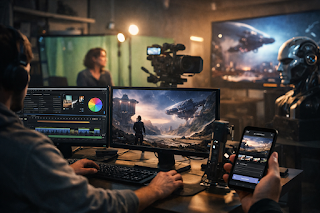

Imagine turning a simple text prompt into a polished promo video in minutes—no cameras, no crews, just your idea and an AI powerhouse. That’s the promise of AI video creation today, and it’s evolving faster than ever. For content creators and agencies juggling tight deadlines and budgets, these tools aren’t just nice-to-haves; they’re game-changers. They democratize high-quality video production, letting solopreneurs compete with big studios.
AI has already transformed static images into dynamic clips, but recent leaps in generative models are pushing boundaries. We’re talking hyper-realistic motion, seamless editing, and context-aware storytelling that feels human-crafted. As digital marketing demands more video—think social reels, YouTube explainers, and TikTok ads—these innovations mean creators can scale output without scaling headcount.
Google’s Bold Leap into Generative Video
At the forefront stands Google, whose DeepMind team has been quietly perfecting video generation. Their latest models build on years of research in diffusion tech and transformer architectures, trained on vast datasets of real-world footage. The result? AI that understands physics, emotions, and narrative flow, spitting out videos that rival professional shoots.
This isn’t hype—early demos show clips with consistent character movement, natural lighting, and even lip-sync for voiceovers. For agencies, this slashes pre-production time from weeks to hours. A real estate firm, for instance, could generate virtual property tours from bullet-point descriptions, complete with drone-like pans and ambient music suggestions.
Seamless Integration Powers Everyday Workflows
One of the biggest shifts is how these advanced models are embedding into user-friendly platforms. Professionals now access Google’s latest AI video model, veo 3.1, directly on invideo, enabling the creation of promos, social media videos, explainers, product demos, real estate tours, and much more with unprecedented ease and quality.
This integration means no more wrestling with clunky APIs or cloud consoles. invideo’s intuitive interface lets you iterate prompts, tweak styles, and export in formats ready for Instagram or LinkedIn. Creators report 5x faster turnaround, freeing time for strategy over grunt work.
Key Capabilities That Set New Standards
Veo 3.1 excels in areas that plagued earlier tools:
- Hyper-Realistic Motion: Unlike choppy outputs from older models, it simulates fluid camera moves, like a slow zoom on a product reveal, grounded in real physics.
- Contextual Consistency: Characters age naturally across scenes; backgrounds adapt to lighting without glitches.
- Multimodal Inputs: Feed it text, images, or audio, and it blends them into cohesive stories—perfect for branded content.
- Customization Depth: Adjust aspect ratios, durations (up to 2 minutes per clip), and styles from cinematic to cartoonish.
For example, a digital marketer crafting a SaaS demo can prompt: “Show a frustrated user struggling with spreadsheets, then switch to our app’s smooth interface with upbeat music.” The output? A ready-to-post video that converts viewers.
These features address pain points like uncanny valley effects, making AI videos indistinguishable from stock footage in many cases.
Boosting Efficiency for Solopreneurs and Teams
Content creators often wear every hat—writer, editor, poster. AI levels the field. A solo YouTuber in Durgapur could use these tools to produce weekly tech reviews, matching agency polish without outsourcing. Agencies benefit too: scale client campaigns by automating 80% of ideation and rough cuts.
Data backs this up. Platforms report users creating 10x more videos monthly, with engagement rates up 30% due to fresher, trend-aligned content. E-commerce brands love it for quick product teasers, driving impulse buys on platforms like Shopify.
Strategic Wins for Agencies in a Video-First World
Agencies thrive on differentiation. Veo 3.1-like models enable hyper-personalized campaigns at volume. Pitch a client a custom explainer? Generate variants for A/B testing overnight. Real estate agencies can tour unbuilt properties, closing deals faster.
Cost savings are massive: a traditional 30-second ad might run $5,000–$20,000. AI drops that to under $50, including iterations. Plus, it handles localization—swap accents or cultural nuances via prompts, ideal for global reach.
Exploring Complementary Tools in the Ecosystem
Beyond standalone models, platforms are bundling features to streamline end-to-end creation. invideo, for instance, also offers an ai video generator app that complements these advancements, making it a one-stop shop for everything from scriptwriting to subtitle generation.
This app shines for mobile creators, turning phone notes into vertical shorts optimized for Reels or Shorts. Pair it with advanced models, and you’ve got a workflow that rivals enterprise suites like Adobe Premiere, but 10x faster.
Navigating Challenges and Ethical Frontiers
No tech is perfect. Current hurdles include occasional artifacts (like flickering edges in complex scenes) and high compute demands, though cloud optimizations are closing the gap. Watermarking and metadata help track AI origins, combating deepfakes.
Ethically, creators must prioritize originality—AI excels at remixing, not inventing from scratch. Agencies should blend it with human oversight for brand voice. Regulations like the EU AI Act loom, mandating transparency, so tools with audit trails will win.
On the bright side, it empowers underrepresented voices. A marketer in West Bengal can now produce Hollywood-level videos without Mumbai budgets, fostering diverse storytelling.
Real-World Impact: Case Studies from the Trenches
Consider “TechBit,” a digital agency specializing in e-commerce. They adopted similar AI tech and cut video production time by 70%, landing 15 new clients in Q1 2026. One campaign—a meme-style product demo—garnered 2M views on TikTok.
Or take indie creator Sarah Lopez, who uses AI for travel vlogs. “I prompt real estate tours of dream destinations,” she says, “and edit in personal footage. It’s like having a virtual crew.” Her channel grew 40% in subscribers.
These stories show AI isn’t replacing creatives—it’s amplifying them.
Monetization and Growth Opportunities Ahead
The economic ripple is huge. PwC predicts the AI media market hitting $100B by 2030, with video leading. Creators monetize via platforms like YouTube’s Shorts Fund or agency retainers for AI-accelerated services. Agencies can upsell “AI-first” packages, bundling generation with analytics.
For SEO pros, video boosts dwell time and rankings—Google favors dynamic content. Optimize with transcripts, timestamps, and alt-text for max visibility.
Looking Ahead: Convergence with Emerging Tech
Expect Veo 3.1 evolutions to merge with AR/VR for immersive ads and live-stream enhancements. Voice AI will enable real-time edits during broadcasts. Open-source alternatives will spur innovation, while edge computing makes it mobile-native.
Invideo’s ecosystem hints at this future, with apps evolving into collaborative hubs for teams.
Embracing the Shift for Long-Term Success
AI video creation isn’t a fad—it’s the new normal. Content creators and agencies that adapt will dominate. Start small: experiment with prompts, refine your style, and measure ROI. The tools are here; the creativity is yours.
Tools like these lower barriers, spark innovation, and let stories shine. Whether you’re a digital marketer crafting campaigns or an agency scaling deliverables, the future is bright—and automated.