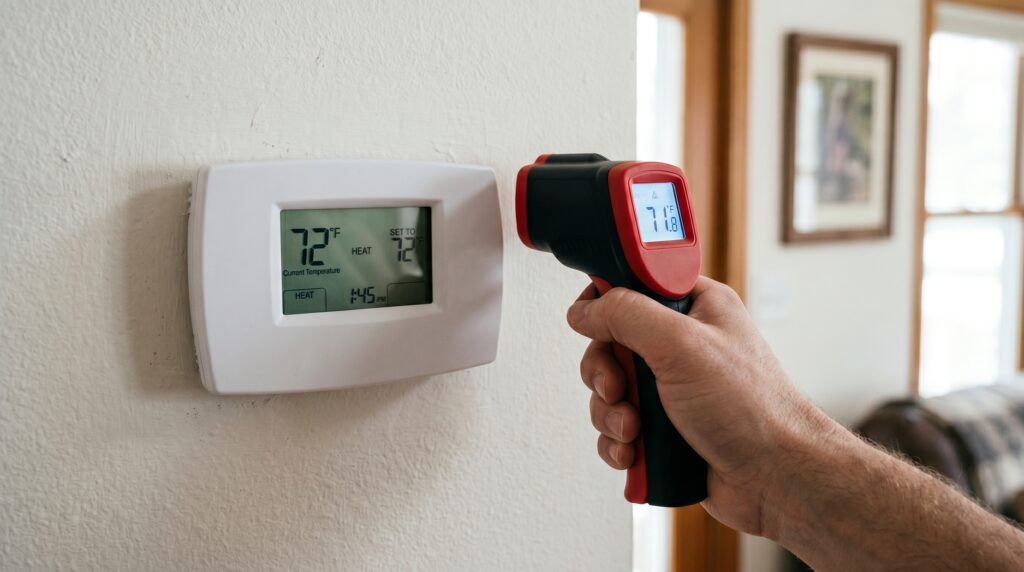

The thermostat gets blamed first. The thermostat gets adjusted twice a day by whoever sits nearest to it. The thermostat gets replaced, eventually, with a smart model that emails somebody charts. None of that changes the fact that the front half of a six-employee suite off Hurstbourne Lane sits at 78 degrees while the back conference room reads 66, all day, every day. An office that splits like that has an air distribution problem rather than a control problem, and the repair that actually works is a measured diagnostic from a crew doing hvac repair louisville ky businesses use for light commercial work. Everything else is guesswork dressed up as maintenance.
The Thermostat Myth Costs Offices Real Money
The myth is simple, and it is everywhere: if one end of the office is wrong, the thermostat must be wrong. Reality is duller than that. A thermostat is a switch with an opinion about one spot on one wall, about four feet off the floor, in whichever room the original installer found convenient. It reads that spot and nothing else. Once the system is running, the temperature in every other room depends entirely on how much conditioned air actually reaches it, which is a question of duct size, duct length, return path, damper position, and whether a ceiling grid got dropped over a supply register during somebody’s fit-out. A thermostat can only report one room’s air, so it can never balance the rest of the suite. The split we see most often traces back to a return that was never enlarged when an open floor got carved into offices.
Money is where a manager feels this. A suite budgeting under $3,000 a year for heating and cooling has roughly $250 a month to work with, and an unbalanced system eats that quietly, because the equipment keeps running to satisfy one sensor while half the floor is already overcooled. Say the office drops the setpoint two degrees every summer to make the back room bearable. Nobody notices that as a line item. It runs all season anyway. Here is the rule I give clients. If the gap between your warmest and coolest occupied room is under four degrees, leave the thermostat alone and adjust the diffusers. Above four degrees, stop changing settings and pay for a diagnostic, because at that point you are buying runtime you cannot use.
Questions Managers Ask About Zoning And Sizing
Most of these calls open with a solution instead of a symptom. Someone has already priced a mini split for the conference room, or a salesperson has told them the suite needs zoning. Sometimes that really is the answer, and more often it is an expensive way around a duct problem that costs a fraction as much to correct. Three questions come up in nearly every walkthrough.
Would Adding A Zone Fix Our Hot And Cold Ends?
Zoning earns its cost when two areas carry genuinely different loads, such as a conference room behind a west-facing window wall next to an interior bullpen. It does nothing when the back room simply is not receiving enough air, since a damper cannot deliver volume the duct never carried in the first place. Ask for static pressure and register airflow numbers before anyone quotes you a zoning panel.
Is The Unit Just Too Small For Our Suite?
Oversized is the more common finding, which surprises people. A system with too much capacity satisfies the thermostat fast, shuts off, and never runs long enough to push air into the far corners of the floor. Short cycling paired with a 12-degree spread across a small suite points at distribution and a capacity mismatch far more often than at equipment that cannot keep up.
Can A Mini Split Just Cover The Cold Room?
It can, and for one odd room nobody can duct properly, that is sometimes the pragmatic call. The catch is that you then run two systems with competing opinions about the same air, and the second unit’s install cost plus its power draw lands on the same budget the split was already inflating. Price the repair first, then decide whether the workaround still looks cheaper.
Measured Airflow Ends The Guessing
A real diagnostic is boring, which is part of why it gets skipped. A technician measures supply airflow at each register, checks static pressure across the coil and the filter, compares return capacity against the tonnage on the nameplate, and works out what the last two or three fit-outs did to the duct branches above the ceiling. What usually turns up is small and cheap. A crushed flex run, a balancing damper closed since somebody’s remodel, a return grille sized for half the air the blower wants. That back conference room reading 66 has often been starved for air since the day its walls went up, and no setpoint on the wall was ever going to change that.
Cooling load is worth understanding before you argue with a utility bill, too. NOAA’s Climate Prediction Center tracks expected air conditioning demand using cooling degree days, and its weekly degree day tables, including those covering August 2026, count each degree a day’s mean temperature runs above 65 degrees Fahrenheit as one cooling degree day. A hot stretch lifts the load on every part of the system at once, so a suite that felt borderline in May turns unbearable by late summer. That is a longer detour into weather data than most operations managers asked for. Back to the point: load explains why the problem worsens, and airflow explains why it is lopsided in the first place.
So the takeaway for anyone watching a $3,000 annual facilities budget is not complicated. Uneven temperature is a symptom of air that is not arriving, and measuring where that air goes costs far less than replacing the equipment moving it. Before you book hvac repair louisville ky offices depend on, decide that you want register airflow readings and static pressure numbers handed to you in writing, and treat a shrug plus a new thermostat as your cue to call somebody else. Plenty of contractors will give a second opinion on a light commercial system at no charge. The figure that comes back from an actual measurement is the only one you can budget against.