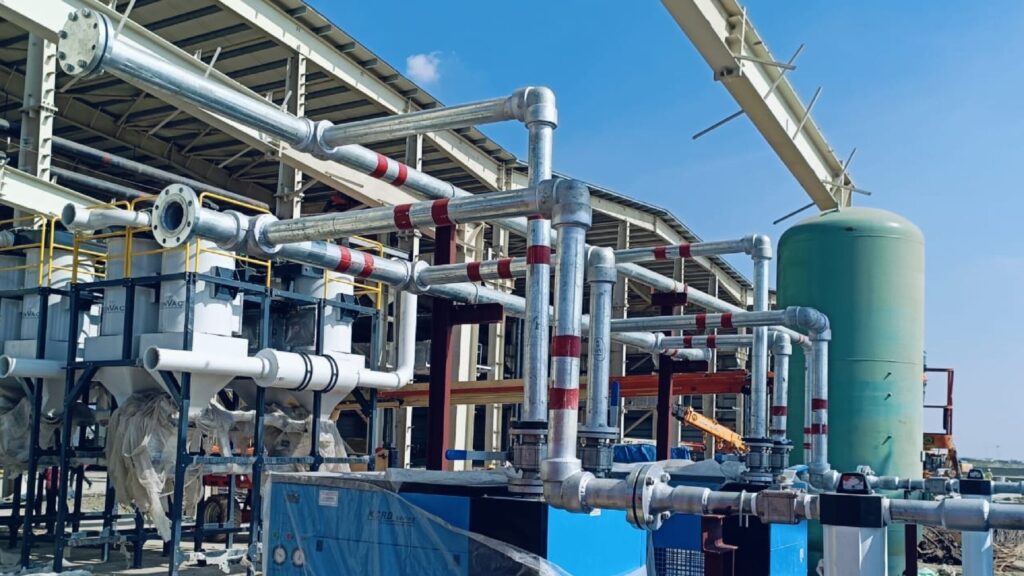

Compressed air systems are among the most operationally critical utilities in a manufacturing facility. They power pneumatic tools, control automated equipment, drive assembly line processes, and support quality control operations across nearly every production environment. When those systems fail or underperform, the impact is immediate and measurable — downtime, rejected product, equipment damage, and unplanned maintenance costs.
Despite this, many manufacturers treat the hiring of piping contractors as a procurement decision rather than an engineering one. The result is a pattern of repeated mistakes that surface not during installation but months later, when production demands are highest and the original contractor is long gone. Understanding where these decisions go wrong — and why — gives facility managers and operations leaders a meaningful advantage before a single pipe is cut or fitting is joined.
Mistake 1: Treating All Contractors as Interchangeable
There is a broad assumption in many procurement processes that any licensed piping contractor can handle a compressed air system. In practice, compressed air piping contractors occupy a specialized niche that requires a distinct combination of knowledge: how pressure behaves across a distribution network, how different pipe materials respond to system cycling, where moisture accumulates and why, and how design decisions at the point of installation affect system performance years down the line. These are not skills shared equally across all mechanical or plumbing contractors.
Why Specialization Matters More Than Licensing Alone
A contractor may hold all the necessary certifications for general piping work and still lack the operational experience to design a compressed air distribution system that performs efficiently under real production loads. General contractors working outside their area of depth often replicate configurations from previous projects without accounting for the specific demands of a new facility — different pressure requirements, varying drop points, different compressor technology, or layout constraints that affect flow dynamics.
The consequences rarely show up on inspection day. They appear gradually: pressure drops at the end of long runs, moisture problems near sensitive equipment, or unexplained variability in pneumatic tool performance. By the time these issues are diagnosed, the connection to the original installation decision has often been forgotten.
Mistake 2: Prioritizing Lowest Bid Without Understanding Scope Differences
Competitive bidding is a standard and sensible part of contractor selection. The problem arises when bids are compared without a clear understanding of what each contractor has actually included in their scope of work. Compressed air piping projects involve a range of design and installation variables — pipe sizing and material selection, the placement and type of fittings, pressure drop calculations, drainage provisions, and integration with existing compressor infrastructure — and different contractors resolve these variables in different ways.
What Gets Left Out of a Low Bid
A contractor offering a significantly lower price may be using lighter-gauge materials, omitting isolation valves at critical points, skipping system design documentation, or planning for minimal testing after installation. None of these omissions are necessarily visible in a line-item comparison. When the systems installed under a low bid begin to show wear, leak at connections, or fail to maintain consistent pressure during peak demand, the remediation costs frequently exceed what would have been spent on a more thorough contractor from the start.
The more useful approach is to define the full scope of work before soliciting bids, then evaluate bids against that defined scope. This shifts the conversation from price alone to value against a consistent standard — and it surfaces the gaps in lower bids before they become operational problems.
Mistake 3: Skipping a Documented System Design Phase
Many compressed air piping projects proceed directly from a site walk to installation without a formal design document. In smaller facilities or straightforward retrofits, this may seem reasonable. In practice, even modest systems benefit significantly from a documented design phase that captures pressure requirements, flow demands at each drop point, pipe routing decisions, and provisions for future expansion.
The Operational Cost of Installing Without a Plan
Without a documented design, the installation is driven entirely by the installer’s judgment in the moment. Decisions about pipe sizing, routing, and fitting placement are made on-site, often without full visibility into how the system will be used or how it will need to grow. The result is a system that works at commissioning but struggles when production scales, equipment is added, or facility layout changes.
There is also a maintenance dimension. A system installed without documentation is a system that future technicians cannot easily diagnose. When a pressure problem emerges, there is no baseline to compare against, no record of where isolation points were placed, and no reference for how the system was intended to behave. That absence of documentation adds time and cost to every future service call.
Standards bodies such as the International Organization for Standardization have published guidance on compressed air quality and system management that underscores the importance of design documentation as a foundational element of a reliable installation.
Mistake 4: Overlooking the Contractor’s Familiarity With the Facility’s Compressor Infrastructure
A compressed air piping system does not exist in isolation. It connects directly to a compressor — or in larger facilities, multiple compressors — and the performance of the distribution network is directly tied to how well that connection is managed. Contractors who specialize in piping without a working knowledge of compressor systems often create installations that are technically correct at the pipe level but poorly matched to the equipment they serve.
How Mismatched Systems Create Long-Term Inefficiency
When piping is designed without consideration for the compressor’s operating characteristics — its output pressure range, duty cycle, moisture management approach, or control logic — the resulting system frequently runs less efficiently than it should. The compressor may short-cycle, or the piping may be sized in a way that creates pressure fluctuations that the compressor’s controls were not designed to handle.
This mismatch also affects energy consumption. Compressed air systems are among the largest consumers of electricity in many manufacturing environments. A piping network that is not well-matched to the compressor infrastructure forces the compressor to work harder than necessary to maintain pressure at end-use points, and that inefficiency compounds across thousands of operating hours. Hiring a contractor who understands both sides of the system — the compressor and the distribution network — reduces this risk substantially.
Mistake 5: Neglecting Post-Installation Testing and Commissioning Verification
It is common for compressed air piping installations to be considered complete when the final connections are made and the system is pressurized. In most cases, this marks the beginning of a verification process rather than the end of the project. A system that holds pressure at startup may still have small leaks at fittings, inadequate flow at certain drops, or moisture accumulation in sections of pipe where drainage provisions are insufficient.
What a Proper Commissioning Process Should Include
Thorough post-installation verification involves more than a walk-through with a pressure gauge. It should include a leak detection check across all connections, a confirmation that pressure at end-use points meets operational requirements under actual load conditions, a review of drainage function across the system, and a baseline record that can be referenced for future maintenance and troubleshooting.
Contractors who skip or abbreviate this phase are effectively transferring the risk of unknown installation defects to the facility. What is not identified at commissioning becomes the facility’s problem to diagnose later — typically at the worst possible time, when production is running and the contractor’s crew has moved on to the next job.
Requiring a written commissioning report as a contract deliverable is one of the simplest ways to ensure this step receives appropriate attention. It creates accountability and gives the facility a documented baseline that has real operational value over the life of the system.
Closing Thoughts
The decisions made when selecting and working with a compressed air piping contractor have consequences that extend well beyond the installation date. A system that is designed carefully, installed by contractors with relevant experience, and properly commissioned at the end of the project will require less maintenance, perform more consistently, and support production operations more reliably over time. One that is assembled under price pressure, without a clear scope or design, and handed over without formal verification creates a slow accumulation of operational risk that is difficult to trace back to its source.
Manufacturers who treat contractor selection as a strategic decision rather than a procurement formality tend to avoid the most expensive outcomes. The five mistakes outlined here are not rare or unusual — they are patterns that repeat across facilities of all sizes and industries. Recognizing them before a project begins is far less costly than discovering them after the system is in operation.
For facilities in Ohio and the surrounding region, working with experienced compressed air piping contractors who understand both the distribution network and the compressor infrastructure it connects to is a practical starting point for avoiding the problems described here. The right contractor brings not just installation capability, but the judgment to design a system that performs under real conditions and stands up to years of continuous use.