
As AI computing continues to expand, data center networks are facing a major transformation. Traditional server traffic is no longer the only concern. Modern AI infrastructure must support GPU clusters, distributed storage, high-performance switching, model training platforms, and real-time inference services at the same time. In large language model workloads, the network is not just a supporting system; it directly affects computing efficiency, response speed, and overall service quality.
This is especially true for LLM training and inference environments. During LLM training, massive amounts of data move continuously between GPU servers, storage systems, and switching layers. Parameters, gradients, checkpoints, and datasets must be transferred with high bandwidth and low latency. If the network becomes congested, expensive GPU resources may sit idle while waiting for data. In AI inference platforms, every TOKEN REQUEST may trigger communication between API gateways, model routing systems, inference servers, cache layers, databases, and billing platforms. As request volume increases, the demand for faster and more reliable internal connectivity becomes much stronger.
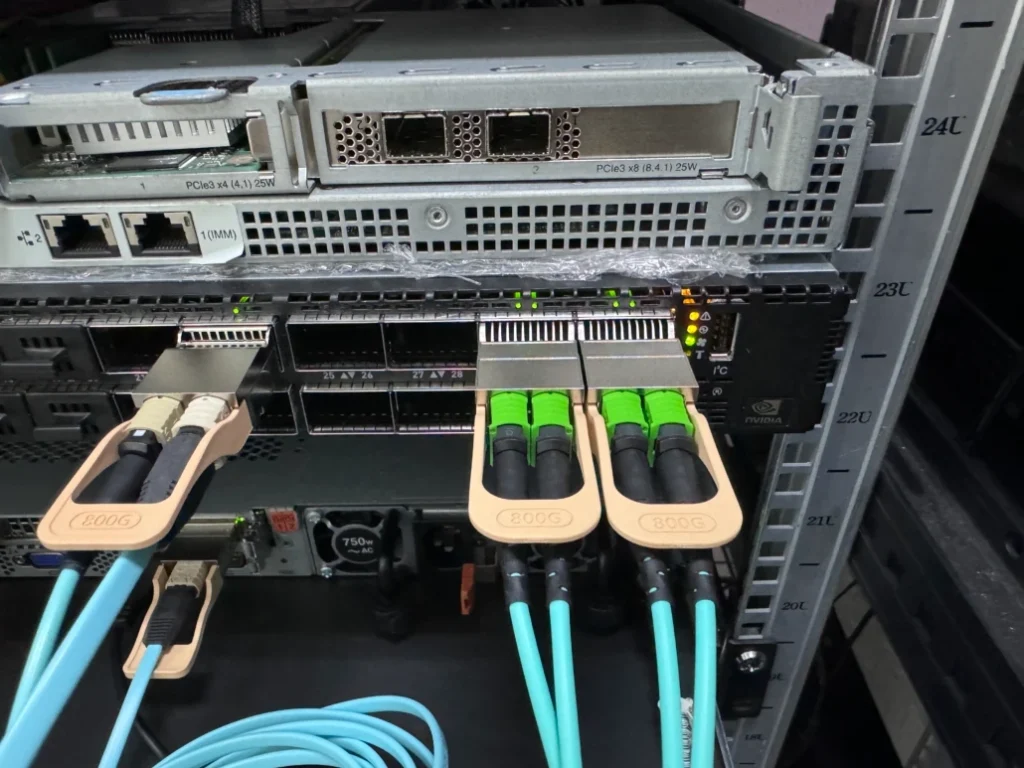
This is where the 800G SR8 optical module becomes highly valuable. The 800G SR8 is designed for short-reach, high-density data center connections. It is typically used for switch-to-switch, switch-to-server, and high-performance interconnect scenarios within AI data centers. By delivering 800Gbps bandwidth through parallel optical channels, 800G SR8 enables data centers to build faster and more compact network architectures.
Compared with lower-speed solutions, 800G SR8 can significantly reduce the number of ports, fibers, and cables required for the same bandwidth capacity. For AI computing clusters, this is a practical advantage. High-density GPU environments already require a large amount of power, cooling, and physical space. Simplifying cabling while increasing bandwidth helps operators improve airflow, reduce rack complexity, and make network management easier.
In LLM infrastructure, 800G SR8 can be used to support the high-speed connections between leaf switches, spine switches, and GPU server clusters. Large-scale model training requires strong east-west traffic performance, because data does not only move from users to servers. Instead, data flows constantly between compute nodes. A stable 800G network helps improve cluster efficiency and reduces the risk of bottlenecks during heavy training workloads.
For AI TOKEN platforms, 800G SR8 also plays an important role. A TOKEN REQUEST is not simply a small API message. Behind each request, the system may need to authenticate the user, select the right model, route the request to the proper inference node, calculate token usage, record billing data, and return the model response. When thousands or millions of TOKEN REQUESTS are processed every day, backend network performance becomes critical. 800G SR8 can help these platforms handle higher request density and maintain more consistent response performance.
Another key benefit of 800G SR8 is its suitability for short-distance AI data center deployment. Many AI clusters are built within the same room, same row, or nearby racks. In these environments, short-reach optical modules provide an efficient balance between bandwidth, cost, and deployment simplicity. 800G SR8 is especially useful where operators need extremely high bandwidth but do not require long-distance transmission.
As AI applications continue to grow, the pressure on data center networks will only increase. LLMs are becoming larger, inference traffic is becoming heavier, and TOKEN REQUEST workloads are becoming more continuous and unpredictable. Enterprises that want to build scalable AI infrastructure must ensure that their internal network can keep up with computing demand.
Overall, the 800G SR8 optical module is an important solution for high-density AI computing environments. It supports fast short-reach connectivity, reduces cabling complexity, improves network scalability, and helps GPU clusters operate more efficiently. For data centers focused on LLM training, AI inference, and high-volume TOKEN REQUEST processing, 800G SR8 provides a strong foundation for the next generation of AI network infrastructure.