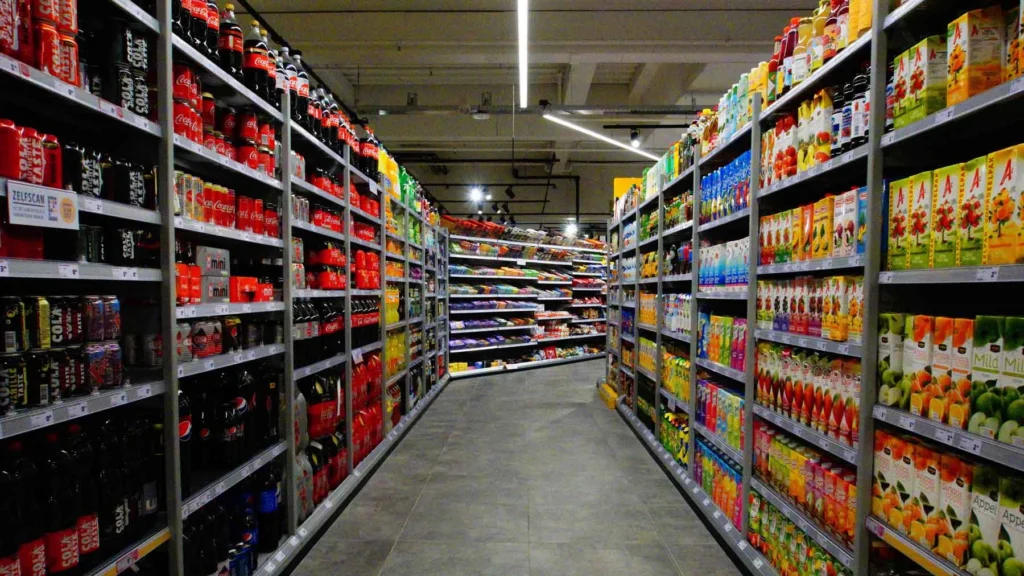

The right supermarket shelving does more than hold stock. A well-planned retail layout shapes how customers move through the store, how long they stay, and how much they spend. Whether you run a supermarket, convenience store, off-licence, or mini-mart, the shelving system you choose directly affects both the customer experience and the day-to-day efficiency of your team. Choosing the right shop shelving is essential for creating an organised, visually appealing, and profitable retail space.
This guide covers how to choose the right gondola shelving for UK retail environments, how to plan an effective store layout, and how to keep shelving systems well maintained over time.
What is supermarket shelving?
Supermarket shelving refers to the commercial display systems used inside supermarkets, convenience stores, mini-markets, and general retail shops to organise and present products to customers.
The most widely used system in UK retail is the gondola unit. A gondola is a freestanding, double-sided shelving unit designed to maximise display space along store aisles, allowing customers to browse both faces as they walk through. Wall-mounted single-sided units run along the store perimeter and are the backbone of most shop layouts.
Dynamic Shelf supplies both configurations across the UK. Our retail gondola units and wall shelving units are manufactured directly, available in upright heights of 1950mm and 2250mm, and ship as complete bays with adjustable shelves, perforated back panels, and EPOS ticket strips included as standard.
Why gondola shelving is the industry standard in UK retail
Gondola shelving has become the default choice for UK supermarkets, convenience stores, and mini-markets for practical reasons. The units are adjustable, modular and designed to be reconfigured as product ranges change throughout the year.
That flexibility matters most in:
- seasonal stock rotation and promotional campaigns
- fast-moving consumer goods environments with frequent range changes
- mini-market shelving layouts where floor space is limited
- high-turnover convenience stores where shelf restocking speed counts
Choosing the right shelving for your store
Selecting the correct shelving depends on your floor space, product categories, and customer flow. Most UK retail stores use a combination of three unit types.
Wall shelving units
Single-sided wall units run along the store perimeter. They are the most space-efficient option, keeping central aisles clear while maximising display capacity on every wall surface. Common uses include packaged groceries, drinks, household products, and toiletries.
Double-sided gondola units
Placed in the centre of the floor to create aisles, double-sided gondola units give customers browsing access on both faces. Wider bays (1000mm and 1250mm) suit high-volume grocery categories. Narrower bays (665mm and 800mm) work well in tighter convenience store layouts.
End bay displays
End bays are the highest-converting positions on the shop floor. Positioned at the end of each gondola run, they are typically used for promotions, seasonal products, new arrivals, and impulse purchases. A well-positioned end bay consistently outperforms mid-aisle shelf space for visibility and sales rate.
How store layout affects buying behaviour
Retail layout is not a neutral decision. The way shelving is arranged directly influences how customers move through the store and what they notice along the way.
Common layout mistakes that cost retailers sales:
- overcrowded aisles that interrupt customer flow and make browsing uncomfortable
- inconsistent shelf heights that make product categories harder to read at a glance
- promotional end bays left empty or stocked with everyday items that do not drive impulse
- wall shelving runs that do not reach full height, leaving valuable vertical display space unused
The stores that perform best are typically the easiest to navigate, not the ones with the most products on display. Clear aisles, logical product grouping and consistent shelf heights all contribute to a shopping experience customers return to.
Best practices for gondola shelving layouts
A few consistent principles separate well-performing retail layouts from average ones.
Keep main aisles clear
Aisles should allow two customers to pass comfortably. A minimum of 900mm aisle width is standard in UK convenience store layouts. Wider is better where floor space allows.
Use eye-level shelving for priority products
Products placed at eye level (roughly 1200mm to 1600mm from the floor) receive significantly more customer attention than those at floor or high-reach positions. Plan your product placement around this before finalising shelf heights.
Avoid overstocking shelves
Shelves packed beyond their facing capacity look disorganised and make individual products harder to identify. Clean, well-faced shelving consistently outperforms dense, overstocked displays for customer engagement.
Rotate end bays regularly
Customers notice when the same promotion has been on an end bay for six weeks. Rotating end bay displays every two to four weeks maintains engagement and gives more products promotional exposure over time.
Maintaining gondola shelving in high-traffic retail environments
Well-maintained shelving protects both the store presentation and the safety of customers and staff. These are the checks that matter most in a busy retail environment.
- Clean shelving weekly – dust and marks build up fast on busy gondola runs, especially near food and drink
- Inspect brackets and connections monthly – heavy stock puts constant pressure on shelf fittings, so check nothing has shifted under load
- Replace damaged shelves straight away – a bent shelf is a safety risk and the first thing customers notice
- Review your layout every six months – ranges change, customer habits shift, and a modular gondola system makes reconfiguring simple
Common mistakes retailers make with supermarket shelving
Even good-quality shelving underperforms when the layout or maintenance approach is wrong. These are the most frequent issues seen in UK retail fit-outs.
- Choosing shelving that is too tall for the store ceiling, which forces uprights to be cut down and compromises the structural integrity of the bay.
- Buying mismatched units from different suppliers, resulting in inconsistent heights and finishes that make the store look unplanned.
- Ignoring gondola end bays entirely, leaving the highest-value display positions understocked or unused.
- Failing to account for the base shelf depth when planning aisle widths, which is a common source of congestion in convenience store layouts.
Frequently asked questions
What is the best supermarket shelving for a convenience store?
For most UK convenience stores, a combination of wall-mounted single-sided units along the perimeter and compact double-sided gondola units in the centre works best. Dynamic Shelf gondola units are available in bay widths from 665mm to 1250mm, making them suitable for tight floor plans as well as larger layouts.
What is a gondola unit in retail?
A gondola unit is a freestanding, double-sided shelving unit used in supermarkets and retail stores to create browsable aisles. The term covers both the floor-standing island version and the single-sided wall version. In UK retail, gondola shelving typically refers to steel-framed units with adjustable shelves and perforated back panels.
What height should retail gondola shelving be?
UK convenience stores typically use 1950mm uprights for standard gondola and wall shelving runs. Taller 2250mm uprights maximise vertical display space and are common in larger supermarkets and off-licences. Dynamic Shelf supplies both heights as standard, with the same shelf and bracket system fitting both.
Can gondola shelving be extended after purchase?
Yes. Dynamic Shelf gondola and wall shelving units are designed as add-on bays. Start with a single run and extend it later using additional bays, legs, and back panels. Shelves, brackets, EPOS strips, and wire baskets are all available separately from the shelves and accessories range.
How do I maintain retail shelving in a busy store?
Weekly cleaning, monthly bracket checks, and prompt replacement of any damaged components are the minimum maintenance requirements for a busy retail environment. Dynamic Shelf stocks replacement parts individually, so a single damaged shelf does not require replacing the entire bay.