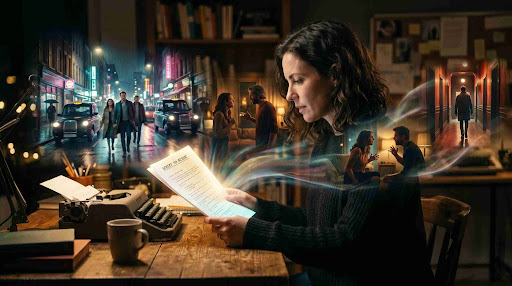

Scripts used to describe what happens.
Now they define how things unfold.
That shift sounds small, but it completely changes how video is written, structured, and even imagined.
For decades, scriptwriting followed a predictable logic. Scenes were broken into shots. Shots were described individually. Dialogue and action were separated from camera movement, and everything came together later during production.
That workflow made sense when production was slow, manual, and dependent on teams.
It starts to break when the system generating the video understands everything at once.
That’s where seedance 2.0 changes the equation.
Scripts Are No Longer Written Shot by Shot
Traditional scripts are built like instructions.
Scene 1: wide shot
Scene 2: close-up
Scene 3: cutaway
Each piece exists independently, and the director connects them later.
Seedance 2.0 removes that separation.
Instead of writing instructions for individual shots, creators now write sequences that already contain flow, camera logic, and progression. A single prompt can generate multiple connected shots with transitions already handled inside the output.
That changes how scripts are written.
You don’t describe shots anymore.
You describe movement.
One Prompt Becomes a Sequence
The biggest shift is this:
A script is no longer a list.
It’s a continuous idea.
When working with seedance 2.0, the input is not broken into parts. It’s written as a flowing sequence where action, camera, and pacing exist together.
Instead of:
“A woman runs. Cut to wide shot. Cut to close-up.”
You write:
“A woman sprints through a narrow corridor as the camera tracks beside her, then swings behind as she turns, rising slightly as she reaches the exit.”
That’s not editing.
That’s directing inside the script.
Camera Direction Moves Into Writing
In traditional workflows, camera decisions happen later.
With seedance 2.0, camera logic is part of the input.
That means scriptwriting now includes:
- Camera movement
- Angle transitions
- Framing logic
These are no longer separate layers.
They are embedded directly into how the scene is written.
This is why outputs feel more cinematic.
Because the camera is not reacting afterward.
It is part of the original instruction.
Why Scriptwriters Think Differently Now
This changes the mindset completely.
Instead of thinking:
“What shots do I need?”
Writers start thinking:
“How should this moment flow?”
That shift moves scriptwriting closer to directing.
Seedance 2.0 encourages this because it understands sequence, not just description.
Higgsfield makes this usable by allowing creators to combine text, image, and reference inputs into one structured workflow instead of splitting everything across tools.
Character Consistency Changes Dialogue Writing
Another subtle shift happens with characters.
In older workflows, consistency is handled in production.
In AI video, inconsistency is a major problem.
Seedance 2.0 maintains character identity across shots. That means the same face, clothing, and behavior remain stable throughout the sequence.
This changes how dialogue is written.
Writers can now assume continuity.
They don’t need to simplify scenes to avoid inconsistencies.
They can write longer, connected interactions.
That’s a major upgrade.
Scripts Now Include Timing, Not Just Words
Timing used to be handled in editing.
Now it’s part of the script.
Because seedance 2.0 aligns motion, audio, and visuals together, pacing becomes embedded in the input.
Writers start thinking about:
- Pause timing
- Speech rhythm
- Scene duration
This creates scripts that feel more like performance directions than static text.
Higgsfield supports this by ensuring that these elements stay synchronized across the entire generation process.
Audio Changes Script Structure
One of the biggest changes comes from audio.
In traditional workflows, audio is layered later.
Here, it’s integrated.
Seedance 2.0 generates audio alongside visuals, meaning dialogue, ambient sound, and motion are connected from the start.
This changes scriptwriting.
Instead of writing dialogue separately, writers think about how speech interacts with movement.
This creates more natural scenes.
Why Multi-Input Changes How Scripts Are Built
Scripts are no longer text-only.
Seedance 2.0 supports multiple inputs:
- Reference images
- Video clips
- Audio samples
This means scripts can now be partially visual.
A writer can define a character through an image, a tone through audio, and a sequence through text.
That’s a completely different approach.
Higgsfield enables this integration so creators don’t have to manage separate pipelines.
The Shift From Description to Instruction
Older scripts described scenes.
Modern scripts instruct systems.
That distinction matters.
Description says what something looks like.
Instruction defines how it behaves.
Seedance 2.0 responds better to instruction because it processes relationships between elements rather than static descriptions.
This is why scripts are becoming more dynamic.
Industry Validation of This Shift
This is not just a tool-level change.
It reflects a broader industry movement.
AI video systems are moving toward multimodal generation, where text, audio, and visuals are processed together rather than separately. This shift is already being recognized as a new standard in video creation workflows.
Seedance 2.0 fits directly into this direction.
It is not adapting to the change.
It is driving it.
Why Scripts Feel More Like Storyboards Now
There is another interesting shift.
Scripts are starting to resemble storyboards.
Not visually, but structurally.
They include:
- Movement
- Perspective
- Timing
- Flow
This makes them more complete.
Instead of handing off interpretation to production, the script itself contains the experience.
Higgsfield’s Role in This Evolution
The shift in scriptwriting would not work without proper infrastructure.
Higgsfield plays a key role here.
By integrating multiple AI models into a single workflow, it allows seedance 2.0 to process complex inputs without fragmentation.
This includes:
- Multi-shot generation
- Audio synchronization
- Character consistency
Higgsfield ensures these elements work together.
Without that, script-level control would break down.
Why This Changes Production Speed
When scripts contain direction, fewer steps are needed later.
There is less:
- Editing
- Rework
- Adjustment
Seedance 2.0 reduces the gap between idea and output.
Higgsfield makes that process stable enough for repeated use.
This is what makes the workflow scalable.
The Bigger Shift in Creative Thinking
The most important change is not technical.
It’s creative.
Writers are no longer describing content for someone else to execute.
They are shaping the final output directly.
That’s a major shift in ownership.
Seedance 2.0 enables this by turning scripts into executable instructions rather than static documents.
Conclusion
Scriptwriting for video is evolving from a descriptive process into a directive one. Seedance 2.0 changes how scripts are written by allowing creators to define sequences, camera movement, and timing within a single input rather than separating them into different stages of production.
By supporting multi-shot generation, native audio, and consistent characters, it enables scripts to function as complete instructions rather than partial descriptions. This reduces the need for post-production adjustments and brings the creative process closer to the final output.
With Higgsfield providing the integration layer that connects these capabilities, seedance 2.0 is not just improving video generation. It is reshaping how creators think about writing for video in the first place.