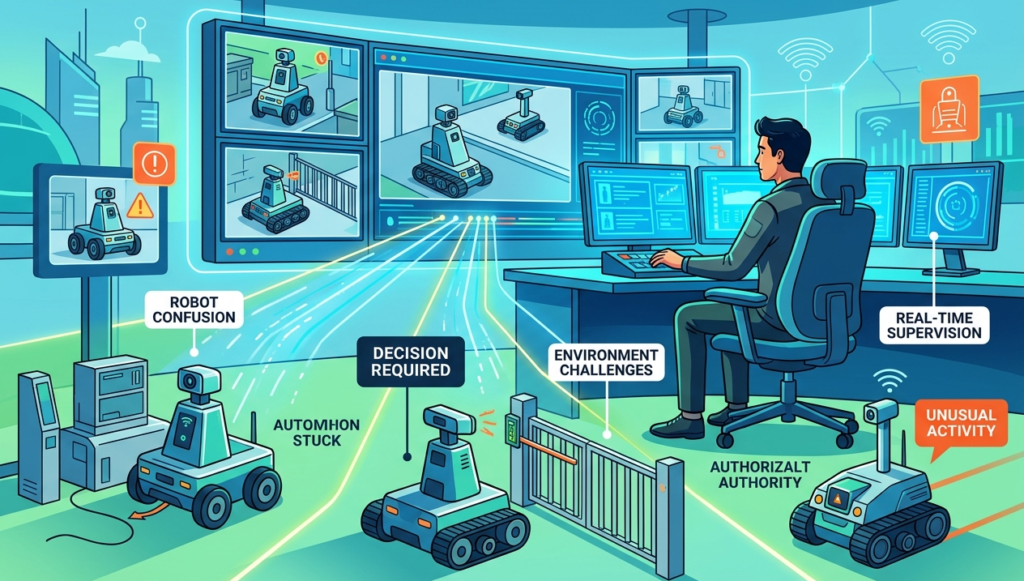

Security patrol robots are becoming increasingly common in commercial buildings, warehouses, campuses, airports, hospitals, and public facilities. Businesses are adopting robotic security systems to improve surveillance coverage, automate routine patrols, and strengthen operational efficiency.
These autonomous robots can monitor environments, detect unusual activity, capture video footage, and support security teams around the clock. However, despite advances in artificial intelligence and automation, security robots still require human oversight to operate effectively in real-world environments.
This is why many organizations are integrating robot teleoperation and robot monitoring services into their security operations to combine automation with real-time human decision-making.
🤖 The Growing Role of Security Patrol Robots
Security patrol robots help organizations automate repetitive surveillance tasks while improving visibility across large facilities and commercial spaces.
Common functions of security robots include:
- Monitoring parking lots and entrances
- Conducting routine patrols
- Capturing real-time video footage
- Detecting unusual activity or movement
- Supporting access control monitoring
- Providing alerts during operational incidents
These systems help businesses strengthen security operations while reducing the need for constant manual patrols.
⚠️ Why Autonomous Security Robots Still Need Human Support
Although security robots are highly effective for monitoring and surveillance, real-world environments are unpredictable. Autonomous systems may encounter situations that require human judgment, contextual understanding, and immediate decision-making.
Some common operational challenges include:
- Unexpected obstacles or navigation issues
- Crowded or changing environments
- False alarms and sensor inaccuracies
- Complex security incidents
- Human interaction and emergency response situations
Without human oversight, these situations can create operational risks and reduce overall security effectiveness.
Human monitoring support helps ensure that robotic systems can respond more reliably to real-world conditions.
⚙️ How Human Monitoring Improves Security Robot Operations
Remote operators monitor security robots through centralized control systems using:
- Live camera feeds
- Sensor data and alerts
- GPS tracking systems
- Operational dashboards
- Two-way communication platforms
This human-in-the-loop approach allows operators to:
- Review alerts and suspicious activity in real time
- Assist robots with navigation challenges
- Respond quickly to operational incidents
- Reduce false alarms and monitoring errors
- Maintain continuous surveillance coverage
Instead of replacing security personnel, robot monitoring services enhance overall operational visibility and support faster response coordination.
Businesses looking to improve automation and operational efficiency often also explore scalable support solutions available through the OBI Services homepage.
📊 Benefits of Human-Supported Security Robotics
Combining robotics with human monitoring provides several advantages for businesses and commercial facilities.
✅ Improved Security Coverage
Robots can patrol continuously while operators monitor multiple systems simultaneously.
✅ Faster Incident Response
Remote monitoring teams can respond quickly to alerts and suspicious activity.
✅ Reduced Operational Downtime
Human support helps resolve technical or navigation issues before they affect operations.
✅ Better Situational Awareness
Operators provide contextual judgment that autonomous systems may not fully understand.
✅ Scalable Security Operations
Businesses can manage larger robotic security deployments more efficiently through centralized monitoring.
🏢 Industries Using Security Patrol Robots
Many industries are now integrating robotic security systems into daily operations.
Commercial Buildings
Security robots monitor entrances, parking areas, and shared facilities.
Warehouses & Logistics Centers
Robots support perimeter patrols and operational monitoring across large facilities.
Healthcare Facilities
Hospitals use security robots to improve surveillance coverage and operational safety.
Airports & Transportation Hubs
Autonomous patrol systems help monitor high-traffic public environments.
Educational Campuses
Universities and campuses deploy robotic patrol systems to strengthen security operations.
In each case, combining automation with human oversight improves reliability and operational safety.
For more insights into robotics, automation, and operational support solutions, businesses can explore this related industry blog.
🚀 The Future of Security Robotics
The future of security automation is not about removing human involvement—it is about improving surveillance operations through smarter collaboration between robotics and human expertise.
As security technologies continue evolving, businesses that integrate human-in-the-loop monitoring systems will be better positioned to:
- Improve operational security
- Reduce monitoring risks
- Scale surveillance operations efficiently
- Maintain better incident response capabilities
- Adapt to increasingly complex environments
Security patrol robots will continue transforming modern surveillance operations, but their long-term success will depend on combining autonomous technology with real-time human monitoring support.