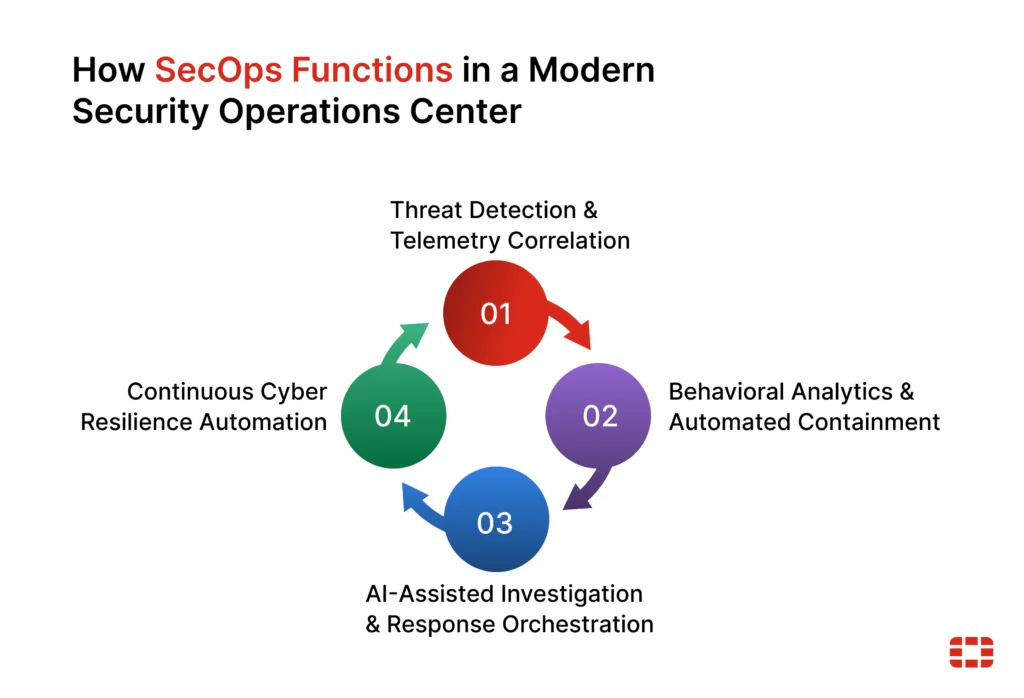

Security operations is often evaluated in operational terms: how fast threats are detected, how quickly incidents are contained, and what the alert-to-true-positive ratio looks like. These metrics matter, but they capture only part of what a mature SecOps function delivers. The most significant benefits of a well-built security operations program extend beyond the SOC floor to the organization’s risk posture, regulatory standing, culture, cost structure, and ability to sustain security investment over time. Understanding these broader organizational benefits helps security leaders make the case for SecOps investment and helps business leaders understand what they are actually funding.
A Unified View of Organizational Risk
One of the most consequential benefits of mature security operations is the creation of a unified, real-time view of the organization’s security risk posture. In organizations without a mature SecOps function, risk information is fragmented across tools, teams, and reporting cycles. Vulnerability data sits in one system. Incident data sits in another. Identity and access anomalies are tracked separately. No one has a consolidated picture of the organization’s actual exposure at any given moment.
A mature SecOps program aggregates this information into a coherent operational risk picture. Asset inventory, known vulnerability status, active monitoring alerts, open incidents, and threat intelligence are visible in a single operational context. This unified view enables better decision-making at every level; security teams can prioritize based on actual risk rather than the loudest alarm, and senior leadership can understand organizational exposure without waiting for periodic reports that are outdated by the time they are delivered.
Understanding SecOps benefits for faster detection as only one dimension of what SecOps delivers understates the broader organizational value the function provides when it is built to maturity.
Enabling Regulatory Compliance as an Operational Byproduct
Regulatory compliance requirements for enterprise security programs have grown significantly in recent years, and non-compliance carries increasing consequences. In the United States, the SEC’s cybersecurity incident disclosure rules, which require public companies to disclose material cybersecurity incidents within four business days of determining materiality and to provide annual disclosures covering cybersecurity risk management, strategy, and governance, have made security operations program documentation a fiduciary concern rather than purely an IT matter. Guidance on how organizations should structure their security programs and documentation processes to meet SEC filing requirements is covered in detail in reporting on SEC cyber disclosure rules, which outline the specific obligations under both 8-K incident disclosures and 10-K annual cybersecurity program reporting.
A mature SecOps program generates the evidence base required for compliance as a natural output of its operations. Incident logs, detection timelines, response documentation, access control records, and vulnerability management histories are all byproducts of a functioning SecOps program. Organizations that build SecOps correctly do not need to conduct separate compliance evidence-gathering exercises; the evidence exists because the program is running. This integration of compliance into operational practice reduces the cost and burden of regulatory compliance and eliminates the risk of gaps between what the program actually does and what is reported to regulators.
Reducing Total Cost of Security Ownership
Security programs that lack operational coherence incur costs that are difficult to see until they are examined carefully. Tool sprawl is a major driver: organizations with many separately purchased security products pay licensing costs for tools that overlap in capability, require separate management overhead, produce separate data formats that must be reconciled, and demand separate training for the analysts who use them. The integration work required to enable these tools to share data meaningfully is itself a significant ongoing cost.
Mature SecOps programs rationalize this through deliberate tool consolidation, integrating telemetry from multiple sources into a unified detection and response platform and eliminating redundant tools that deliver marginal additional coverage relative to their cost. When fewer tools share more data and are managed through a common workflow, the per-analyst capacity to monitor and respond increases, which means the same security outcome can be achieved with less headcount or better outcomes with the same number of personnel.
The reduction in incident costs is a second major TCO benefit. Organizations with faster detection and response capabilities experience lower total incident costs because smaller blast radii, shorter recovery periods, and less data exfiltrated translate directly into lower direct costs and lower reputational exposure. The financial benefit of shortening mean time to detect and respond is not a theoretical calculation; it is a real reduction in the cost of the incidents that do occur.
Strengthening the Organization’s Insurance Position
Cyber insurance has become an important financial risk management tool for enterprises, and insurers have become considerably more rigorous in evaluating the security programs of organizations seeking coverage. Organizations that can demonstrate mature security operations programs documented detection capabilities, defined and tested incident response plans, evidence of continuous monitoring and vulnerability management are in a materially better position in insurance underwriting than those that cannot.
In practical terms, this means that SecOps maturity affects the cost, coverage terms, and availability of cyber insurance. Organizations with strong operational evidence of security program maturity can access better coverage at better premiums. Organizations that cannot demonstrate this maturity face higher premiums, coverage exclusions, or difficulty obtaining coverage at all. The SEC’s clarifications on cyber incident disclosure obligations, including the requirement to document formal cybersecurity risk management processes and provide evidence that risks are regularly presented to the board, also directly inform how insurers evaluate organizational security governance, as detailed in coverage of cyber incident reporting requirements under the current regulatory framework. A SecOps program that generates the right documentation as part of normal operations supports both regulatory and insurance standing simultaneously.
Building a Security-Aware Organizational Culture
Security operations do not operate in isolation. Its effectiveness depends on the behavior of the broader organization’s employees who report suspicious activity, IT teams who communicate changes that affect the security monitoring environment, and business units who involve security teams in new technology decisions before deployment. A mature SecOps program builds these relationships over time through consistent, professional engagement with the rest of the organization.
When security operations function well, they become visible to the rest of the organization as a service rather than a gatekeeper. Employees who report phishing attempts receive prompt acknowledgment and feedback. IT teams that flag anomalous network behavior find that SecOps acts on that information. Business units that consult the security team before procuring new software find the process efficient rather than obstructive. Over time, this consistent positive experience builds an organizational security culture, a genuine integration of security awareness into how people across the enterprise work, rather than a compliance exercise that sits on top of their actual workflow.
This cultural benefit is difficult to quantify directly but has measurable security outcomes. Organizations with a strong security culture detect more threats earlier, because more people are alert to suspicious indicators. They experience fewer successful phishing and social engineering attacks. And they have less shadow IT, because employees are more likely to involve the security team in technology decisions when that involvement has historically been constructive rather than obstructive.
Providing a Platform for Continuous Security Improvement
Perhaps the most durable benefit of a mature SecOps program is structural: it creates the operational infrastructure for continuous security improvement. Organizations without mature SecOps react to individual incidents and audit findings in isolation. Organizations with mature SecOps have a continuous feedback loop every incident produces lessons that improve detection rules, response playbooks, and vulnerability prioritization. Every threat hunting activity produces either a finding that improves detection coverage or a confirmation that existing coverage is working. Every tabletop exercise surfaces gaps in coordination or process that can be addressed before they become real incident liabilities.
This compounding improvement is what makes the long-term return on investment in SecOps disproportionate to the initial cost. The program built in year one is materially more capable than the program running in year three, not because more money has been spent, but because the operational infrastructure for learning and improving is functioning. Each cycle of detection, response, and review makes the next cycle faster and more effective.
Frequently Asked Questions
How does a mature SecOps program support merger and acquisition due diligence?
When an organization is being evaluated as an acquisition target, acquirers increasingly conduct cybersecurity due diligence that examines the target’s security program maturity, incident history, and control documentation. A target organization with a mature SecOps program can provide clear, documented evidence of its detection capabilities, incident response history, vulnerability management practices, and compliance posture. This accelerates due diligence, reduces uncertainty about inherited risk, and can positively affect valuation. Organizations without mature SecOps often cannot produce this evidence, creating uncertainty that the acquirer prices into the deal.
What is the relationship between SecOps maturity and cyber insurance premiums?
Insurers evaluate the security program maturity of applicants as part of underwriting, using questionnaires, documentation reviews, and in some cases technical assessments to determine how well an organization can detect, respond to, and recover from a cyber incident. Organizations that can demonstrate mature SecOps capabilities documented detection coverage, tested incident response plans, evidence of continuous monitoring typically receive better coverage terms and premiums than those that cannot. As the insurance market has tightened, the documentation of SecOps maturity has become a practical prerequisite for obtaining meaningful coverage.
How does SecOps contribute to business continuity planning?
SecOps contributes to business continuity by ensuring that incidents are detected and contained before they can cause the scale of operational disruption that would trigger business continuity responses. It also contributes through the incident response planning process itself, which forces the organization to identify critical systems, define recovery priorities, and establish the communication and coordination protocols that business continuity plans require. A mature SecOps program and a mature business continuity program share foundational elements and reinforce each other.