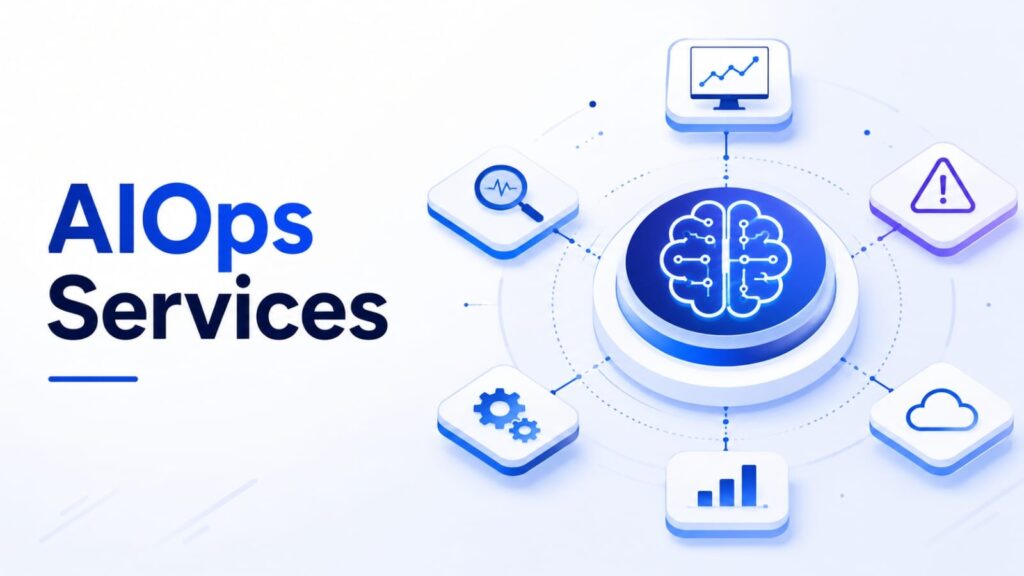

Modern businesses rely heavily on digital infrastructure, cloud environments, and enterprise applications to maintain operations and deliver seamless customer experiences. As IT ecosystems become increasingly complex, traditional monitoring and operations management approaches struggle to keep up with the growing volume of data, alerts, and system dependencies. This is where AIOps Services are changing the future of IT operations.
AIOps, or Artificial Intelligence for IT Operations, combines artificial intelligence, machine learning, data analytics, and automation to optimize and automate IT management processes. Instead of relying solely on manual monitoring and reactive problem-solving, organizations can now leverage intelligent systems that detect anomalies, predict issues, automate workflows, and improve overall operational efficiency.
Businesses adopting AIOps services gain faster incident resolution, reduced downtime, proactive monitoring, and improved scalability. As digital transformation accelerates, AIOps is becoming an essential component of modern enterprise IT strategies.
What are AIOps Services?
AIOps services involve implementing AI-powered technologies and automation tools to streamline and enhance IT operations. These services analyze massive volumes of operational data generated by applications, servers, networks, cloud platforms, and infrastructure systems.
By using machine learning algorithms and advanced analytics, AIOps platforms can identify patterns, detect anomalies, correlate events, and automate responses in real time. This helps IT teams reduce manual workloads and focus on strategic initiatives instead of repetitive operational tasks.
AIOps services are commonly used for:
- Infrastructure monitoring
- Incident management
- Performance optimization
- Log analysis
- Cloud operations
- Security monitoring
- Automated remediation
These services enable organizations to build intelligent, self-healing IT environments.
Why Do Businesses Need AIOps Services?
Modern IT environments are more distributed and dynamic than ever before. Cloud computing, microservices, remote work, and hybrid infrastructures generate enormous amounts of operational data every second. Traditional monitoring tools often generate excessive alerts without meaningful context, making it difficult for IT teams to quickly identify critical issues.
AIOps services address these challenges by introducing intelligent automation and predictive capabilities into IT operations.
-
Managing Increasing IT Complexity
As organizations scale their digital infrastructure, managing interconnected systems manually becomes inefficient. AIOps platforms centralize monitoring and provide unified visibility across all environments. This improves operational control and simplifies infrastructure management.
-
Reducing Downtime and Service Disruptions
Unexpected outages can lead to financial losses and poor customer experiences. AIOps solutions detect anomalies early and automate incident responses before issues escalate. Proactive monitoring reduces downtime and improves service reliability.
-
Improving Operational Efficiency
IT teams often spend significant time handling repetitive tasks and investigating alerts. AIOps automates these workflows, reducing manual effort and improving productivity. Automation enables teams to focus on innovation and strategic planning.
-
Enhancing Decision-Making with Data Insights
AIOps platforms analyze operational data and provide actionable insights for infrastructure optimization and performance improvement. These insights help organizations make informed technology decisions.
Core Components of AIOps Services
AIOps services combine multiple technologies and operational practices to create intelligent IT ecosystems. By integrating artificial intelligence with IT operations, organizations can automate repetitive tasks, improve incident response, and enhance overall system reliability. These platforms help businesses manage complex digital environments more efficiently while reducing operational costs and downtime.
-
AI-Powered Monitoring and Observability
AI-powered monitoring and observability provide organizations with continuous insights into the health and performance of their IT infrastructure. These capabilities enable faster issue detection, better operational visibility, and smarter decision-making across hybrid and cloud-native environments. By leveraging automation and machine learning, AIOps platforms can quickly process massive volumes of operational data.
-
Real-Time Infrastructure Monitoring
AIOps platforms continuously monitor servers, applications, databases, and networks in real time. They collect and analyze operational metrics to identify performance issues and anomalies instantly.
Real-time visibility helps IT teams maintain system health and ensure uninterrupted operations.
These monitoring systems can automatically detect unusual behavior and generate alerts before issues escalate into critical failures. Continuous tracking of infrastructure performance also enables organizations to optimize resource utilization and improve service availability. Automated dashboards and intelligent reporting further help teams make informed operational decisions quickly.
-
Advanced Observability Across Systems
Observability goes beyond traditional monitoring by providing deeper insights into system behavior. AIOps tools analyze logs, traces, events, and metrics together to understand root causes effectively.
This comprehensive approach improves troubleshooting and system optimization.
Advanced observability enables IT teams to gain end-to-end visibility across distributed applications and cloud environments. Correlating data from multiple sources helps identify hidden dependencies and performance bottlenecks more accurately. As a result, organizations can accelerate problem resolution and enhance the overall user experience.
-
Predictive Performance Analysis
Machine learning models identify patterns and predict potential failures before they occur. Predictive analytics enables proactive maintenance and reduces unexpected disruptions.
Organizations can address issues before they impact users or business operations.
Predictive performance analysis helps businesses minimize downtime by forecasting capacity constraints, hardware failures, and application slowdowns in advance. AI-driven insights allow IT teams to prioritize preventive actions and allocate resources more effectively. This proactive strategy improves operational stability, service reliability, and long-term infrastructure planning.
Intelligent Incident Management
Intelligent incident management enables organizations to detect, analyze, and resolve IT issues more efficiently using AI and automation. AIOps platforms reduce operational complexity by streamlining incident workflows and improving response accuracy. These capabilities help IT teams maintain service continuity and deliver better user experiences.
-
Automated Alert Correlation
Traditional systems generate thousands of alerts, making it difficult to identify critical incidents. AIOps platforms correlate related alerts and group them into meaningful incidents.
This reduces alert fatigue and improves incident response efficiency.
By filtering duplicate and low-priority alerts, AIOps tools help IT teams focus on the most impactful issues. Intelligent correlation engines analyze patterns across systems to identify relationships between events in real time. This leads to faster incident detection, improved operational efficiency, and reduced workload for support teams.
-
Root Cause Analysis
AIOps solutions analyze dependencies and historical data to identify the root cause of incidents quickly.
Faster root cause analysis minimizes downtime and accelerates issue resolution.
Advanced analytics and machine learning algorithms help uncover hidden relationships between infrastructure components and application services. This enables IT teams to diagnose complex problems with greater accuracy and speed. Effective root cause analysis also prevents recurring incidents and improves long-term system stability.
-
Automated Incident Response
Many AIOps platforms can trigger automated remediation workflows when issues are detected.
Automation reduces manual intervention and ensures faster recovery times.
Automated incident response helps organizations resolve common operational problems without requiring constant human involvement. Predefined workflows can restart services, allocate resources, or isolate affected systems instantly when anomalies occur. This improves service reliability, shortens mean time to resolution (MTTR), and enhances overall operational resilience.
Machine Learning and Predictive Analytics
Machine learning and predictive analytics are at the core of modern AIOps platforms, enabling intelligent decision-making and proactive IT operations. These technologies help organizations identify trends, detect risks, and optimize system performance using data-driven insights. By continuously analyzing operational data, AIOps solutions improve accuracy, efficiency, and business continuity.
-
Anomaly Detection
Machine learning algorithms identify unusual system behavior that may indicate performance issues or security threats.
Early anomaly detection improves operational resilience.
AIOps platforms use advanced analytics to detect deviations from normal system behavior in real time. These intelligent systems can identify hidden issues that traditional monitoring tools may overlook. Early detection enables IT teams to take corrective actions quickly, reducing downtime and minimizing the impact of operational disruptions or cyber threats.
-
Capacity Planning and Forecasting
AIOps platforms analyze resource usage trends and predict future infrastructure requirements.
This helps organizations optimize resource allocation and avoid performance bottlenecks.
Predictive forecasting allows businesses to prepare for future workloads and infrastructure demands more effectively. By analyzing historical data and usage patterns, AIOps tools can recommend scaling strategies and capacity upgrades before issues arise. This proactive planning improves system performance, reduces operational costs, and supports business growth.
-
Continuous Learning and Optimization
AIOps systems continuously learn from operational data and improve their recommendations over time. This adaptive intelligence enhances long-term operational efficiency.
Continuous learning enables AIOps platforms to refine their algorithms and deliver more accurate insights with every interaction. As systems evolve, machine learning models adapt to changing environments, user behaviors, and workload patterns. This ongoing optimization improves automation accuracy, strengthens IT operations, and supports smarter decision-making across the organization.
Cloud and Hybrid Infrastructure Management
Cloud and hybrid infrastructure management enables organizations to efficiently monitor, manage, and optimize complex IT environments across on-premises systems and multiple cloud platforms. AIOps services provide centralized control, intelligent automation, and real-time visibility to ensure seamless operations. These capabilities help businesses improve scalability, reduce operational complexity, and maintain high system performance.
-
Multi-Cloud Environment Monitoring
Organizations often use multiple cloud providers and hybrid infrastructures. AIOps services provide centralized visibility across all environments.
Unified monitoring simplifies cloud operations and improves scalability.
AIOps platforms aggregate data from public clouds, private clouds, and on-premises infrastructure into a single operational view. This centralized monitoring helps IT teams detect issues faster and maintain consistent performance across distributed environments. Improved visibility also supports better governance, compliance management, and operational efficiency.
-
Container and Kubernetes Monitoring
Modern applications frequently run in containers and Kubernetes clusters. AIOps platforms monitor these environments to ensure performance and reliability.
This supports efficient cloud-native application management.
Containerized applications generate highly dynamic workloads that require continuous monitoring and intelligent analysis. AIOps tools track container health, resource utilization, and orchestration performance in real time. This enables organizations to maintain application stability, accelerate deployments, and improve the reliability of cloud-native services.
-
Dynamic Resource Optimization
AIOps solutions automatically optimize cloud resources based on workload demands.
Dynamic scaling improves cost efficiency and application performance.
Intelligent resource optimization helps organizations allocate computing power, storage, and network resources more effectively. AIOps platforms use predictive analytics and automation to scale infrastructure up or down according to real-time usage patterns. This reduces unnecessary cloud spending while ensuring applications maintain optimal performance during peak workloads.
Security and Compliance Automation
Security and compliance automation helps organizations strengthen cybersecurity defenses while ensuring adherence to industry regulations and standards. AIOps platforms use artificial intelligence, automation, and real-time analytics to detect threats, monitor compliance, and respond to security incidents efficiently. These capabilities reduce operational risks, improve governance, and enhance overall system protection.
-
Threat Detection and Security Monitoring
AIOps platforms analyze logs and network behavior to identify suspicious activities and security threats. Proactive threat detection strengthens cybersecurity defenses.
Advanced machine learning algorithms continuously monitor user behavior, network traffic, and system events to detect anomalies in real time. This enables organizations to identify potential cyberattacks, unauthorized access, and malicious activities before they escalate into major incidents. Continuous security monitoring also improves visibility across complex IT environments and supports faster threat mitigation.
-
Compliance Monitoring
Organizations operating in regulated industries must maintain compliance with standards such as GDPR, HIPAA, and PCI-DSS. AIOps solutions automate compliance checks and reporting processes.
Automated compliance monitoring helps businesses track regulatory requirements and maintain accurate audit records with minimal manual effort. AIOps platforms can continuously assess system configurations, security policies, and operational practices to identify compliance gaps. This reduces the risk of penalties, improves governance, and ensures organizations remain aligned with industry standards.
-
Automated Security Responses
Some AIOps systems can automatically isolate affected systems or trigger predefined security workflows during incidents. This reduces response time and minimizes damage.
Automated security response capabilities allow organizations to contain threats quickly without waiting for manual intervention. AIOps platforms can execute predefined remediation actions such as blocking malicious traffic, quarantining compromised devices, or initiating incident response protocols instantly. Faster response times help minimize operational disruption, protect sensitive data, and strengthen overall cybersecurity resilience.
Benefits of AIOps Services for Enterprises
Businesses implementing AIOps services gain major operational and business advantages. These platforms improve IT efficiency through automation, real-time analytics, and intelligent monitoring. AIOps also helps organizations maintain reliable and scalable digital operations.
-
Faster Issue Detection and Resolution
AI-powered monitoring and automation enable rapid identification and remediation of incidents.
This minimizes downtime and improves service reliability.
AIOps tools detect performance issues in real time and help IT teams resolve problems quickly. Faster incident response improves system availability and reduces business disruptions.
-
Improved IT Team Productivity
Automation reduces repetitive operational tasks, allowing IT teams to focus on strategic initiatives and innovation.
By automating routine processes such as monitoring and alert management, AIOps reduces manual workload. This allows IT teams to focus on innovation and business-critical tasks.
-
Reduced Operational Costs
Efficient resource management and automated workflows lower infrastructure and maintenance costs.
AIOps platforms optimize resource usage and reduce unnecessary operational expenses. Predictive maintenance and automation also help minimize downtime and support costs.
-
Enhanced User Experience
Stable and high-performing systems deliver better experiences for customers and employees.
Proactive monitoring and performance optimization ensure smooth digital experiences with fewer service interruptions. This improves customer satisfaction and employee productivity.
-
Scalability for Growing Businesses
AIOps solutions support dynamic and scalable IT environments, making them ideal for enterprises undergoing digital transformation.
These platforms help organizations manage growing infrastructures efficiently across cloud and hybrid environments. Intelligent automation supports scalability without increasing operational complexity.
Industries Leveraging AIOps Services
AIOps is transforming operations across multiple industries by improving system reliability, automation, and operational efficiency. Organizations use AIOps to manage complex IT environments, reduce downtime, and enhance customer experiences.
-
Healthcare
Healthcare organizations use AIOps to monitor critical systems, ensure uptime, and maintain compliance.
AIOps helps hospitals and healthcare providers maintain reliable access to patient records, medical applications, and connected devices. It also supports regulatory compliance and improves operational efficiency.
-
Finance and Banking
Financial institutions leverage AIOps for fraud detection, infrastructure monitoring, and secure transaction processing.
AIOps enables banks to detect unusual activities, maintain secure digital transactions, and ensure high system availability. This improves customer trust and operational security.
-
Retail and E-Commerce
Retail businesses use AIOps to optimize digital platforms and improve customer experiences during high traffic periods.
By monitoring applications and infrastructure in real time, AIOps helps retailers prevent downtime and maintain fast website performance during peak shopping seasons.
-
Telecommunications
Telecom providers implement AIOps for network optimization and service reliability.
AIOps platforms help telecom companies monitor large-scale networks, detect issues quickly, and improve service quality. This ensures stable connectivity and better customer experiences.
-
Manufacturing
Manufacturers use AIOps to monitor industrial systems and enable predictive maintenance.
Predictive analytics helps manufacturers identify equipment issues before failures occur. This reduces downtime, improves production efficiency, and supports smarter factory operations.
How Moon Technolabs Delivers Advanced AIOps Services?
Moon Technolabs provides intelligent AIOps services designed to help businesses modernize IT operations and improve infrastructure efficiency. With expertise in AI, cloud computing, DevOps, and enterprise software development, the company delivers scalable and automated operational solutions.
Their AIOps capabilities include:
- AI-powered infrastructure monitoring
- Intelligent incident management
- Cloud and hybrid environment optimization
- Predictive analytics and automation
- Security monitoring and compliance solutions
- DevOps and CI/CD integration
Moon Technolabs helps organizations build resilient, self-healing IT ecosystems that support long-term digital growth.
Conclusion
AIOps services are redefining IT operations by combining artificial intelligence, automation, and analytics into a unified operational strategy. By enabling proactive monitoring, intelligent incident management, and automated remediation, AIOps helps businesses reduce downtime, improve efficiency, and optimize infrastructure performance.
As digital ecosystems continue to grow in complexity, organizations need intelligent operational frameworks that can adapt and scale effectively. Partnering with experienced providers like Moon Technolabs ensures successful AIOps implementation and long-term operational success.