
Battery manufacturing has become one of the more demanding environments in modern industrial production. The chemistry involved is sensitive, the tolerances are tight, and the consequences of contamination — whether from particulates, moisture, or airborne debris — can compromise cell performance in ways that are not always visible during production but become apparent downstream. As more manufacturers scale up capacity for lithium-ion cells, solid-state batteries, and related electrochemical storage products, the question of environmental control has moved from a secondary concern to a central engineering decision.
One of the most consequential choices a facility planner or operations leader faces is which ISO classification to design toward. ISO Class 6 and ISO Class 7 are the two standards most commonly referenced in battery manufacturing contexts, and while both represent controlled environments by any general standard, they are not interchangeable. The difference between them affects construction cost, operational overhead, maintenance requirements, and ultimately the type of production process each environment can reliably support.
Understanding that difference — not in abstract specification terms, but in terms of real production risk and operational practicality — is where the decision-making process should begin.
What ISO Classification Actually Means in a Production Context
ISO classifications for controlled environments are defined under the internationally recognized standard ISO 14644-1, which establishes airborne particulate cleanliness classes for clean rooms and clean zones. Each class defines the maximum allowable concentration of particles at specific sizes per cubic meter of air. As the class number decreases, the allowable particle count decreases, meaning a Class 6 room is cleaner than a Class 7 room and requires more rigorous air handling, filtration, and environmental controls to maintain that standard.
For those evaluating clean rooms for battery manufacturers, the classification is not just a regulatory checkbox — it is a direct reflection of how well the production environment can be controlled against the specific contamination risks that affect battery quality. Moisture, metallic particles, and fine dust are among the most damaging contaminants in electrode coating, cell assembly, and electrolyte filling operations. The classification level determines how aggressively the facility can manage these risks on a continuous basis.
It is worth noting that ISO classification alone does not define a complete clean room solution. Temperature, humidity, and pressure differentials are also controlled variables in battery manufacturing environments, and they interact with the particulate classification in ways that affect both equipment selection and operational protocols. The ISO class sets the particulate standard, but the full environmental specification extends beyond it.
The Role of Air Changes and Filtration in Maintaining Class Standards
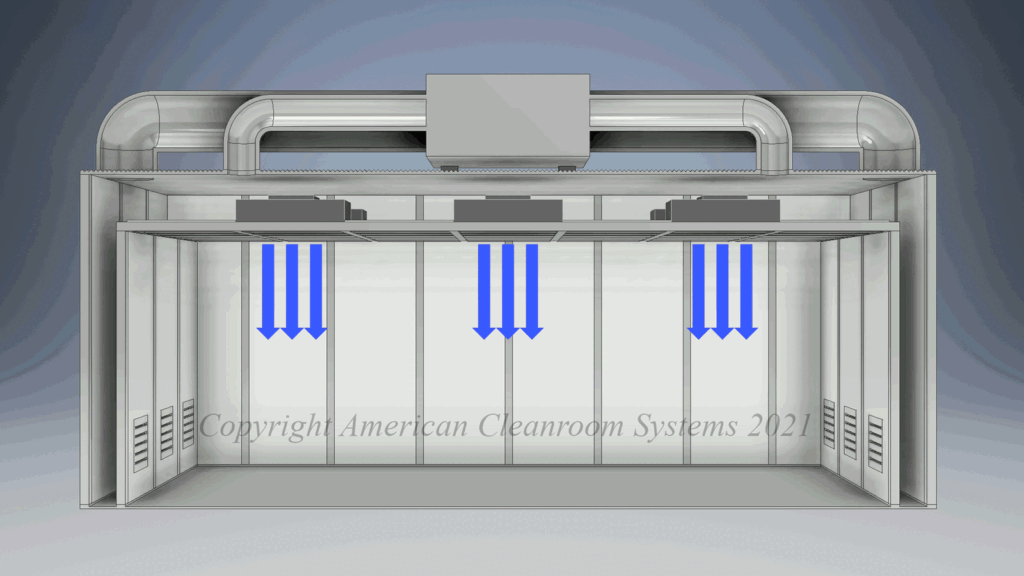
One of the most practical distinctions between ISO Class 6 and Class 7 is the air change rate — how frequently the volume of air within the room is replaced and filtered. Higher cleanliness classes require more frequent air changes, which means more powerful air handling systems, more high-efficiency particulate filters, and more energy consumption to sustain operations continuously.
In a Class 7 environment, the air change rate is lower than in a Class 6 environment, which means the filtration infrastructure can be less intensive and the associated mechanical systems are somewhat less complex. For manufacturers whose processes can tolerate a slightly higher particulate threshold, this translates into lower capital investment in HVAC design and lower ongoing energy costs. However, it also means that any disruption to the air handling system — a filter failure, a door seal issue, or a sudden production surge — can push the environment out of compliance more quickly than in a Class 6 room, because the margin for error is smaller in relative terms.
In a Class 6 environment, the tighter particulate control requires a more robust and redundant air management system. The benefit is a more stable baseline that can absorb minor operational variations without compromising the environment. For processes that involve ultra-thin electrode coatings or precision cell assembly where even small contamination events affect yield rates, this stability has direct value.
Where ISO Class 7 Is Appropriate for Battery Production
ISO Class 7 is not a compromise or a lesser standard in absolute terms. For a significant portion of battery manufacturing operations, it represents the correct level of environmental control without unnecessary overhead. The key is matching the class to the sensitivity of the specific process being performed in that space.
Battery manufacturing facilities are not monolithic environments. Different stages of production carry different contamination risks. Incoming material handling, component staging, and certain types of module assembly work operate at lower contamination risk than electrode coating or electrolyte handling. Designing every area of a facility to Class 6 specifications when only a subset of operations require that level of control adds cost and complexity without proportionate benefit.
Applications Where Class 7 Performs Adequately
In practice, Class 7 environments are well-suited to battery manufacturing operations that involve:
- Cell module assembly where components are already sealed and the primary contamination risk comes from general airborne debris rather than fine particulates
- Quality inspection and testing areas where finished or semi-finished cells are evaluated but not exposed to sensitive chemical processes
- Certain packaging and labeling operations where products are enclosed and the controlled environment exists primarily to protect personnel and maintain general cleanliness standards
- Support and staging zones adjacent to higher-class areas, where controlled entry conditions are needed but full Class 6 control is not required
The economic argument for Class 7 in these zones is straightforward. The infrastructure costs less to build, costs less to operate, and is easier to maintain at the required standard over time. For a large-scale facility where different zones serve different functions, a tiered approach — Class 6 in the most sensitive areas, Class 7 elsewhere — often represents the most defensible engineering decision.
Where ISO Class 6 Becomes Necessary
The case for ISO Class 6 is most compelling when the production process involves direct exposure of sensitive materials to the room environment for extended periods. In battery manufacturing, this is most clearly the case during electrode coating, where the active material is applied to foil substrates in a state that makes it susceptible to contamination before it is dried, compressed, and sealed into a cell structure.
Electrolyte filling operations present a similar case. Liquid electrolytes are highly reactive with moisture, and even brief exposure to an environment with elevated humidity or particulate contamination can affect the electrochemical properties of the final cell. While moisture control is technically a separate parameter from ISO particulate classification, the two are often managed together in Class 6 environments because the air handling systems designed for tighter particulate control also support more precise humidity regulation.
Yield Rates and Long-Term Quality Consistency
The financial case for Class 6 in sensitive process areas is often made most clearly through yield data rather than upfront cost comparisons. When contamination events occur during electrode preparation or cell assembly, the impact is rarely contained to a single unit. In high-volume production, a contamination event that affects a batch of electrodes or a run of cells represents a loss that can be difficult to quantify in advance but becomes very apparent in finished product quality audits, warranty claims, and customer returns.
Class 6 environments reduce the frequency of these events by maintaining tighter control over the airborne particulate environment on a continuous basis. The investment in higher-specification air handling, more frequent filter replacement, and more rigorous commissioning and qualification processes pays back over time through improved yield consistency and reduced rework rates. For manufacturers competing on cell performance and reliability, this consistency has strategic value beyond the production floor.
Commissioning and Ongoing Validation Requirements
One practical consideration that often receives less attention during the planning phase is the difference in commissioning and ongoing validation requirements between Class 6 and Class 7 environments. A Class 6 room requires more rigorous initial qualification testing to demonstrate that the environment consistently meets the required particulate standard under operational conditions, not just at rest. It also requires more frequent revalidation intervals and more detailed monitoring protocols during production.
These requirements are not burdensome for manufacturers who plan for them from the outset, but they do affect staffing, scheduling, and the documentation systems needed to maintain regulatory compliance. Facilities that underestimate this operational dimension sometimes find that the ongoing cost of maintaining a Class 6 environment is higher than anticipated, not because the technical systems are inadequate, but because the human and procedural infrastructure was not designed to match the standard.
Making the Decision Based on Process, Not Precedent
The most reliable way to determine whether a given production area needs ISO Class 6 or Class 7 is to work backward from the process, not forward from industry norms or what neighboring facilities have built. Different battery chemistries, different cell formats, and different production scales all carry different contamination sensitivity profiles. A decision made on the basis of what a comparable facility uses may not be appropriate for a different process architecture or a different product specification.
The starting point should be a detailed process review that identifies which stages of production involve open exposure of sensitive materials, what the contamination sensitivity of those materials is under realistic operating conditions, and what the cost of a contamination event would be at each stage. From that analysis, the appropriate classification for each zone in the facility can be determined on a defensible technical basis rather than by default.
It is also worth engaging with HVAC and clean room engineering specialists who have direct experience in battery manufacturing environments, since the interaction between particulate control, humidity management, and chemical safety requirements creates design considerations that are specific to this industry and not always covered by general clean room design guidance.
Conclusion
The choice between ISO Class 6 and ISO Class 7 in a battery manufacturing facility is not a question with a universal answer. Both classifications serve legitimate purposes, and the right answer depends on which processes are being performed, how sensitive those processes are to contamination, and what the operational and financial consequences of a contamination event would be.
What is clear is that the decision carries long-term consequences. The classification standard shapes the mechanical infrastructure, the commissioning requirements, the ongoing operational cost, and the yield performance of the facility over its entire production life. Treating it as a secondary specification or deferring it to late-stage design is a risk that tends to create problems that are expensive to correct after construction.
Approaching this decision with the same rigor applied to process engineering and equipment selection is not excessive — it is appropriate given what is at stake. For manufacturers who are early in the facility planning process, the time invested in getting this decision right is time well spent.