
Introduction
LNG terminals operate in one of the most demanding industrial environments. They handle liquefied natural gas at extremely low temperatures, manage high-value assets across large outdoor sites, and work around areas where flammable gas may be present. For HSE, security, and operations teams, visibility is not simply a convenience. It is a critical part of safe terminal management.
A typical LNG terminal includes storage tanks, loading arms, jetty areas, vapour handling systems, pipe racks, compressor zones, control rooms, road tanker bays, and long perimeter boundaries. Many of these areas are exposed to harsh weather, low-light conditions, restricted access, and potential hazardous atmospheres. This is why explosion proof PTZ cameras have become an important part of modern monitoring strategies.
Unlike fixed cameras, PTZ cameras can pan, tilt, and zoom to follow activity across wide areas. When designed for hazardous locations, they provide visibility without introducing unsuitable electrical equipment into classified zones.
The Monitoring Challenge at LNG Terminals
In a real-world LNG terminal environment, the challenge is rarely limited to one blind spot. The issue is usually the scale and complexity of the site. A single control room team may need to observe movement across the jetty, monitor tanker loading, check restricted areas, follow maintenance work, and respond to alarms from gas detection or access control systems.
Fixed CCTV may cover entry gates, buildings, and selected process points, but it often struggles to deliver flexible visibility across large hazardous zones. If an operator needs to inspect unusual activity near a loading bay, confirm whether a vehicle has entered a restricted route, or zoom in on a pipeline area after an alarm, fixed cameras can be limited.
Explosion proof PTZ cameras solve this gap by giving operators wider situational awareness. A properly positioned PTZ unit can scan a large perimeter section, rotate towards an incident, zoom into a specific asset, and provide visual confirmation before teams are sent into the field.
Why 360° Perimeter Monitoring Matters
The perimeter of an LNG terminal is not only a security boundary. It is also an operational safety zone. It may include vehicle routes, restricted access points, pipe corridors, utility areas, fence lines, emergency exits, and external storage or loading sections.
A 360° monitoring approach helps teams observe the full movement pattern around the site rather than relying on isolated camera views. This is especially important during vessel unloading, road tanker movement, night-time patrols, maintenance shutdowns, adverse weather, gas leak investigations, and unauthorised access attempts.
With PTZ coverage, the control room can quickly shift from general surveillance to close-up inspection. For example, if a motion alert is triggered near the fence line, the camera can rotate to the location and zoom in to verify whether it is an intruder, an animal, a loose object, or an authorised maintenance team.
Where Explosion Proof PTZ Cameras Add the Most Value
LNG terminals do not need explosion proof cameras everywhere. The requirement depends on hazardous area classification, equipment location, and operational risk. However, there are several zones where PTZ cameras often provide strong value.
The jetty is one of the most active and risk-sensitive parts of the terminal. It involves vessel approach, loading arms, hoses, safety barriers, personnel movement, and communication between ship and shore teams. A PTZ camera can provide wide-area monitoring while also zooming in on connection points.
Tank farm perimeters also need continuous awareness. PTZ cameras can monitor access roads, inspection paths, stairways, and nearby process equipment, helping operators check abnormal movement without sending personnel immediately into exposed zones.
Road tanker loading bays are another priority. These areas involve vehicle positioning, hose connection, grounding procedures, and traffic control. Explosion proof PTZ cameras can help control room teams monitor whether loading procedures are being followed.
Pipe racks and valve stations can also be difficult to monitor because of long distances and structural obstructions. PTZ cameras placed at strategic points can help teams check valve access, maintenance work, and activity around critical line sections.
A Practical Case Example
Consider a large LNG import terminal with multiple perimeter sections and a busy loading area. The site already has conventional CCTV at the main gate and admin buildings, but the HSE team identifies gaps around the tank farm boundary, marine jetty approach, and tanker loading zone.
During a safety review, the operations team finds that several alarm events require visual verification before field teams can respond. In some cases, operators cannot confirm whether an alarm relates to a genuine hazard, routine activity, or environmental movement.
The terminal installs ATEX-certified explosion proof PTZ cameras at selected hazardous-area viewpoints. The cameras are positioned to provide overlapping coverage of the tank perimeter, loading bay, and jetty approach. The PTZ function allows operators to maintain a wide patrol view and then zoom in when an alarm, access request, or operational concern occurs.
After implementation, the control room gains better visibility across areas that previously required radio updates or manual confirmation. Security teams can track perimeter activity more effectively. Maintenance supervisors can review restricted work areas before authorising entry. HSE managers can use recorded footage to investigate near misses, improve training, and refine site procedures.
This type of deployment is where industrial camera providers such as SharpEagle can be considered as part of a broader hazardous-area monitoring strategy, particularly when facilities need certified explosion proof camera systems for oil, gas, and process environments.
Key Features to Look For
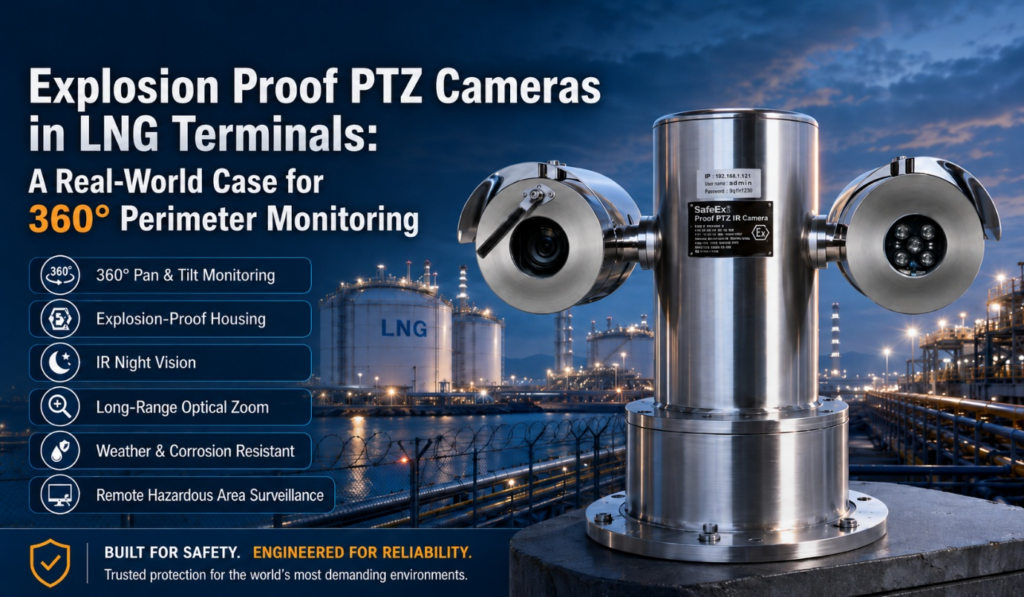
When selecting explosion proof PTZ cameras for LNG terminals, the camera should be chosen for the hazardous zone and the operating environment. Important features include ATEX or IECEx certification, 360° pan capability, strong optical zoom, low-light visibility, corrosion-resistant housing, outdoor weather protection, secure cabling, and smooth integration with the existing VMS or control room system.
The camera is only one part of the solution. Installation design, certification documents, cable routing, network security, maintenance access, and control room procedures are equally important.
Final Thoughts
For LNG terminals, visibility supports both safety and security. Explosion proof PTZ cameras give operators the flexibility to monitor large hazardous areas, verify alarms, track perimeter movement, and reduce unnecessary exposure for field teams.
A well-designed 360° perimeter monitoring strategy does not replace trained personnel, gas detection, access control, or emergency procedures. Instead, it strengthens them by giving teams clear visual information when decisions need to be made quickly.