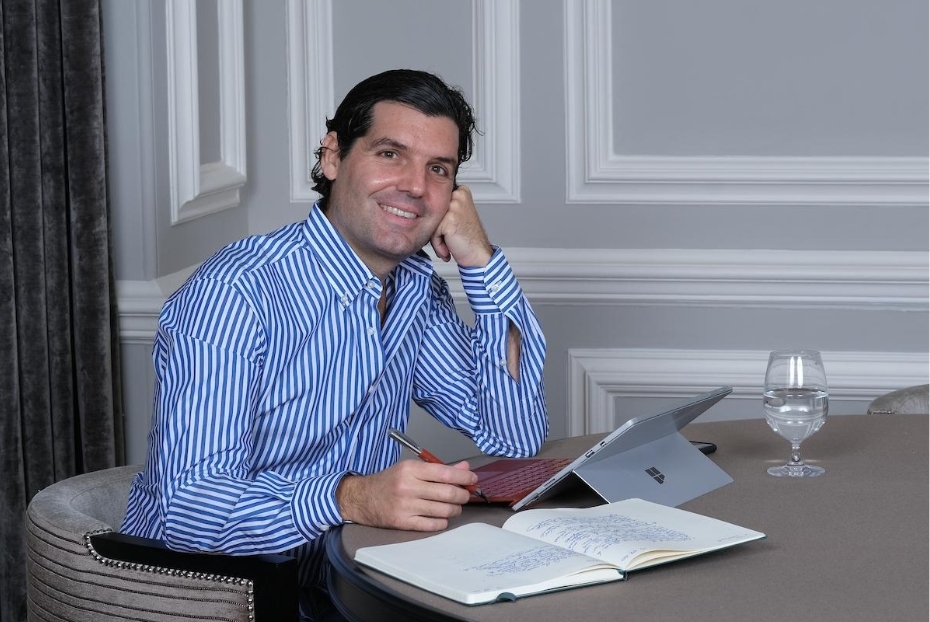

There was a boy who couldn’t stop dreaming. He would sit in classrooms, stare out of windows, and let his mind float toward futures that nobody around him could see. Teachers grew impatient. Friends shrugged it off. Family members occasionally worried. Alejandro Betancourt López was, by his own admission, the kind of child people dismissed. “I always was daydreaming about being somebody more important or achieving higher goals,” he has said. “Everybody thought I was losing my time or wasting or being irrelevant, and I was always sure that I was going to get somewhere else.”
Decades later, Betancourt López lives in London and oversees a portfolio
that spans energy, fintech, consumer brands, artificial intelligence, and robotics. The daydreaming never stopped. What changed is that the people around him stopped dismissing it. The boy who stared out of windows became an investor whose instinct for timing, for sensing where a market is headed before others catch on, has produced results that are difficult to argue with. His story is about a particular kind of stubbornness: the refusal to stop believing in what he could see, even when nobody else could.
The Psychology of Seeing What Isn’t There Yet
Optimism is an unfashionable quality in finance. The industry rewards
scepticism, caution, the ability to poke holes in a thesis. Betancourt López operates differently. “I’m very optimistic, always, and I think that’s one of the keys to success,” he has explained. “If you’re pessimistic, it’s going to rain. If you’re optimistic, you’re going to see the sun.” This is not the breezy, performative positivity of a motivational poster. For Betancourt López, optimism is a working method, a lens through which he evaluates opportunities that others pass over because they cannot yet see the upside.
There is science behind this. Research into goal-setting behaviour has
consistently shown that people who visualise their objectives, who picture the outcome they want with clarity and specificity, are measurably more likely to reach them. A widely cited study by Dr. Gail Matthews at Dominican University found that individuals who wrote down and visualised their goals were 42% more likely to achieve them than those who did not. Separate research has found that 59% of people who practise visualisation report feeling more confident in their ability to succeed. Brain imaging studies have gone further still. Many of the same neural networks are activated by vividly picturing an experience as by actually living through it. The brain, in other words, does not draw a sharp line between rehearsal and reality.
Betancourt López didn’t come to these findings through academic study. He arrived at them by living them. “Once you start believing in it, it becomes reality without you noticing it,” he has said. “I don’t know how, or energies or religion or what’s that fifth element that makes it, but it happens.” His language isn’t clinical. He speaks like someone describing a phenomenon he has observed repeatedly but never fully explained to his own satisfaction. He is honest about the limits of his understanding, willing to say he does not entirely know why his approach works, only that it does. This separates him from the many investors who construct elaborate post-hoc rationalisations for decisions that were, at their core, intuitive.
Conviction Before the Crowd Arrives
The practical consequence of this mindset shows up most clearly in
Betancourt López’s timing. He has a pattern of entering markets and backing companies before mainstream opinion catches up. With Hawkers, the Spanish sunglasses brand, he saw potential in influencer marketing at a moment when the approach was still novel and, crucially, cheap. Most brands hadn’t yet grasped how social media endorsements could drive direct sales at scale. By the time competitors understood the model and rushed to replicate it, Hawkers had already built a customer base and brand recognition that would have cost many times more to achieve a few years later.
The pattern repeated with Auro, the ride-hailing and urban mobility
business. Betancourt López and his team accumulated operating licences across markets at a time when the regulatory value of those licences wasn’t yet widely appreciated. Licences in the mobility sector are finite, difficult to obtain, and increasingly expensive. Their worth was recognised before the broader market caught on, and that allowed Auro to build a position that competitors could not easily replicate, regardless of how much capital they were willing to deploy.
More recently, his focus has turned to artificial intelligence. He was
investing in AI companies years before the sector exploded into mainstream consciousness following the release of large language models that captured public attention. That early positioning has yielded what he describes as a 20x return on certain AI investments. He is now also moving into robotics and technology manufacturing, areas where he sees a similar gap between current valuations and future importance. “Everything I do is based on intuition and information,” he has explained. “Intuition based on the right information and the right people that surrounds you.”
Swinging for Home Runs
Betancourt López uses a baseball metaphor to describe his approach to
risk and reward, and it’s worth pausing on because it reveals something important about how he thinks. “I hit more home runs than I strike out,” he has said. “I’m very proud of that, that I don’t swing for first base. I always swing for a home run.” The distinction matters. Many investors aim for modest, reliable gains, the equivalent of a base hit. They build portfolios designed to produce steady, incremental returns with minimal downside. There is nothing wrong with this approach; it is sensible and disciplined.
It is also not how Betancourt López operates. His model accepts that
some bets will fail entirely. Out of ten high-stakes investments, he has noted, “if two of them go well, they pay for the eight and make you a good profit for everything else.” This is closer to the venture capital model than to traditional private equity, and a particular temperament is required to sustain it. You have to be comfortable watching investments go to zero without losing confidence in the overall approach. You have to believe, deeply and consistently, that your ability to identify the right opportunities will produce enough winners to cover the losses and then some.
This temperament connects directly back to the visualisation habit. An
investor who cannot picture success clearly, who focuses primarily on what might go wrong, will find it very difficult to sustain a home-run strategy over time. The losses will erode confidence. The near-misses will breed caution. Betancourt López’s ability to maintain conviction through the inevitable failures appears to be rooted in the same quality that made him a daydreamer as a child: he can see the outcome he wants with a vividness that makes setbacks feel temporary rather than definitive.
Passion as an Edge
Ask most investors what gives them an advantage, and the answers tend to
cluster around information, access, analytical frameworks, proprietary data. Betancourt López gives a different answer. “The edge you have is because you have that passion,” he has said. “That’s the advantage. It’s not how smarter you are than most people, it’s about how much dedicated you are and how sure you are you’re going to achieve that.” This is a surprisingly humble claim from someone with a track record of outsized returns. He is essentially saying that his advantage is not intellectual superiority but emotional commitment.
That commitment manifests as relentlessness. “Once I start something, I
just don’t stop,” he has said. “I try to see every single option that could turn negative and try to mitigate it beforehand.” The combination is unusual. Many passionate people are reckless; many cautious people lack fire. Betancourt López seems to operate with both qualities simultaneously. He is driven by an almost irrational belief in the outcome, yet he remains methodical about identifying and managing risks along the way. His education at Suffolk University gave him analytical tools, and his early career in energy taught him how capital-intensive industries work. But the underlying drive, the engine beneath the analysis, is something more personal and less easily taught.
The Buyer Who Holds On
Every investor has blind spots, and Betancourt López is candid about
his. “I’m a good buyer, but I’m a terrible seller,” he has admitted. He tends to hold positions longer than a purely rational analysis might recommend. He will stay with investments through periods when others would take profits and move on. This tendency has costs, certainly. There are gains left unrealised, moments when selling would have been the optimal move. But it also connects to the same conviction that drives his best decisions. Selling requires you to stop believing in the future of something you once believed in deeply enough to buy. For someone whose entire methodology is built on sustained belief, the act of letting go is not something that comes naturally.
There is an interesting tension here. The same quality that allows
Betancourt López to enter positions early, before the crowd sees value, also makes it harder for him to exit at the right moment. His self-awareness about this pattern suggests he’s thought carefully about the trade-offs. He knows that the conviction which produces his best investments can also lead him to hold on too long. Rather than trying to eliminate the tendency, he seems to have accepted it as the price of his particular approach. The alternative, becoming a dispassionate seller, might improve his exit timing but would likely erode the very qualities that make him a strong buyer in the first place.
From Daydream to Discipline
The arc from childhood daydreamer to London-based investor with a
portfolio spanning multiple continents and industries isn’t a straight line. Betancourt López transitioned from energy into technology and banking, from Latin American markets into European and global ones. Each move required a fresh act of imagination, a willingness to picture himself succeeding in an unfamiliar context before he had any evidence that he would. His current enthusiasm for AI, robotics, and technology manufacturing follows the same pattern that has defined his career: identify a sector before consensus forms around its value, build a position while others hesitate, and hold on with the stubbornness of someone who has already seen the outcome in his mind.
“Once you start believing in it, it becomes reality without you noticing
it.” He said this about success in general, but it could serve equally well as a description of how markets work. Prices move toward value, eventually. The question is whether you can see the value before the price reflects it, and whether you’ve got the patience and conviction to wait. Betancourt López has built a career on answering both questions in the affirmative, armed with nothing more complicated than the habit of daydreaming that everyone once told him to stop.