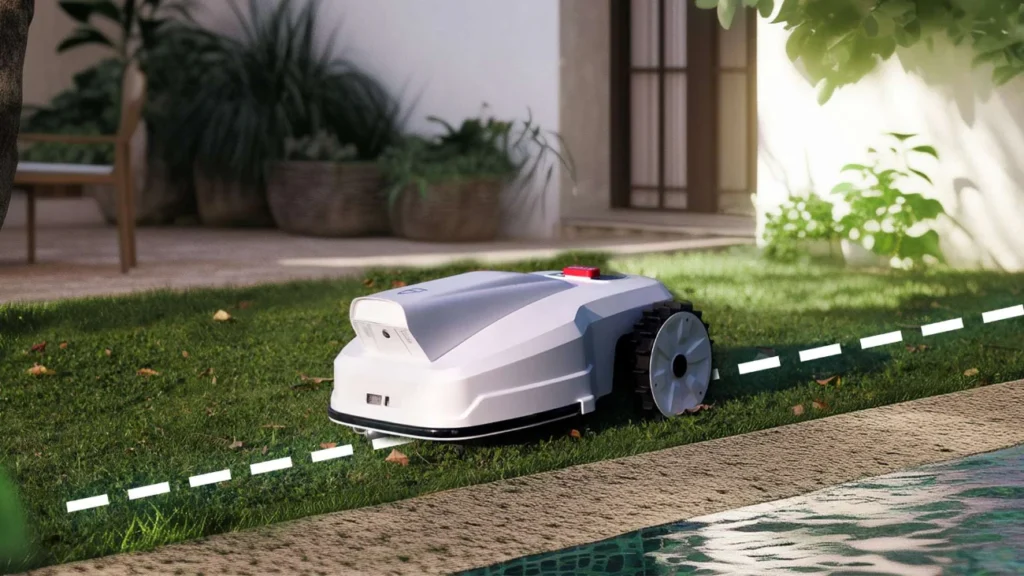

Ask anyone who mowed their own yard a decade ago and they’ll tell you the same thing: it was loud, hot, and ate up half a Saturday. That picture is fading fast. Walk through a suburban neighborhood today and you’re as likely to see a small machine trimming the grass on its own as you are someone pushing a mower. The reason behind that change is artificial intelligence, and few products show what it now makes possible better than the GoKo Robot Lawn Mower.
Before getting to GoKo specifically, it’s worth understanding the bigger shift it’s part of, because this isn’t a one-off gadget story. It’s an entire category growing up.
A market that stopped being a novelty
For years, automated mowing was treated as a toy for early adopters. Not anymore. Depending on which research firm you read, the global robotic lawn mower market is already worth several billion dollars and is set to keep climbing through the next decade, with growth rates landing somewhere in the high single digits to low double digits each year. The exact numbers vary, but the direction doesn’t.
What’s pushing all of this? A few things, and they reinforce each other. Homeowners increasingly want their houses to run themselves, and the yard is one of the last chores still done by hand. Landscaping companies, meanwhile, can’t find enough workers, so they’re turning to fleets of mowers to keep up. And as more cities tighten rules around noisy, gas-burning equipment, quiet battery-electric machines look better by the year.
There’s a technical turning point in here too, and it might be the most important one. The whole industry is walking away from buried boundary wires. The old robotic mowers needed hours of cable laid around a lawn’s edge before they’d run. The new ones figure out the yard themselves using cameras, satellite positioning, and a fair amount of onboard intelligence. That single change is what turned an AI lawn mower from a hassle into something a regular family would actually buy.
What the intelligence actually does
Here’s the honest truth about older robot mowers: they were fine on a flat, square, empty lawn and hopeless on anything else. A garden bed, a sloped corner, a kid’s soccer ball left out overnight — any of those could throw them off. AI is what fixed that.
A modern smart lawn mower sees its surroundings instead of bumping into them. Computer vision lets it tell the difference between grass it should cut and a flower bed it should leave alone, or spot a pet wandering across the lawn and steer clear. On top of that, fusion positioning that mixes satellite RTK signals with visual mapping gives the machine a precise sense of where it is, even under trees where plain GPS gets confused. Add route planning that adapts to the shape of the yard, and you get a mower that handles complicated properties without someone hovering over it.
The knock-on effect is that the category has outgrown the neat little backyard. AI navigation now shows up on steep properties, big estates, sports fields, even solar farms and municipal grounds. For most people, though, the appeal is simpler than all that. The grass gets cut, it looks good, and they get their weekends back.
GoKo as a window into where this is heading
If you want one product that sums up the direction the industry is moving, the GoKo Robot Lawn Mower is a good place to look. GoKo is the consumer brand from Robot++, a company that built its name in industrial autonomous robotics, and its M6 model takes that heavy-duty engineering and points it at the home market. The interesting choice here is what GoKo decided not to do. Instead of chasing the crowded low end — cheap robots for small flat lawns — it went after the yards everyone else avoided: steep slopes, rough ground, large multi-zone properties.
That’s a smart bet, because it lines up almost exactly with the trends the market analysts keep flagging.
The vision system is the heart of it. The M6 runs an AI-powered setup with four cameras that can recognize more than 200 kinds of objects, backed up by side cameras that tighten its edge cutting and help it slip through narrow gaps. This is precisely the kind of camera-based obstacle avoidance that separates the current generation of robot lawn mower from the wire-bound machines that came before.
Setup is wire-free, too. Rather than burying cable, the M6 leans on a blend of RTK and VSLAM positioning to understand both where it is and how it’s moving. No trenching, no weekend lost to installation — which, again, is the broader market trend showing up in a single product.
Where the M6 really pulls ahead, though, is on terrain. It runs four-wheel drive with adaptive suspension and is built to climb slopes up to roughly 42 degrees, the sort of grade that leaves a typical entry-level robot spinning its wheels. Its front wheels actually steer, so it can make tight turns without the dragging, pivot-in-place motion that tears up turf on older skid-steer designs. It even varies its cutting routes over time so you don’t end up with worn tracks pressed into the grass. The lawn ends up looking more even and natural, which is the whole point.
It’s also built to cover ground. An expandable battery lets it handle large areas on a single charge, and across a full day it can take on the kind of acreage that only became practical to automate once AI navigation matured. Unlimited zone mapping means it doesn’t choke on yards split into several separate sections.
READ ALSO: How can semiconductor manufacturers strengthen their supply chains?