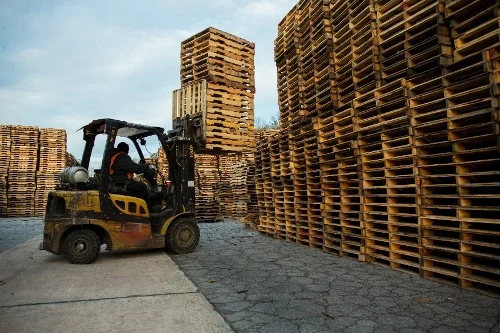

Pallet procurement is rarely treated as a strategic decision until something goes wrong. A delayed shipment, a supplier who can’t meet volume, or a load that fails inspection at a distribution center — these are the moments when buyers realize that the standard pallet they assumed was always available is actually subject to real supply constraints, regional pricing differences, and varying quality standards. In the Dallas Fort Worth metro, where warehousing, freight, and distribution activity runs at a scale that few other U.S. markets match, the stakes around pallet sourcing are higher than most operations anticipate.
This guide is written for purchasing managers, warehouse operations leads, logistics coordinators, and business owners who need to make informed, reliable decisions about sourcing the most widely used pallet format in North American commerce. It covers how the regional market works, what drives pricing, how to evaluate quality and supplier reliability, and what to consider before committing to a sourcing arrangement.
Why the Dallas Fort Worth Market Shapes Pallet Availability
The Dallas Fort Worth region functions as one of the largest inland freight hubs in the country. The density of distribution centers, cross-docking facilities, manufacturing operations, and retail fulfillment infrastructure creates both a high supply of used pallets and consistent demand pressure for new or reconditioned units. This dual dynamic means that pallet availability in the region fluctuates more than buyers from smaller markets typically expect.
For anyone researching sourcing options, the 48×40 Pallets Dallas Fort Worth guide provides a practical entry point for understanding how local suppliers operate, what inventory cycles typically look like, and how buyers can position themselves to maintain consistent access to the volumes they need.
Unlike coastal markets where port activity drives pallet flow, DFW’s pallet economy is shaped primarily by inland freight movement, the concentration of major retailers and distributors, and a significant manufacturing base that spans food processing, building materials, and consumer goods. This means that pallet demand in the region is broad and diversified, which generally supports steady supply — but also means competition for quality inventory can be meaningful during peak periods.
The Role of Regional Distribution Infrastructure
DFW sits at the intersection of several major interstate corridors, which makes it a natural staging ground for goods moving across the southern United States. The presence of large distribution networks — including those serving grocery, home improvement, and general merchandise retail — means that enormous volumes of pallets cycle through the region continuously. Used pallets returned from retail distribution often re-enter the supply chain through regional pallet processors and recyclers, which creates a reasonably active secondary market.
However, the condition and consistency of these recycled pallets varies considerably. Buyers who prioritize cost above all else may find adequate supply in the secondary market, but operations that require dimensional consistency, load-bearing reliability, or compliance with retailer pallet programs will need to be more selective about where they source.
Understanding Pallet Grading and What It Means in Practice
Pallet grading is an informal but widely understood system in the industry. It communicates the general condition and expected performance of a pallet without requiring detailed inspection of every unit. The challenge is that grading standards are not universally enforced, which means the same grade label can mean different things depending on the supplier.
Grade A pallets are generally understood to be structurally sound, free from broken boards, and consistent in dimension. They may show signs of use but are expected to perform reliably under normal load conditions. Grade B pallets may have minor repairs or slight inconsistencies but are still functional for many applications. Below that, pallets are typically sold for repair or as raw material for mulch and other end uses.
Why Grade Consistency Matters More Than Grade Level
The practical problem many buyers encounter is not that they purchased the wrong grade, but that the grade they received was inconsistently applied across a delivery. When a warehouse operation receives a mixed-condition pallet load described as Grade A, the variability creates real problems — pallets that fail under load, slow down automated handling equipment, or get flagged during outbound shipping audits. The operational cost of dealing with inconsistent quality often exceeds the cost difference between grades in the first place.
When evaluating suppliers in the 48×40 pallets Dallas Fort Worth market, asking specifically about how grading is applied internally — whether inspection is visual, dimensional, or load-tested — gives buyers a clearer picture of what consistency they can actually expect. Suppliers who grade systematically rather than visually tend to produce more predictable outcomes across larger orders.
New vs. Reconditioned Pallets: A Practical Comparison
New pallets offer the highest level of dimensional consistency and structural integrity, which matters most in applications where pallets interact with automated systems, racking infrastructure, or retailer compliance requirements. They are also free from the contamination risks that can accompany reconditioned units in food-grade or pharmaceutical applications.
Reconditioned pallets, when properly processed, offer a meaningful cost reduction and are entirely appropriate for a wide range of industrial, warehousing, and internal transfer applications. The key word is “properly” — reconditioned pallets that have been inspected, repaired with matching lumber species, and re-nailed to original spec perform very differently from those that have simply been sorted and restacked. Buyers should ask suppliers to describe their reconditioning process in specific terms before making volume commitments.
Pricing Dynamics for 48×40 Pallets in the DFW Region
Pallet pricing in any regional market is influenced by lumber commodity costs, fuel and transportation costs, available inventory volume, and the competitive density of local suppliers. In the 48×40 pallets Dallas Fort Worth market, all of these factors interact in ways that create price variation even among suppliers offering nominally similar products.
Lumber pricing is a primary driver of new pallet costs. When softwood lumber prices rise — as they did significantly during the supply chain disruptions of recent years — new pallet prices follow closely. The industry bodies that track wood products pricing note that these fluctuations can be substantial enough to shift buyer behavior toward reconditioned options during high-price periods, which in turn affects reconditioned pallet availability and pricing.
Volume Commitments and Their Effect on Cost Structure
Most regional pallet suppliers price more competitively for buyers who can commit to consistent volume over time. This is not simply a discount structure — it reflects the operational reality that suppliers can better manage their inventory, staffing, and logistics planning when they have predictable order flows. Buyers who approach pallet sourcing on a spot-buy basis typically pay a premium, both in unit price and in the risk of encountering availability gaps during high-demand periods.
Establishing a supplier relationship with a defined minimum monthly volume, even if that volume is modest, generally produces better pricing outcomes and more reliable service than buying opportunistically. For operations that are scaling up, it is worth having a direct conversation with suppliers about projected volume growth and whether pricing structures can adjust accordingly.
Delivery and Logistics Costs Within the DFW Market
The geographic spread of the Dallas Fort Worth metro — which spans multiple counties and extends significant distances in all directions — means that delivery costs vary meaningfully depending on where a buyer’s facility is located. Suppliers based in the industrial corridors near major highways tend to have lower outbound freight costs for nearby buyers, while facilities in outlying areas may face higher delivery charges or longer lead times.
Buyers sourcing 48×40 pallets in the Dallas Fort Worth area should factor full landed cost — unit price plus delivery — into any supplier comparison rather than evaluating unit price in isolation. A lower unit price from a supplier located farther from the delivery point may not represent actual savings once freight is calculated.
Evaluating Supplier Reliability Beyond Price
In pallet procurement, reliability means something very specific: the supplier’s ability to deliver the agreed quantity, at the agreed quality level, on the agreed timeline, consistently over time. Price is only one dimension of a sourcing decision, and in many operations, it is not the most consequential one.
A supplier who delivers consistently at a slightly higher price creates less operational disruption than one who competes aggressively on price but struggles to maintain inventory during peak periods. For warehouse operations and distribution centers that depend on pallet availability to keep inbound and outbound freight moving, a sourcing gap of even a few days can create cascading delays.
Questions to Ask Before Committing to a Supplier
Evaluating a potential supplier for 48×40 pallets in the Dallas Fort Worth region involves more than reviewing a price sheet. Buyers benefit from understanding the following before making commitments:
- How the supplier manages inventory during high-demand periods, including whether they maintain buffer stock or operate purely on a just-in-time basis
- Whether their reconditioning or processing capacity is in-house or outsourced, and how quality control is applied at each stage
- What their typical lead time is for orders at your expected volume, and whether that lead time is consistent or variable
- How they handle claims or delivery issues, including whether there is a straightforward process for replacing non-conforming pallets
- Whether they have experience supplying operations with similar compliance requirements, such as food safety, retail pallet programs, or heat treatment certification needs
Heat Treatment Requirements and Compliance Considerations
Pallets used in international shipping or in supply chains that intersect with imported goods may be subject to heat treatment requirements under international phytosanitary standards. This is relevant to buyers in the 48×40 pallets Dallas Fort Worth market because DFW’s role as a logistics hub means that pallets frequently move between domestic and import/export supply chains, sometimes without buyers fully tracking where their pallets have been or where they are going.
Heat treated pallets carry a specific stamp indicating compliance. Buyers who supply international customers, participate in retail programs that require compliance documentation, or operate in regulated industries should confirm with their supplier whether their pallet inventory is heat treated and properly stamped. Using non-compliant pallets in a supply chain that requires certification can result in shipment rejection and replacement costs that far exceed the cost of sourcing compliant pallets from the start.
Building a Sustainable Sourcing Arrangement
Pallet procurement that functions reliably over time is built on communication, predictability, and a clear understanding of mutual expectations between buyer and supplier. The buyers who experience the fewest disruptions are generally those who have taken the time to establish clear order parameters, share forward-looking volume projections with their supplier, and maintain an open line of communication about changes in their operational needs.
In a regional market as active as Dallas Fort Worth, building a reliable relationship with one or two primary pallet suppliers — rather than constantly shopping for the lowest spot price — tends to produce better long-term outcomes. Suppliers who view a buyer as a consistent, communicative partner are more likely to prioritize that buyer’s orders when inventory is constrained.
Conclusion
Sourcing 48×40 pallets in the Dallas Fort Worth region involves navigating a market that is large, active, and variable. Price matters, but it is rarely the only factor that determines whether a sourcing arrangement works over time. Quality consistency, supplier reliability, delivery logistics, and compliance requirements all shape the real cost and operational impact of a pallet procurement decision.
Buyers who approach pallet sourcing with the same rigor they apply to other supply chain decisions — asking specific questions, evaluating full landed cost, and building supplier relationships based on transparency — will generally find that their operations run more smoothly and their costs are more predictable. The Dallas Fort Worth market has sufficient supplier depth to support well-structured sourcing arrangements for most volume levels, but that depth is only useful to buyers who know how to evaluate what they are actually buying.