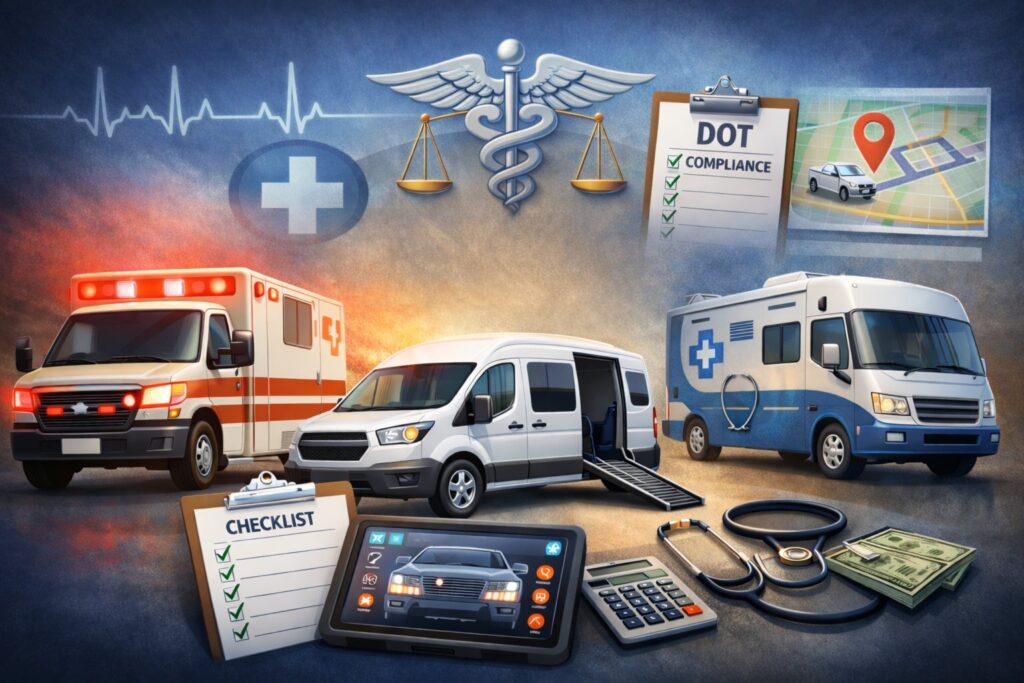

Emergency medical services operate under conditions that leave very little margin for error. A delayed dispatch, a vehicle that breaks down en route, or a crew that arrives without accurate patient information can each contribute to outcomes that no technology budget discussion can adequately address. The pressure on EMS administrators and fleet supervisors is not abstract — it is felt in every shift, every call, and every after-action review.
Most conversations about fleet management in the EMS context tend to center on cost reduction: lower fuel consumption, fewer maintenance overruns, better asset utilization. These are legitimate concerns, and software does address them. But the more consequential case for modern fleet management in emergency services is not financial. It is operational and, ultimately, clinical. The features that matter most in this environment are the ones that directly affect response capability, crew safety, and care continuity — not just the ones that show up favorably on a quarterly report.
This article examines seven specific capabilities within EMS fleet management platforms that carry real weight when it comes to patient outcomes and crew reliability.
1. Real-Time Vehicle Availability and Status Tracking
One of the most persistent challenges in EMS dispatch is knowing, with confidence, which units are genuinely available at any given moment. A unit listed as “available” in an outdated system may be restocking supplies, completing documentation from a prior call, or experiencing a mechanical issue that the crew has not yet formally reported. That gap between assumed availability and actual readiness is where response times slip — and where patients pay the cost.
Modern ambulance fleet management software addresses this by maintaining a live operational picture that reflects real conditions rather than scheduled states. When dispatchers work from accurate, current vehicle status data, they make better unit assignments. The difference between sending the nearest available unit versus the nearest listed unit may be measured in minutes, but in cardiac or trauma events, those minutes are clinically significant.
Why Status Accuracy Matters Beyond Dispatch
Status visibility does not only serve the dispatcher. It also gives fleet supervisors the ability to identify patterns — units that frequently transition from available to unavailable outside of expected windows, crews that consistently run long on restocking, or geographic coverage gaps that emerge during peak call periods. These patterns, when visible, can be addressed proactively. When they remain hidden in manual logs or delayed reporting, they compound quietly until a critical gap appears at the worst possible time.
2. Predictive Maintenance Scheduling
An ambulance that fails mechanically during an active response is not just an operational inconvenience — it is a direct threat to a patient’s life and a crew member’s safety. Traditional maintenance schedules based on mileage intervals or calendar dates do not account for the actual wear patterns that emergency vehicles experience. Repeated high-load starts, extended idling, frequent hard braking, and operation in extreme temperatures all accelerate component wear in ways that standard service intervals do not capture.
Fleet management platforms with predictive maintenance capability monitor vehicle health data continuously and flag maintenance needs based on actual operational behavior, not arbitrary schedules. This shifts maintenance from reactive to proactive and substantially reduces the likelihood of an in-service mechanical failure.
The Downstream Effect on Fleet Reliability
When maintenance is reactive, fleets tend to operate with chronic unit shortages. A vehicle pulled for emergency repair during a high-demand period forces other units to cover additional territory, increases crew fatigue, and stretches response coverage thin. Predictive scheduling allows maintenance teams to plan work during low-demand windows, keeps more units in reliable service, and reduces the cumulative strain on both vehicles and personnel. The operational benefit is not just mechanical — it affects every aspect of service delivery.
3. GPS-Based Route Optimization and Traffic Integration
Response time is one of the most studied variables in emergency medicine. Research published by organizations such as the National Highway Traffic Safety Administration has long recognized that time-to-scene in certain emergency categories directly correlates with patient survival rates. Route optimization within fleet management systems contributes to this by ensuring that crews are directed along the fastest available path, not simply the shortest one.
The distinction matters because road conditions, traffic patterns, construction, and incident-related congestion change constantly. A static routing approach — one that relies on crew familiarity or basic GPS navigation — does not adapt dynamically. Integrated fleet systems that pull live traffic data and recalculate routes in real time give dispatch and crews an active advantage over these variables.
Consistency Across Crew Experience Levels
Route knowledge varies significantly across a fleet’s personnel. Experienced crews often develop strong local familiarity, but newer personnel — or crews responding in unfamiliar districts during mutual aid events — may not have that same knowledge base. Dynamic routing removes the dependence on individual crew experience for this specific function, introducing a level of consistency that benefits response times regardless of who is driving and where they are operating.
4. Driver Behavior Monitoring and Safety Alerts
Emergency vehicle crashes are a significant source of injury and death among EMS personnel. High-speed response driving, fatigue, and the inherent risks of operating large vehicles through congested urban environments all contribute. Driver behavior monitoring within fleet management systems tracks patterns such as hard acceleration, sharp cornering, excessive speed, and harsh braking — providing supervisors with data that can inform both training and real-time intervention.
This capability is not about surveillance for its own sake. It is about identifying risk before it becomes an incident. A crew member who consistently exhibits fatigue-related driving patterns on overnight shifts is flagging a safety concern that might otherwise go unaddressed until something goes wrong.
Building a Culture of Accountability Without Blame
The value of driver monitoring depends heavily on how the data is used. When behavior data is applied punitively without context, crews respond with distrust and defensiveness. When it is used to support coaching, identify systemic factors like shift length or dispatch frequency, and recognize improvement, it becomes a tool for genuine safety culture development. Fleet management platforms that present this data clearly and without distortion give supervisors the information they need to have productive conversations rather than reactive ones.
5. Equipment and Supply Inventory Tracking
A well-maintained, promptly dispatched ambulance is only as effective as the equipment and supplies it carries. Inventory gaps — a missing medication, a depleted oxygen supply, an unchecked AED — can compromise care delivery at the moment it matters most. Manual supply checks are inconsistent across shifts, especially during high-volume periods when crews are moving quickly between calls.
Fleet management platforms that incorporate inventory tracking allow supplies to be logged, monitored, and flagged for replenishment automatically. This reduces the likelihood of a unit going into service with an undetected deficiency and creates an auditable record of supply compliance across the fleet.
Integration with Post-Call Workflows
The restocking process after a call is a known weak point. Crews returning from a complex call are often fatigued, completing documentation, or immediately reassigned. Systematic inventory tracking that integrates with post-call workflows — prompting supply verification and logging at defined points in the return-to-service process — creates structure around a step that is easy to shortcut under pressure.
6. Electronic Pre-Hospital Care Report Integration
The handoff between EMS and hospital receiving teams is a critical transition point in patient care. Information that is incomplete, delayed, or inaccurate at the point of handoff forces hospital staff to reconstruct clinical history under time pressure, which introduces risk. Fleet management platforms that integrate with electronic pre-hospital care reporting systems allow clinical data collection to begin during transport and be transmitted ahead of arrival, giving receiving teams actionable information before the patient reaches the door.
This feature sits at the intersection of fleet operations and clinical workflow in a way that most fleet management discussions undervalue. The ambulance is not just a vehicle — it is the first stage of the care environment, and the data it generates has direct clinical relevance.
Continuity as a Safety Variable
Gaps in care continuity are well-documented contributors to adverse outcomes. When the receiving facility has accurate pre-hospital information — mechanism of injury, initial vitals, interventions performed, medication administered — they can prepare the appropriate resources and respond more precisely. This coordination benefit compounds across a fleet and across time, contributing to systemic improvements in how an EMS agency and its hospital partners work together.
7. Compliance and Certification Tracking
EMS agencies operate within a complex regulatory environment that governs everything from vehicle inspection requirements to crew certification maintenance. Lapses in compliance are not just administrative problems — they can result in units being pulled from service, crews unable to legally respond, or insurance and liability exposure that affects the agency’s ability to operate at all.
Fleet management systems that include compliance and certification tracking maintain a centralized record of inspection dates, license renewals, equipment certifications, and regulatory deadlines. When these records are distributed across paper logs, individual HR files, and separate maintenance records, the risk of something falling through the cracks increases with the size of the fleet and the pace of operations.
Operational Continuity as a Patient Safety Issue
A compliance failure that takes a unit or a crew member out of service at the wrong time — during a multi-casualty incident, a severe weather event, or a period of already-reduced staffing — has direct consequences for the community that agency serves. Keeping certification and inspection records current and visible is not administrative overhead. It is a foundational condition for reliable service delivery, and it belongs in any serious discussion about what fleet management contributes to patient and community outcomes.
Conclusion: The Standard Should Be Clinical, Not Just Operational
Fleet management in emergency medical services carries a different weight than it does in most other industries. The consequences of a vehicle failure, a missed supply check, or a routing inefficiency are not measured in delayed deliveries or missed service windows — they are measured in outcomes that affect real people in their worst moments.
The seven features described here are not theoretical capabilities. They reflect the practical demands of running an EMS operation where reliability, accuracy, and speed all carry clinical stakes. Organizations evaluating or upgrading their systems would do well to apply that standard consistently: not just asking what a platform costs to run, but what it costs not to have when the next call comes in.
The financial case for better fleet management will always be present and easy to make. The more important case — the one that justifies the organizational commitment and the operational discipline required — is the one that begins and ends with what happens to patients when everything in the system works the way it should.