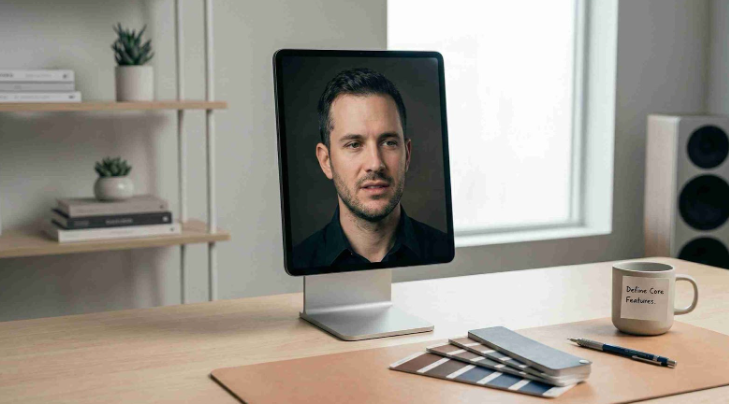

There was a time when visual production followed a predictable order.
You started with planning. Then came the shoot. After that, editing, revisions, and finally distribution. Every step depended on the one before it. If something changed late in the process, you either lived with it or went back to the beginning.
That structure made sense when production was linear.
It does not hold up anymore.
The Problem With Starting From Scratch
Modern content workflows are no longer built around a single output.
They are built around variation.
A single campaign can require:
- Multiple creatives for testing
- Different versions for platforms
- Adjustments for audience segments
Starting from scratch every time creates friction.
Not just in cost, but in time, coordination, and consistency. Each new version introduces the risk of deviation. Lighting shifts, composition changes, identity varies.
The result is a workflow that feels fragmented.
Why the First Step Matters More Than Ever
In traditional production, the first step was about capturing.
Now, the first step is about control.
Teams are no longer asking how to create a visual. They are asking how to create a visual that can evolve.
That shift changes where tools are introduced in the workflow.
Instead of being used at the end for adjustments, certain tools are now being used at the beginning to define flexibility.
Starting With Adaptability Instead of Finality
The smartest workflows today are not built around final outputs.
They are built around adaptable assets.
A base visual is created with the expectation that it will be modified, tested, and extended. Identity becomes one of the most important variables in that process.
This is where Face Swap starts to appear earlier in the workflow than most people expect.
Rather than being used as a correction tool, it is used as a planning tool. Higgsfield Face Swap allows teams to define how identity can change across variations before the rest of the production process is locked in.
That changes how everything else is built.
Identity Becomes a Controlled Variable
In most traditional workflows, identity is fixed early.
Once a model is selected and a shoot is completed, changing that identity becomes expensive.
This limits flexibility.
Face swap workflows reverse that.
Higgsfield Face Swap allows identity to remain fluid. The same visual structure can support multiple identities without requiring additional production.
This turns identity into a controllable variable rather than a constraint.
Why This Aligns With Modern Creative Systems
The broader shift in visual production is toward modular systems.
Instead of building everything from scratch, teams are assembling components:
- Base visuals
- Adaptable elements
- Reusable structures
This approach is similar to how other areas of technology have evolved.
Even in computer vision, foundational tools like OpenCV have emphasized modularity and adaptability, as seen in developments around face recognition systems.
The same principle now applies to creative workflows.
Higgsfield Face Swap fits into this model by making identity modular.
Reducing Downstream Complexity
One of the biggest advantages of introducing flexibility early is that it reduces complexity later.
If identity can be adjusted without affecting the rest of the image, then:
- Fewer reshoots are needed
- Fewer revisions are required
- Fewer inconsistencies appear
Higgsfield Face Swap helps stabilize the workflow by removing one of the most difficult variables to change.
Faster Iteration Without Breaking Structure
Speed has always been important.
But speed without structure leads to inconsistency.
The goal is not just to move faster, but to move faster while maintaining alignment.
Higgsfield Face Swap enables this by allowing teams to generate variations quickly without altering composition or tone.
The structure remains stable. The identity adapts.
This makes iteration more efficient.
From Linear Workflows to Layered Workflows
Traditional production is linear.
Each step follows the previous one.
Modern workflows are layered.
Multiple elements can be adjusted independently without restarting the process.
Face swap technology supports this shift.
Instead of locking identity at the beginning, it allows identity to be adjusted at any stage.
Higgsfield Face Swap becomes part of a layered system where changes do not disrupt the entire workflow.
Why Agencies Are Moving This Step Earlier
Agencies are not adopting this approach for novelty.
They are doing it because it solves real problems.
When face swap is introduced early:
- Campaign variations become easier to produce
- Testing becomes more flexible
- Creative decisions can be adjusted later without penalty
Higgsfield Face Swap allows agencies to plan for change instead of reacting to it.
The Strategic Advantage
The advantage is not just efficiency.
It is control.
When identity is flexible, teams can:
- Test different directions
- Adapt to performance data
- Customize content for specific audiences
All without restarting production.
Higgsfield Face Swap supports this level of control by making identity adaptable from the start.
A New Default for Visual Workflows
As this approach becomes more common, expectations will change.
Starting with fixed visuals will feel limiting.
Starting with adaptable visuals will feel standard.
Face swap technology is part of that transition.
Higgsfield Face Swap is not just an editing tool. It is becoming part of how workflows are structured from the beginning.
Conclusion
Visual production is no longer about creating a single perfect output.
It is about creating systems that can adapt.
The tools that matter most are the ones that introduce flexibility early in the process.
Face swap AI is becoming one of those tools.
Higgsfield Face Swap allows teams to treat identity as a variable rather than a constraint, making it easier to build workflows that are scalable, consistent, and adaptable.
As production continues to evolve, starting with flexibility will become the smarter approach.